 Whatcom County
Why Bellingham Roofs Wear Out Faster Than the Warranty Says
A roof in Bellingham does not have an easy job. Sitting near Bellingham Bay and the Strait of Georgia means homes here take on salt-laden air that most inland manufacturer warranties were never really tested against. Add in driving rain that comes off the water sideways during fall and winter storms, and a wet season that can keep a roof damp for weeks at a stretch, and you get a climate that ages roofing materials well ahead of their rated lifespan. Most roofing products are engineered and tested for average conditions, not the specific combination of salt exposure, near-constant moisture, and heavy tree cover that a lot of Whatcom County properties deal with.
Salt Air and Metal Fatigue
Salt in the air accelerates corrosion on anything metal — flashing, fasteners, vent stacks, gutter hardware. On homes closer to the water, we routinely find pitted or rusted-through flashing well before the shingles around it show their age. Our standard on repairs near the coast is to use corrosion-resistant fasteners and flashing rather than whatever happens to be the cheapest option at the supply house, because replacing a $2 piece of flashing now is a lot less disruptive than chasing a leak it caused later.
Moss: More Than a Cosmetic Problem
Whatcom County's tree cover, cloud cover, and rainfall add up to a moss season that, on shaded or north-facing slopes, is close to year-round. Moss is not just unattractive — it holds moisture directly against the shingle surface, lifts tabs as it grows, and works its way into nail heads and seams. Over time it breaks down the granule layer that protects shingles from UV and rain, and during a heavy, wind-driven rain event, moss mats can force water backward under shingles that would otherwise have shed it fine. A lot of the "mystery leaks" we get called out for trace back to moss that had been sitting untreated for a year or two.
When Repair Makes Sense — and When It Doesn't
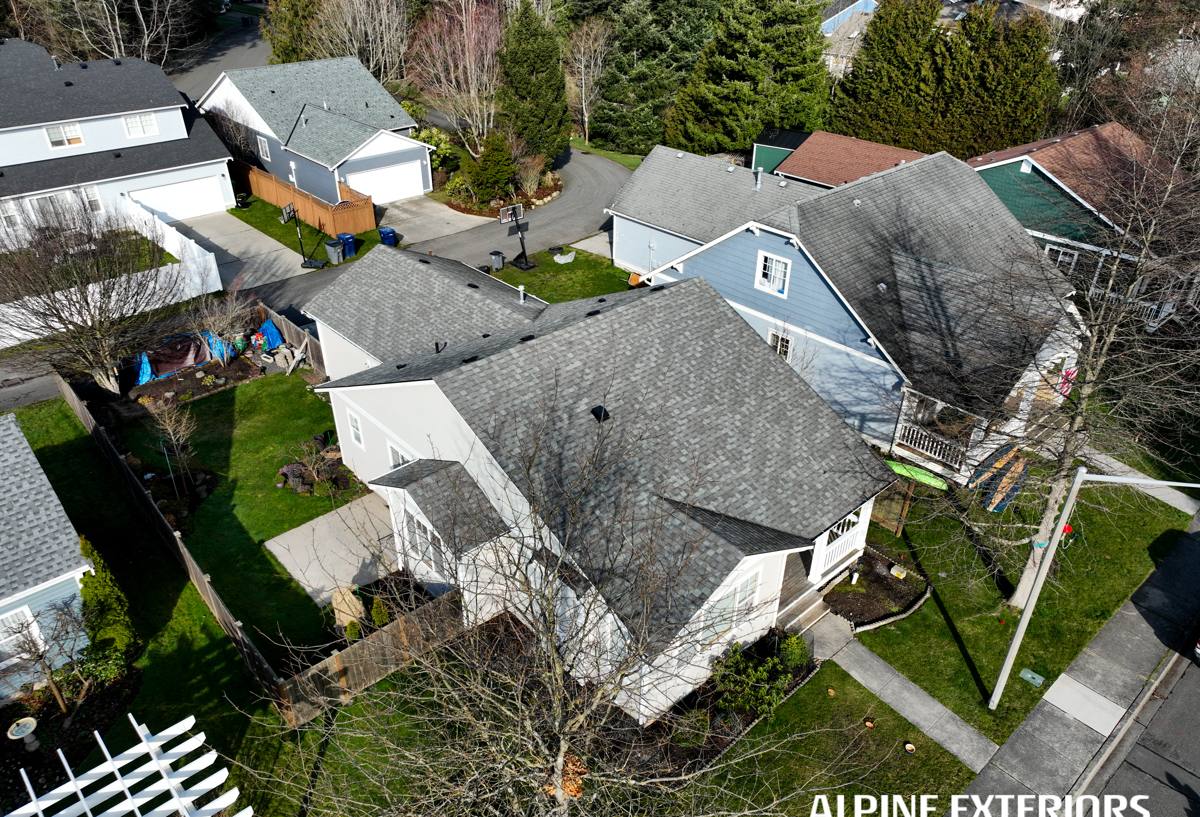
Not every roof problem calls for a full replacement, and we don't treat every service call as a sales opportunity. Repair is usually the right call when the damage is localized: a failed flashing detail, a handful of wind-damaged or blown-off shingles, a cracked pipe boot, moss-related leaks caught before they've spread, or valley wear on an otherwise sound roof. Replacement starts to make more sense when the whole field of shingles is thinning and losing granules evenly, when you've had repairs in three or four different spots over a couple of years, or when the roof is approaching the end of its realistic service life for this climate.
Here are the signs that usually mean it's time to have someone take a real look:
- Granules building up in gutters or at the base of downspouts
- Thick moss mats or dark streaking on north-facing or shaded slopes
- Ceiling stains near exterior walls, chimneys, or skylights that show up after a driving rain
- Shingles that are curling, cracking, or missing outright
- Rusted, lifted, or separated flashing around vents, chimneys, or skylights
- Soft spots or noticeable sag when walking the attic deck
- Daylight visible through the roof deck from inside the attic
What a Correct Roof Repair Actually Involves
A repair that actually holds up is more than patching the spot where water showed up inside the house. It starts with figuring out where the water is really getting in, because in a lot of cases that's not the same place it shows up on the ceiling.
Diagnosing the Real Problem
Water follows the path of least resistance once it's under the roofing material, often traveling along rafters or decking before it drips down somewhere visible. A repair that only addresses the interior stain without tracing the actual entry point — a lifted shingle tab, a failed flashing seam, a nail that backed out — tends to come back within a season or two, usually during the next heavy rain. Part of doing this correctly means getting into the attic, checking the decking for staining or soft spots, and following the water back to its source before any material gets replaced.
Matching Materials, Not Just Colors
Shingles fade and weather over time, so a repair patch using brand-new material almost never matches perfectly, especially on a roof that's ten or more years old. We try to match manufacturer and product line as closely as possible, and we'll tell you upfront if an exact color match isn't realistic — sometimes a product line has been discontinued or the color has simply weathered too far from its original shade. In those cases we talk through placement options, like pulling replacement material from a less visible slope, rather than promising a seamless match we can't deliver.
Roof Repair vs. Full Replacement: Cost Factors
Homeowners often want a quick answer on whether they're looking at a repair bill or a replacement project. It depends on a handful of factors that are worth weighing together rather than any one on its own:
| Factor | Repair Usually Makes Sense | Replacement Usually Makes Sense |
|---|---|---|
| Age of roofing | Well under its expected service life | Nearing or past the end of its expected service life |
| Extent of damage | Localized to one area, slope, or detail | Spread across multiple slopes or the whole field |
| Repair history | First or second issue in recent years | Several repairs in different spots over a short span |
| Decking condition | Solid, no rot or soft spots found | Soft spots, staining, or rot in multiple sheets |
| Moss/algae condition | Treatable, hasn't undermined shingle seal | Long-established growth with visible granule loss |
| Typical investment | A few hundred to a couple thousand dollars | A full tear-off and re-roof, a larger investment |
We'll always give you a straight answer on which side of that table your roof falls on, including telling you when a repair is genuinely the better move even if a replacement would be a bigger job for us.
Our Roof Repair Process
The steps don't change much from job to job, because skipping one is usually how a repair fails early:
- In-person inspection — exterior slopes, attic deck, and any interior water staining, so we're diagnosing the actual cause and not just the symptom.
- Written diagnosis and options — what we found, what it means, and whether repair or replacement is the honest recommendation, in plain language.
- Material sourcing — matching the existing roof as closely as manufacturer availability allows, and flagging it clearly if an exact match isn't possible.
- The repair itself — proper flashing and underlayment detail, correct fastening, and attention to how water will move across that section once the repair is done, not just how it looks from the ground.
- Cleanup — magnetic sweep for stray nails, removal of old material and debris, and gutters checked for anything that fell in during the work.
- Follow-up — documentation of the work done and honest care recommendations for keeping the rest of the roof in good shape.
Materials and Standards We Hold To
Near the coast, we default to corrosion-resistant fasteners and flashing rather than standard-grade hardware, because the cost difference is small compared to the cost of re-doing a repair after saltwater corrosion eats through a cheaper part. We also use quality underlayment and, where the roof design calls for it, ice-and-water shield in valleys and along eaves — areas that take the brunt of driving rain and are the first place a marginal underlayment gives out. This isn't a knock on any particular brand; it's simply our standard for a climate that's harder on roofing than most product testing accounts for.
For roofs with a heavy moss history, zinc or copper strips near the ridge are worth discussing as a maintenance add-on. They help suppress new moss growth over time as rain washes trace metal down the slope, but we're upfront that they're a maintenance tool, not a substitute for periodic moss removal and inspection — nothing eliminates the need for that in a climate like this.
Why Hiring a Crew That Already Works Bellingham Matters
A contractor who works Whatcom County regularly already knows which slopes and neighborhoods tend to hold moss the longest, which roof styles and ages are common in the area, and how to schedule repair work around the region's wet season instead of getting caught mid-repair by a storm rolling in off the water. That local familiarity also means faster access to matching materials, a better read on what a given roof has likely been through based on its age and orientation, and a realistic sense of what's actually causing a leak versus what a homeowner assumes is causing it. It's the difference between a generic repair and one built around how this specific climate treats a roof.
Maintenance That Extends the Life of a Repair
A good repair can be undone early by the same conditions that caused the original problem if nothing changes afterward. A few habits go a long way here:
- Clean gutters and downspouts before the fall rains start, not after they've already backed up
- Have moss treated on a schedule rather than waiting until it's visibly thick
- Trim back overhanging branches that keep a slope shaded and damp longer than it needs to be
- Walk the attic and check ceilings after any major wind or rain event, especially early in the season
If you're dealing with a leak, missing shingles, or just want an honest read on where your roof stands, we're happy to come take a look. The estimate is free, there's no pressure to act on it, and you'll get a straight answer about whether you're looking at a repair or something bigger.