 Whatcom County
 Two Very Different Materials Wearing the Same Job Title
"Siding" covers a lot of ground, and vinyl and James Hardie fiber cement get lumped together more often than they should be. They're both exterior cladding, both come in a wide range of colors and profiles, and both get installed by contractors all over Whatcom County. Past that, they don't have much in common. One is a petroleum-based plastic panel. The other is a cement-based composite engineered to behave more like the wood siding it was designed to replace, without wood's weaknesses. Those differences in what the material actually is drive almost everything else in this comparison — how it holds up to Pacific Northwest weather, how it ages, what it costs to own over 20 years, and what happens when something goes wrong.
We install James Hardie exclusively. We don't carry vinyl, and this page explains the reasoning rather than just asserting it. Vinyl isn't a bad product for what it is — it has real advantages we'll spell out honestly. But once you factor in what Bellingham, Ferndale, Lynden, and the rest of Whatcom County throw at a house year after year, we think the trade-offs stop making sense.
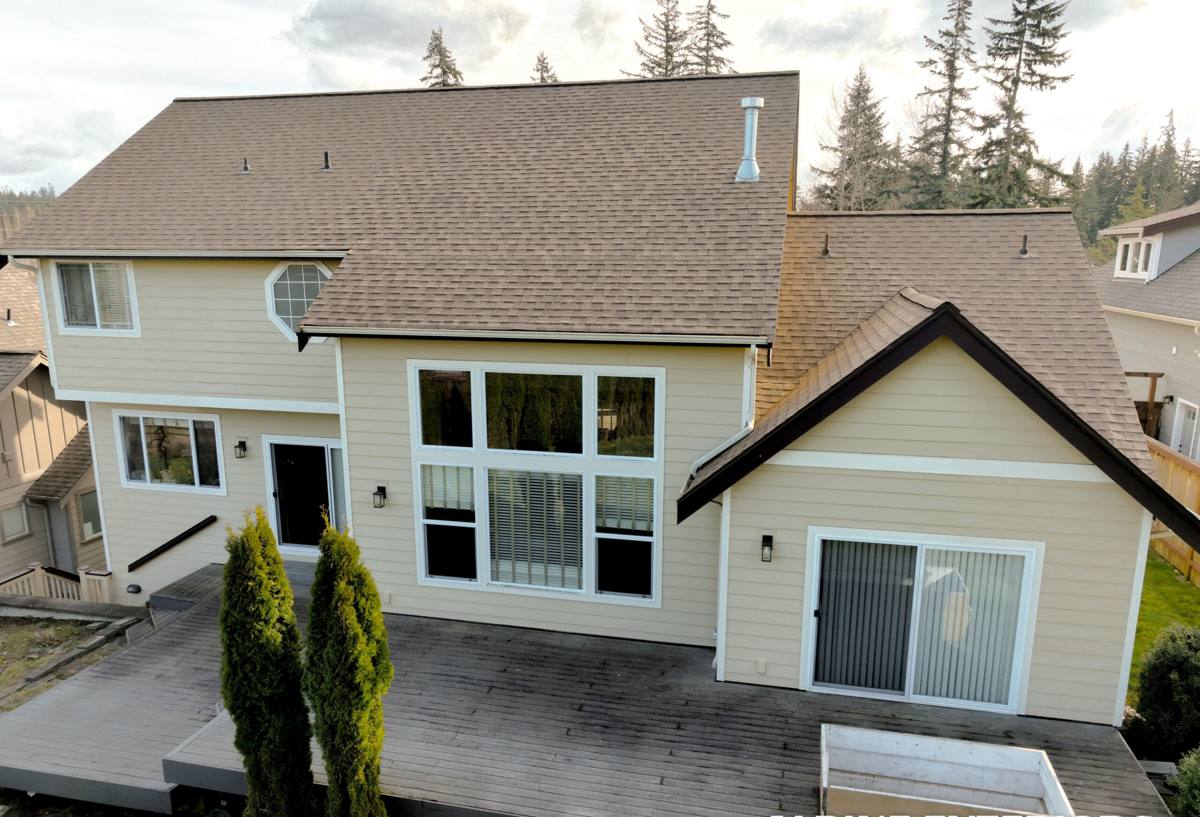
What Each Product Actually Is
Vinyl Siding
Vinyl siding is extruded PVC (polyvinyl chloride) formed into interlocking panels, usually with a hollow-backed profile that snaps onto furring strips or directly over sheathing. Color is mixed into the plastic itself rather than applied as a surface coating, which is why vinyl doesn't peel — but it's also why the color is baked into a material that expands, contracts, and can fade or become brittle with UV exposure over time.
James Hardie Fiber Cement
James Hardie siding is made from cement, sand, and cellulose fiber, cured under pressure into dense, rigid boards and panels. It's non-combustible, dimensionally stable across temperature swings, and heavy enough that it doesn't rattle or flex against the wall the way vinyl can in a stiff wind. Hardie's HZ5 product line is engineered specifically for the freeze-thaw cycles and moisture exposure common to our region.
Performance in Whatcom County's Climate
This is really the heart of the decision. Whatcom County isn't a mild, dry place to side a house — it's salt air off Bellingham Bay and the Strait, driving rain for a good chunk of the year, and long stretches of damp, shaded conditions that grow moss on anything that holds moisture. Any siding product will look fine on day one. The real test is how it holds up after its fifth or tenth wet winter.
Moisture and Moss
Vinyl itself doesn't absorb water, but its seams, laps, and the gap behind the panel are exactly where moisture likes to sit, and that dampness feeds moss and mildew growth on the panel surface, especially on north-facing walls under trees — common all over this county. Hardie's factory-applied ColorPlus finish sheds water cleanly and is formulated to resist the kind of organic growth that thrives in our climate, and the board itself won't warp or delaminate the way lower-grade composite products can when they stay wet.
Salt Air
Homes closer to the water deal with airborne salt that accelerates the breakdown of a lot of exterior materials, including plastics. Vinyl can chalk, discolor, and become brittle faster in a marine environment. Fiber cement is inert to salt in a way plastic isn't — it's cement, not a hydrocarbon product reacting to UV and salt exposure over decades.
Wind and Driving Rain
Vinyl is rated for wind resistance, but it's a thin, flexible material fastened with a hanging-nail system that allows it to expand and contract — which also means it can be pulled loose or cracked in a hard gust, particularly on older or poorly installed jobs. Hardie boards are heavier, mechanically fastened tight to the wall, and don't flex in wind the same way, which also cuts down on the rain getting driven behind the panel during a real Pacific storm.
Fire and Impact Resistance
Vinyl is a plastic, and it behaves like one in a fire — it can soften, deform, and burn. That matters more every year as wildfire smoke and dry-season risk become a bigger part of Pacific Northwest summers, even west of the Cascades. James Hardie siding is non-combustible; it's cement, and it won't contribute fuel to a fire on the exterior of the home. On impact resistance, Hardie boards stand up to hail, thrown debris, and everyday bumps (ladders, branches, lawn equipment) noticeably better than vinyl, which can crack or shatter, especially in cold weather when it becomes more brittle.
Appearance and How It Ages
Vinyl has come a long way in profile and texture options, and it's genuinely low-cost to buy. But it still reads as plastic up close — the sheen, the way it flexes under a knuckle-knock, the visible seams. It also has a ceiling on style: you're not getting crisp architectural trim, deep board-and-batten shadow lines, or a convincing wood-grain shake look the way you can with Hardie's various product lines.
James Hardie's ColorPlus Technology bakes a multi-coat finish onto the board at the factory under controlled conditions, which gives noticeably better color retention than field-applied paint and holds up better over time than vinyl's mixed-in pigment, which fades unevenly, especially on sun-exposed elevations. Hardie also offers lap siding, shingle-look panels, board-and-batten, and trim that can be mixed on one house for a custom look vinyl systems generally can't match.
Installation Sensitivity
Vinyl has a reputation as an easy, forgiving install, and in a narrow sense that's true — it's light and quick to hang. But "easy" cuts both ways: because it's so commonly treated as a low-skill job, corners get cut on flashing, weather barriers, and expansion gaps, and those mistakes don't show up until the first bad winter. Hardie installation is more exacting — proper fastening pattern, clearances, caulking at joints, and flashing details all matter and are spelled out in James Hardie's published installation requirements. That's part of why manufacturer-certified installation matters for fiber cement in a way it doesn't get talked about for vinyl: sloppy Hardie work fails in ways that are the installer's fault, not the material's.
Cost and Long-Term Value
Vinyl wins on upfront price, and there's no honest way around that. Fiber cement costs more to buy and install. The question worth asking is what you're paying for over the life of the siding, not just the invoice on install day.
| Factor | Vinyl | James Hardie Fiber Cement |
|---|---|---|
| Upfront material + install cost | Lower | Higher |
| Typical lifespan | 20–30 years, shorter in harsh coastal exposure | 30–50+ years when installed to spec |
| Color retention | Fades unevenly over time, especially sun sides | ColorPlus factory finish holds color significantly longer |
| Moss/mildew resistance | Grows on surface and behind panels in damp shade | Engineered finish resists organic growth |
| Fire rating | Combustible | Non-combustible |
| Repainting needed | Not paintable in the traditional sense; replace when faded | Rarely, and can be repainted if ever desired |
| Resale perception | Seen as a budget/starter material | Widely recognized as a premium, durable upgrade |
Priced over 30 years rather than at install, fiber cement's higher upfront cost is usually offset by not having to replace or extensively patch a vinyl job partway through a home's ownership, particularly on a house exposed to wind and salt air near the water.
Warranty Structure
Most vinyl siding carries a manufacturer warranty, but the coverage commonly prorates over time and can be affected by fading clauses that are hard to actually collect on in practice. James Hardie backs its ColorPlus products with a strong, transferable limited warranty covering both the substrate and the factory finish — transferability matters if you plan to sell the home, since it passes real coverage to the next owner rather than resetting to nothing.
Why We Standardized on James Hardie
We made a decision as a company to install only James Hardie fiber cement — not LP SmartSide, not vinyl, not Cemplank or Allura, not primed spruce or cedar. It's not that every alternative is unusable; it's that after years of working on homes throughout Whatcom County, Hardie is the one product line that consistently holds up to salt air, driving rain, and moss season without the maintenance headaches or shortened lifespan we've seen elsewhere. Standardizing on one product also means our crews are deeply practiced at Hardie's specific installation requirements rather than switching methods job to job, which is where a lot of siding failures actually originate.
Quick Comparison Checklist
- Want the lowest possible upfront cost and don't mind replacing sooner: vinyl is the cheaper path.
- Home is within a few miles of the water or exposed to wind: fiber cement resists salt air and driving rain better.
- Shaded, damp lot prone to moss: Hardie's finish resists organic growth better than vinyl's seams and panel gaps.
- Planning to sell within 10–15 years: Hardie's resale perception and transferable warranty carry more weight.
- Want deep architectural detail (board-and-batten, mixed profiles, custom trim): Hardie's product range supports it; vinyl's does not.
- Fire exposure or non-combustible siding is a priority: Hardie is non-combustible, vinyl is not.
If you're weighing siding options for a home anywhere in Whatcom County, we're happy to walk your property, look at your specific exposure to wind, moisture, and shade, and give you a straight, no-pressure estimate for a James Hardie install — no sales pitch, just what we'd actually recommend for your house.