 Whatcom County
 Siding in Bellingham: A Different Set of Problems Than Inland Homes Face
Bellingham sits where the Salish Sea, the foothills of the North Cascades, and a marine weather pattern all overlap. That combination is part of what makes the area beautiful, and it's also what makes siding here work harder than siding in a drier, inland climate. Homes close to the water pick up salt-laden air that accelerates corrosion on fasteners and trim. Homes tucked under tree cover deal with shade, humidity, and moss that never fully dries out between fall and spring. And nearly every home in Whatcom County deals with driving, wind-blown rain that doesn't just fall straight down — it gets pushed sideways into wall assemblies, especially on west- and southwest-facing elevations.
None of this is unique to any one neighborhood in Bellingham. Whether a house sits near the waterfront, up in one of the hillside areas with tree cover, or out toward the county's rural edges, the same basic climate stressors apply: persistent moisture, salt exposure, and a moss season that can run eight months or longer. Siding that isn't built for that combination shows it early — through swelling, delamination, staining, or paint failure — often well before a homeowner expects to be thinking about replacement.
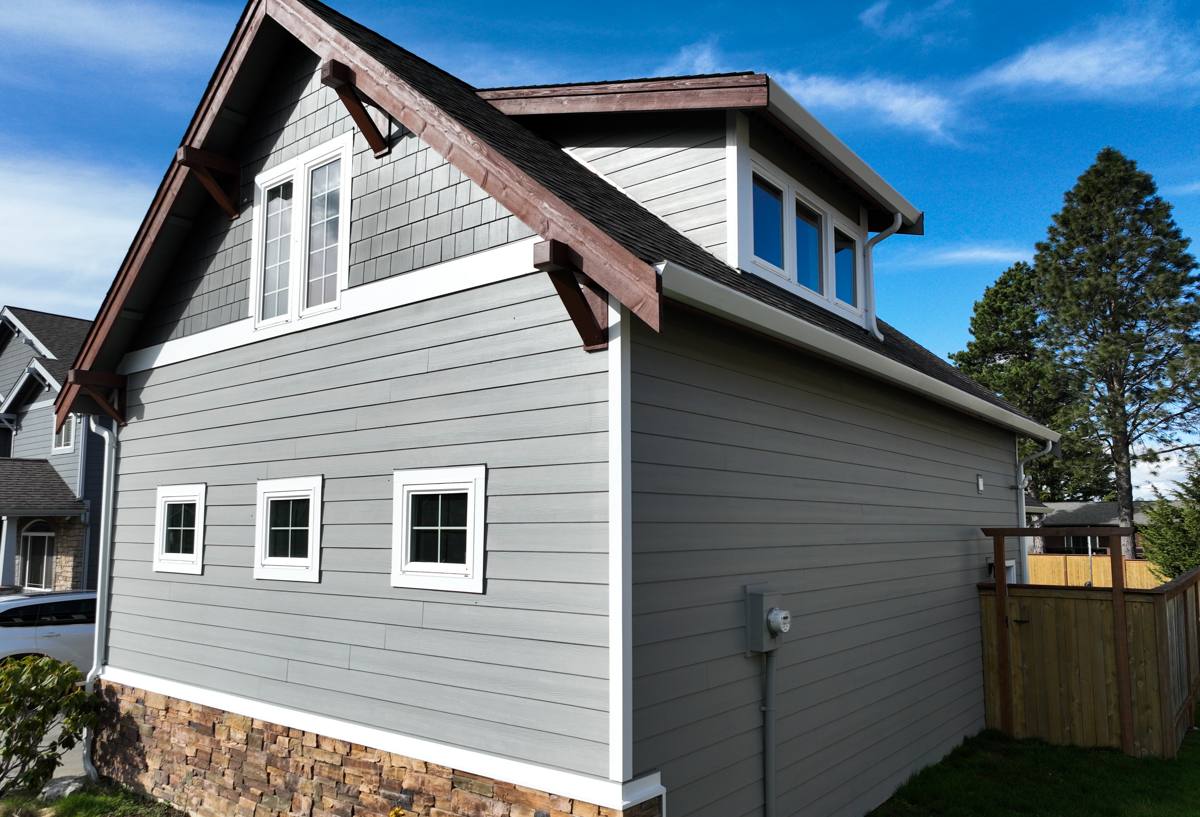
What Constant Moisture and Salt Air Do to a Wall System
It helps to understand the mechanism, not just the symptom. Wood-based and wood-derived siding products (cedar, primed spruce, LP SmartSide) are engineered wood or solid wood at their core. Wood absorbs moisture. When it stays damp for extended stretches — which is exactly what happens under a Whatcom County cloud layer through much of the year — that moisture works into seams, fastener holes, and cut edges. Over repeated wet-dry cycles, the wood fibers swell and contract, which is where paint failure, edge swelling, and eventually rot start.
Salt air adds a second stressor on top of that, mostly affecting metal components: nails, screws, flashing, and any exposed fastener heads. Salt accelerates oxidation, and once a fastener starts to corrode, it can stain the siding around it and eventually lose its grip. This is a bigger factor for homes with direct water exposure or unobstructed wind off the Bay, but marine air travels further inland than most homeowners assume.
Moss is the third piece, and it's more than cosmetic. Moss and algae hold moisture against a wall surface, which keeps that section of siding wet longer than the surrounding areas even after a dry spell. On porous or wood-based siding, that localized damp patch is where problems start first — usually on north-facing walls, under eaves with poor sun exposure, or anywhere airflow is restricted by landscaping.
Why We Only Install James Hardie Fiber Cement
We made a decision as a company to install one siding system — James Hardie fiber cement — and not offer vinyl, LP SmartSide, Cemplank, Allura, primed spruce, or cedar. That's not a marketing position; it's a practical one based on what holds up in exactly the conditions Bellingham and the rest of Whatcom County deal with every year.
Fiber cement is a mix of cement, sand, and cellulose fibers, and it does not absorb and swell the way wood or wood-based composite products do. It doesn't feed moss or mildew growth the way organic materials can, and it's non-combustible, which matters given the wildfire smoke and drought stress the broader Pacific Northwest has seen in recent years even in traditionally wet regions. James Hardie's ColorPlus finish is baked on at the factory under controlled conditions, rather than field-applied paint, which gives it better adhesion and a longer service life before it needs attention — a real advantage in a climate where field-painted surfaces get less drying time between rain events.
James Hardie also engineers regional product lines for different climate zones, including an HZ5 line built for colder, wetter climates like the Pacific Northwest. That's a meaningful difference from a one-size-fits-all siding product: the plank composition and finish are matched to the freeze-thaw and moisture patterns of this specific region rather than a national average.
What We're Not Saying
To be fair to the alternatives: vinyl siding is inexpensive and low-maintenance in mild climates, cedar has a real aesthetic appeal that some homeowners specifically want, and LP SmartSide has improved its engineered-wood formulation over the years. These aren't bad products in every application. Our position is narrower than "avoid these products everywhere" — it's that for the specific combination of driving rain, salt air, and extended moss season that Whatcom County homes face, we've concluded fiber cement is the more durable long-term choice, and we'd rather install one product well than offer several and let cost drive the decision.
Comparing Siding Options for a Whatcom County Home
| Factor | James Hardie Fiber Cement | Vinyl | LP SmartSide / Wood Composite | Cedar |
|---|---|---|---|---|
| Moisture absorption | Very low | Low, but seams can trap water behind panel | Moderate — engineered wood core | High — natural wood |
| Moss/algae resistance | Good, especially with factory finish | Fair | Fair to poor without diligent upkeep | Poor without regular treatment |
| Fire rating | Non-combustible | Combustible | Combustible | Combustible |
| Finish durability | Factory-baked ColorPlus, long fade resistance | Color molded in, can fade/chalk over time | Field or factory paint, needs repainting cycles | Needs staining/painting every few years |
| Typical maintenance | Occasional wash, caulk checks | Low, but brittle in cold/impact | Regular inspection of seams and cut edges | Ongoing sealing, staining, pest watch |
| Warranty structure | Long-term, transferable manufacturer warranty | Varies widely by manufacturer/grade | Varies, often shorter on finish | Typically none from a manufacturer |
Cost is the piece most homeowners want in a table like this, and we're intentionally not putting numbers in one, because real pricing depends on the size and complexity of the home, tear-off condition, trim detail, and current material costs — a broad "per square foot" figure without seeing the house is more likely to mislead than help. What we can say honestly: fiber cement typically costs more upfront than vinyl and is comparable to or less than a well-installed cedar or high-grade composite job once you factor in the finish. The gap narrows further when you account for how much less repainting and repair a Hardie system needs over a 20-30 year window.
What Correct Installation Looks Like Here
Fiber cement performs the way it's rated to perform only when it's installed correctly, and installation quality matters more in a wet marine climate than almost anywhere else. A few specifics that matter for Bellingham homes:
- Rainscreen or drainage gap: A ventilated air gap behind the siding lets incidental moisture drain and dry instead of sitting against the wall sheathing — important given how many wet days this area sees in a typical year.
- Proper flashing at every penetration: Windows, doors, hose bibs, light fixtures, and deck ledgers all need correctly lapped flashing so wind-driven rain can't work its way behind the plank.
- Manufacturer-specified fastening: Correct nail type, spacing, and depth affect both wind performance and long-term warranty coverage — over-driven or under-driven fasteners are a common source of early problems.
- Caulking only where Hardie's install guide calls for it: Over-caulking joints that are supposed to allow drainage can trap water instead of shedding it.
- Cut-edge sealing: Factory-primed edges need field sealing wherever a plank is cut, since a raw cut edge is more absorptive than the finished face.
This is also where a local crew has a real advantage over a traveling install team: we know which elevations in this area take the worst of the weather, how much drainage gap detail actually matters on a hillside lot versus a sheltered one, and what the moss and mildew patterns tend to look like a few years after installation if any of the above steps get shortcut.
Moss, Mildew, and Ongoing Maintenance
Even the best siding system benefits from basic upkeep, and moss deserves specific mention because it's such a defining feature of the Whatcom County exterior environment. Moss doesn't damage fiber cement the way it can compromise wood, but left unchecked it holds moisture against the surface, stains the finish, and can spread onto trim and roofing. A yearly rinse-down (not high-pressure blasting, which can force water behind panels or damage caulking) and keeping nearby vegetation trimmed back for airflow go a long way. We also recommend a walk-around after major storms to check that caulking at trim and penetrations hasn't cracked or pulled away — small gaps are easy to catch early and much cheaper to address than water damage found later.
A Simple Seasonal Maintenance Checklist
- Rinse siding annually, focusing on north-facing and shaded walls where moss collects fastest
- Trim back shrubs and tree limbs to keep airflow against the wall
- Inspect caulking at windows, doors, and trim after the wettest months
- Check gutters and downspouts are directing water away from the foundation and siding base
- Watch for any staining near fastener heads or seams, which can signal a flashing issue
Siding Doesn't Work Alone: Roofing, Windows, and Decks
Siding is one part of a home's exterior envelope, and in a climate like this, the pieces around it matter just as much. A roof with failing flashing will send water down behind otherwise well-installed siding. Windows with degraded seals let moisture into the wall cavity from the inside out. Decks tied into the house need proper ledger flashing so the connection point doesn't become a chronic leak source. We handle siding, roofing, windows, and decks as one company specifically because these systems interact, and a homeowner is better served by a crew that understands how a leak at a window head can show up as a stain three feet down the siding, rather than four separate contractors each only responsible for their own piece.
What to Look for in a Local Siding Contractor
Whatcom County has no shortage of contractors who will quote a siding job, but a marine climate punishes shortcuts faster than a dry one does. A few things worth asking any contractor, us included:
- Are they a factory-certified or preferred installer for the specific siding product they're proposing?
- Will they show you the flashing and drainage-gap details in writing, not just verbally?
- Do they carry current liability insurance and Washington L&I coverage, and can they provide proof?
- What does the manufacturer's warranty actually cover, and is it transferable if you sell the home?
- Can they explain why they recommend the product they're proposing for your specific site conditions — sun exposure, wind exposure, tree cover?
A contractor who can answer these clearly and isn't rushing you toward the cheapest option is usually the safer bet in a climate this demanding.
Warranty and Long-Term Value
James Hardie backs its fiber cement products with a long-term, transferable limited warranty, and the ColorPlus factory finish carries its own separate finish warranty — a structure that reflects how the product is manufactured and tested for regional conditions rather than a generic national spec. For a homeowner planning to stay in a Bellingham home for decades, or one thinking about resale, a documented manufacturer warranty on both the substrate and finish is worth real money, especially compared to products where the finish is field-applied and warranted separately by the installer rather than the manufacturer.
Ready to Talk About Your Home
Every home in Bellingham and the surrounding Whatcom County area sits a little differently — sun exposure, tree cover, proximity to water, and wall condition all affect what a siding job actually needs. If you're noticing moss buildup, paint failure, soft spots, or you're just planning ahead for a home that's due, we're happy to take a look and give you a straightforward, no-pressure estimate. There's a form below to get started.