 Whatcom County
Bellingham Roofs Take a Different Kind of Beating
Bellingham sits where Puget Sound weather and the foothills of the North Cascades meet, and that combination is hard on roofs in ways that don't always show up right away. Storms here rarely bring the dramatic hail or tornado damage you'd see in other parts of the country. Instead, Whatcom County roofs get worn down by a slower, steadier pattern: sideways-driving rain during fall and winter systems, gusty windstorms off the Sound that lift shingles and flashing, salt-laden air near the water that accelerates corrosion on metal components, and a moss season that can run eight or nine months out of the year on shaded, north-facing slopes.
The result is that "storm damage" in Bellingham is often a mix of one sudden event and months of underlying moisture stress. A windstorm might tear loose a section of shingles that was already softened by moss and trapped water, or heavy rain might finally find its way through a seal that's been degrading for a year. A correct repair has to account for both the immediate damage and the conditions that made the roof vulnerable in the first place.
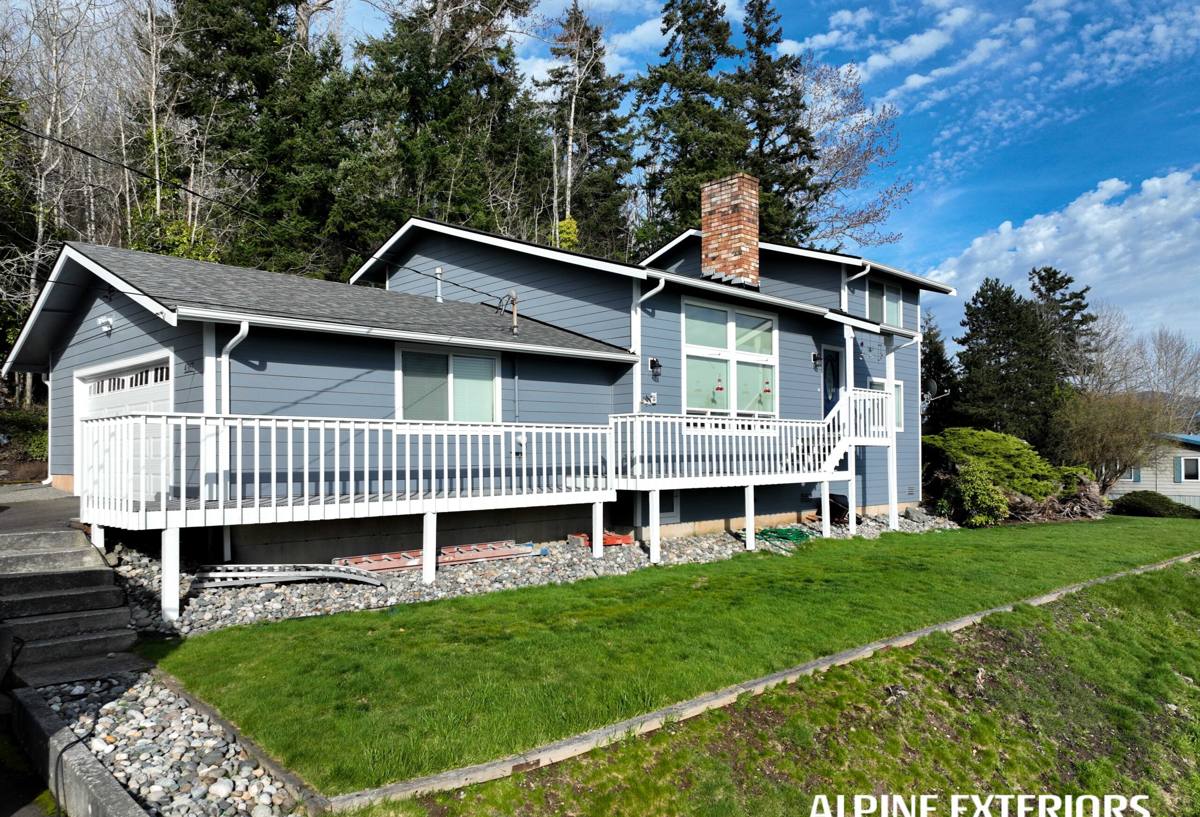
What Actually Counts as Storm Damage Here
Homeowners often picture storm damage as missing shingles after a big blow, but in this climate it covers a wider range of issues. Some of the most common categories we see on Bellingham roofs after a storm:
- Wind-lifted or torn shingles — especially on ridgelines and roof edges exposed to wind coming off Bellingham Bay or funneling through the valleys.
- Flashing failure — around chimneys, skylights, and roof-to-wall transitions, where wind-driven rain can force water sideways under otherwise intact shingles.
- Moss-related lifting — moss mats that hold moisture against the roof deck, freeze-thaw cycling that pries shingles apart, and granule loss underneath the moss itself.
- Gutter and downspout damage — overflow from clogged or storm-battered gutters that backs water up under the roof edge (fascia rot often traces back to this).
- Fallen limbs and debris — Whatcom County has a lot of mature conifers, and even a small branch strike can crack shingles or dent metal roofing.
- Salt-air corrosion on fasteners and flashing — more of an issue for homes closer to the water, where metal components age faster than the shingles around them.
Some of this is obvious from the ground. A lot of it isn't, which is why storm damage on a Bellingham roof often gets discovered months later as an interior stain rather than at the time of the actual storm.
Obvious Damage vs. Hidden Damage
One of the more useful things we can do on a storm-damage call is separate what's visible from what's likely happening underneath. This table covers the pattern we see most often:
| Visible Sign | What's Usually Actually Happening | Urgency |
|---|---|---|
| Shingle tabs on the ground after wind | Adjacent shingles are often loosened too, even if they didn't blow off | Address within days |
| Small ceiling stain, not growing | Slow intrusion at flashing or an underlayment seam, not a hole | Address within 1-2 weeks |
| Moss patches on north-facing slopes | Trapped moisture under the moss mat, possible granule loss | Plan for next dry stretch |
| Sagging or discolored gutter section | Overflow has likely been wetting the fascia and roof edge for a while | Address before next storm |
| Missing granules in gutters after a storm | Shingle wear accelerated, often near the end of useful life | Inspect this season |
The point isn't to alarm anyone over a stain the size of a coin. It's that in this climate, small visible signs correlate with bigger hidden ones often enough that a proper roof inspection — not just a patch — is worth doing after any storm that caused visible damage nearby.
What a Correct Repair Actually Involves
A rushed storm repair on a Whatcom County roof tends to fail in the same predictable way: it addresses the hole but not the water path that let the hole matter. Water on a sloped roof doesn't travel straight down — wind-driven rain especially can move sideways and uphill under shingles before finding a gap. A repair that just re-nails a shingle or caulks a visible crack without checking the underlayment and flashing nearby is a temporary fix at best.
A repair done right typically includes:
- A full-slope inspection, not just a look at the damaged spot, since storm forces rarely affect just one shingle in isolation.
- Underlayment and decking check at the repair area — if water has been getting in for a while, the plywood underneath may need attention, not just the surface layer.
- Flashing evaluation around any nearby penetrations (vents, chimneys, skylights), since flashing failure is a more common root cause than shingle damage itself.
- Matching materials where possible, so the repair doesn't stand out or create a weak seam against the surrounding roof.
- Proper fastening and sealing rated for wind exposure, since a repair that isn't secured for the next windstorm just becomes next season's callback.
- Gutter and drainage check at the repair line, since a repair sitting behind a clogged gutter will fail again regardless of how well it was installed.
Our Process for Storm Damage Calls
When we get a storm damage call in Bellingham, the process is straightforward and we try to keep it moving quickly, since the gap between damage and repair is where most secondary problems (rot, mold, insulation damage) start.
1. Initial assessment
We look at the damage in context — what the storm did, what direction it came from, and what else on that slope or elevation might be affected. Wind damage especially tends to cluster on specific roof faces depending on which way a storm system moved through.
2. Temporary protection if needed
If there's an active leak or exposed decking, we prioritize getting it covered before anything else, particularly if more rain is in the forecast — which in this region is often the case for days at a stretch.
3. Documentation
We photograph and note the damage in a way that's useful if you're filing an insurance claim, including the parts of the damage that aren't obvious from the ground.
4. The repair itself
We do the actual work — matching shingles or metal roofing components, correcting flashing, replacing damaged decking if needed — with an eye toward the underlying cause, not just the visible symptom.
5. Follow-up check
Especially for repairs done during an active storm pattern, we recommend a follow-up look once the weather clears to confirm the repair is holding and nothing else showed up.
Repair or Replace? What Actually Drives That Decision
Not every storm-damaged roof needs a full replacement, and not every roof that "just needs a patch" is a good candidate for one. The honest answer depends on a handful of factors:
| Factor | Leans Toward Repair | Leans Toward Replacement |
|---|---|---|
| Roof age | Under 12-15 years, otherwise sound | Nearing or past expected lifespan for the material |
| Extent of damage | Isolated to one section or slope | Multiple slopes or widespread granule loss |
| Moss/moisture history | Minor, recently treated | Long-term moss mats with visible deck staining |
| Underlying decking | Solid, no soft spots | Soft, delaminated, or previously patched repeatedly |
| Insurance coverage | N/A — cost-driven decision | Full replacement often more cost-effective if covered |
Broadly, straightforward wind or impact damage on an otherwise healthy roof is a repair. A roof that's already near the end of its service life and just got an excuse to show it — that's usually a replacement conversation, and we'll say so plainly rather than stacking patches on a roof that's telling you it's done.
Why Local Materials and Method Choices Matter Here
We favor repair materials and methods that hold up specifically to Whatcom County conditions rather than whatever's cheapest or fastest to install. That means ice-and-water barrier at vulnerable transitions even in repair work, not just full replacements, because wind-driven rain here doesn't behave like a simple downhill flow. It means flashing details sized for real wind exposure rather than minimum code, since coastal gusts put more lateral stress on flashing seams than calmer inland areas see. And on homes with heavy moss history, it can mean recommending zinc or copper strips as part of the repair to slow regrowth on that section — a maintenance-reducing step, not a guarantee, since moss pressure here is constant enough that no product eliminates the need for periodic cleaning.
Insurance Claims: What Helps and What Doesn't
Many storm repairs in this area do get filed through homeowners insurance, particularly after a named windstorm event. A few things make that process smoother:
- Document damage as soon as it's safely visible — insurers often want to see the connection between a specific storm date and the damage.
- Avoid full replacement of undamaged sections before an adjuster has seen the roof, since it can complicate the claim.
- Get a written, itemized estimate that separates storm-caused damage from pre-existing wear (like moss deterioration), since adjusters distinguish between the two.
- Keep any temporary protection (tarps, etc.) documented with photos and dates — insurers generally expect reasonable steps to prevent further damage.
We're glad to provide documentation to support a claim, but we don't inflate estimates or characterize pre-existing wear as storm damage — that approach tends to create problems with the claim later, not solve them.
Signs You Should Have Your Roof Checked After a Storm
Not every storm warrants a call, but these are the signs worth acting on:
- Visible shingle pieces or granules in the yard or gutters after high wind
- Any new interior ceiling stain, even faint, following heavy rain
- A gutter or downspout that's pulled away from the fascia
- A tree limb strike anywhere on the roof, even if nothing looks obviously broken
- Daylight visible through the attic that wasn't there before
- A musty smell in the attic space after a wet stretch
- Moss patches that have visibly thickened since the last dry season
If you're seeing any of these after a Bellingham storm, it's worth having someone look before the next system rolls in — which, in this region, is rarely more than a few days away for much of the year.
Why a Crew That Already Works Bellingham Matters
Storm damage repair isn't a one-size-fits-all trade. A crew that works across the country might default to generic solutions that work fine in drier climates but underperform here. Knowing how Bellingham weather actually behaves — which roof faces take the worst of a southwesterly windstorm, how moss builds on shaded slopes near the tree cover common in this area, how salt air affects metal fasteners closer to the water — changes what gets prioritized in a repair and how it's detailed. It also means faster response: when a windstorm moves through Whatcom County, a local crew already knows which neighborhoods and roof orientations are likely to need attention first, rather than starting from scratch.
If your roof took a hit in a recent storm, or you're just not sure whether that small stain or missing shingle is worth worrying about, we're happy to take a look. Estimates are free, there's no pressure to move forward, and we'll tell you honestly whether you're looking at a simple repair or something bigger — just fill out the form below to get started.