 Whatcom County
 Siding, Roofing, Windows, and Decks in Cordata
Cordata sits in north Bellingham, close enough to the water and the foothills that its homes take on a mix of weather most inland neighborhoods never have to deal with. Salt-laden air drifts in off Bellingham Bay, driving rain rolls through for most of the fall and winter, and the shaded, tree-lined lots that make the neighborhood attractive also hold onto moisture long after a storm has passed. We work on homes throughout this part of Whatcom County, and Cordata's exterior wear patterns are some of the most consistent we see in the county — which is exactly why we've standardized on one siding product instead of offering a menu of them.
This page is about siding specifically, but it's worth knowing up front that we also handle roofing, windows, and decks. Those four systems overlap constantly on a house — a siding job done without attention to roof flashing or window trim just moves the water problem somewhere else. We approach all four as one exterior system, not four separate trades competing for a slot on your schedule.
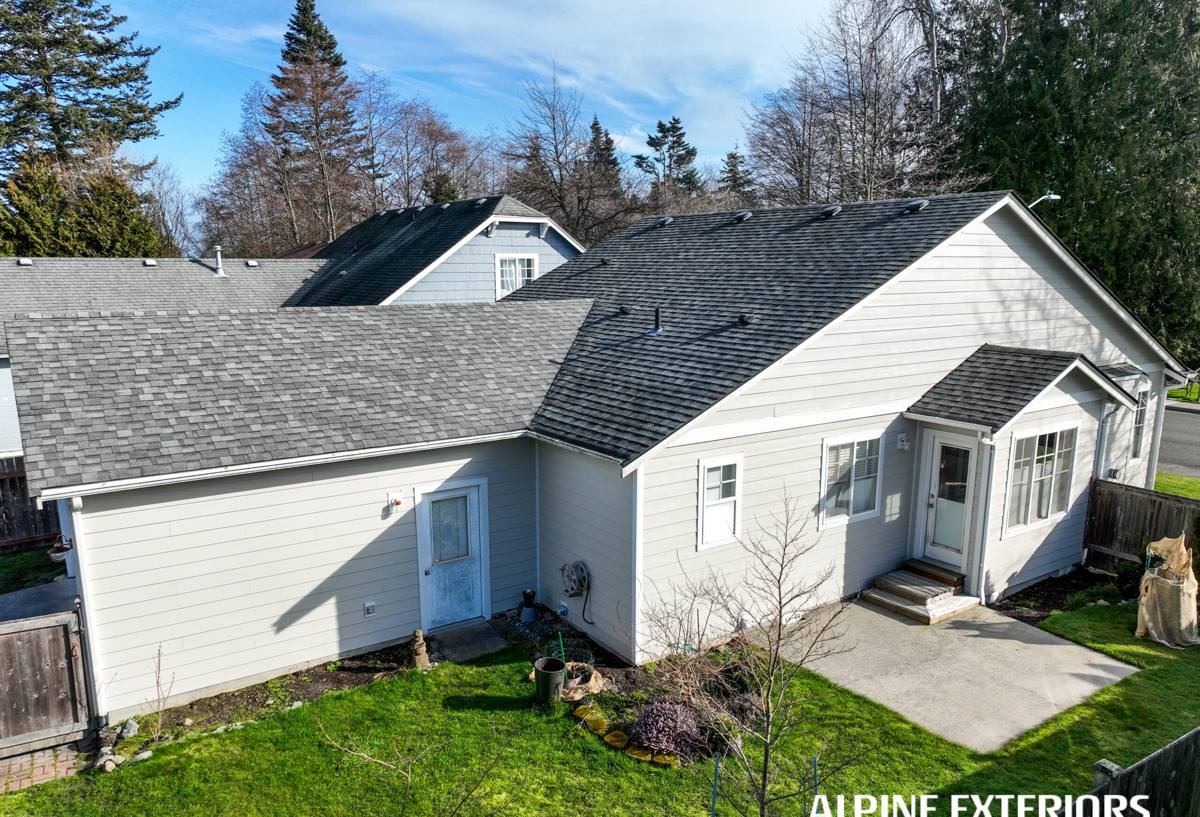
What the Climate Actually Does to Cordata Homes
Driving rain and wind-driven moisture
Whatcom County's weather doesn't just rain straight down — a good share of it comes in sideways, pushed by wind off the Strait and the Sound. That matters more than most homeowners realize, because siding systems are rated and installed differently depending on whether they're expected to shed vertical rain or resist wind-driven moisture pushing up under laps and around trim. A product or installation method that works fine in a drier inland climate can fail here within a decade.
Salt air and metal fasteners
Cordata isn't oceanfront, but it's close enough to Bellingham Bay that salt-bearing air reaches it, especially during winter storm systems. Salt air accelerates corrosion on fasteners, flashing, and any exposed metal trim. Over years, that corrosion can telegraph through paint and caulk lines long before the siding material itself shows its age.
The long moss season
North Bellingham's tree cover and persistent damp keep moss and algae active on north- and west-facing walls for much of the year, not just a few weeks. Moss holds moisture against a wall surface, and on materials that aren't dimensionally stable, that sustained dampness is what starts rot, swelling, or paint failure at seams and butt joints.
Why We Install Only James Hardie Fiber Cement
We used to get asked why we don't offer vinyl, LP SmartSide, cedar, or other fiber cement brands. The honest answer is that after years of repair calls and re-siding jobs across Whatcom County, one product held up consistently better in this specific climate, and we stopped installing the others.
It doesn't feed the moisture cycle
James Hardie siding is fiber cement — sand, cement, and cellulose fiber, not wood fiber or vinyl. It doesn't absorb water the way engineered wood products can, and it doesn't expand and contract with temperature swings the way vinyl does. In a climate where a wall can stay damp for days at a time, that stability matters more than almost any other spec.
It's non-combustible
Fiber cement doesn't burn. That's a genuine safety advantage over vinyl (which can melt and drip) and over wood-based products, independent of anything to do with our regional weather.
ColorPlus factory finish
Hardie's ColorPlus finish is baked on at the factory under controlled conditions, not brushed or sprayed on site. That gives a harder, more UV- and moisture-resistant top coat than field-applied paint, and it carries its own finish warranty separate from the substrate warranty.
Climate-engineered HZ product lines
Hardie makes region-specific HZ (HardieZone) formulations engineered for different moisture and freeze-thaw conditions across the country. We install the HZ5 line appropriate for the Pacific Northwest, which is formulated for our wetter, milder climate rather than a one-size-fits-all national spec.
How Hardie Compares to the Alternatives
| Material | Moisture behavior | Maintenance | Fire performance | Typical warranty structure |
|---|---|---|---|---|
| James Hardie fiber cement | Dimensionally stable, doesn't swell or rot | Occasional wash; factory finish holds up for years | Non-combustible | Long transferable product + finish warranty |
| Vinyl siding | Doesn't absorb water, but expands/contracts and can warp | Low, but color fades and panels can crack in cold | Can melt/deform under heat | Varies widely by manufacturer |
| LP SmartSide (engineered wood) | Treated wood strand product; vulnerable at cut edges and joints if not sealed correctly | Needs diligent caulking/paint upkeep | Combustible | Manufacturer warranty, installation-sensitive |
| Cedar / primed spruce | Natural wood; absorbs and releases moisture seasonally | Highest — regular refinishing needed | Combustible | Typically none beyond workmanship |
None of these are junk products in the abstract — vinyl is inexpensive and low-maintenance in mild climates, cedar has real aesthetic appeal, and engineered wood has improved over the years. But in a neighborhood with Cordata's rain exposure, salt air, and moss pressure, we've found the long-term maintenance burden and moisture risk of the alternatives outweighs their upfront savings.
How We Approach a Siding Job in Cordata
Assessment before anything gets ordered
We start by looking at what's actually happening on the existing wall — where moss and staining concentrate, where trim and flashing have failed, and which elevations take the worst of the wind-driven rain. That assessment shapes the flashing and drainage plan, not just the material choice.
Drainage plane and flashing details
Fiber cement performs well, but only if the water management behind it is done right. That means a proper weather-resistive barrier, correctly lapped flashing at windows, doors, and roof-to-wall intersections, and rainscreen or furring where the wall assembly calls for it. This is the part of the job that doesn't show once the siding is up, and it's also the part that determines whether the house stays dry for the next 30 years.
Installation to manufacturer spec
Hardie's warranty depends on installation following the manufacturer's fastening, clearance, and caulking requirements. We follow those specs as a baseline, not a suggestion — gaps at butt joints, wrong fastener spacing, or siding installed too close to grade or a roofline are common causes of early failure on jobs done by crews unfamiliar with the product.
Roofing, Windows, and Decks — Why We Handle All Four
Siding failures often start somewhere else on the house. A roof that's shedding water onto a wall, a window that's not flashed correctly, or a deck ledger board that's trapping moisture against the siding can undo a good siding job within a few years. Because we handle roofing, windows, and decks alongside siding, we can flag those interactions during the initial estimate instead of after a callback.
- Roofing — proper roof-to-wall flashing protects the siding directly below it
- Windows — correct window flashing is one of the most common failure points behind otherwise good siding
- Decks — ledger attachment and deck-to-wall flashing affect the wall assembly right where they meet
- Siding — the visible layer, but only as good as what's behind it
What This Costs — And What Drives the Range
We don't publish flat per-square-foot pricing because the real cost drivers vary house to house. In general, expect the total to depend on:
| Factor | Why it matters |
|---|---|
| Home size and number of stories | More surface area and access complexity (staging, lifts) raise labor cost |
| Existing siding removal | Tear-off, disposal, and sheathing repair add time before new siding goes up |
| Trim and detail level | More corners, window/door openings, and architectural detail mean more cutting and flashing work |
| Moisture or rot damage found underneath | Hidden sheathing or framing repair is common on older Whatcom County homes and can't be quoted sight-unseen |
| Siding profile and color | Lap width, shingle-style panels, and custom ColorPlus colors carry different material costs |
The only way to get an accurate number is a walk-around estimate — we'll tell you honestly if we find something during that visit that changes the scope.
Signs Cordata Homeowners Should Watch For
- Moss or algae staining that keeps coming back within a season of cleaning
- Soft spots or visible swelling around butt joints and corner trim
- Paint that's peeling or bubbling rather than just fading
- Gaps opening up at caulked joints, especially around windows and doors
- Visible rust streaking from fasteners or trim
- Siding that flexes or feels hollow when pressed near the bottom edge of the wall
Why a Local Crew Matters
Whatcom County's weather isn't dramatic in the way hurricane or hail-prone regions are, but it's relentless — steady rain, persistent damp, and shaded lots that never fully dry out. A crew that installs siding here every week understands where water actually goes on a house in this climate, not just what a manufacturer's install guide says in the abstract. That local repetition is what catches the small details — a missed kickout flashing, a butt joint gap, a fastener pattern that's a little off — before they turn into a repair call five years down the road.
If you're weighing a siding project on a Cordata home, or want a second opinion on roofing, windows, or a deck while we're there, we're happy to walk the property with you and give you a straightforward estimate — no pressure, no upsell script, just what we'd actually recommend for your house.