 Whatcom County
Cordata sits inland from Bellingham Bay but still takes the full brunt of Whatcom County's weather pattern: wet Pacific storms rolling off the Salish Sea, sustained winter wind events, and the long gray stretch from October through May when a roof rarely gets a chance to fully dry out. When a storm damages a roof here, the fix has to account for that climate — not just patch what's visible and hope it holds until the next atmospheric river comes through.
This page covers what storm damage roof repair actually involves for homes in Cordata, what to look for after a bad blow, and how we approach the work so it holds up through another Whatcom County winter.
What Storms Actually Do to Cordata Roofs
Most of the roof damage we see after storms in this part of Whatcom County isn't dramatic. It's rarely a tree through the roof — though that happens too. More often it's the quieter damage that homeowners don't notice until a stain shows up on a ceiling weeks later.
Wind Damage
Whatcom County storms bring sustained wind and gusts that work at roof edges, ridges, and any spot where a shingle or panel is already a little loose. Wind doesn't need to rip a whole section off to cause a problem — it just needs to lift an edge enough to break the seal, and from there, wind-driven rain does the rest. Common wind damage includes:
- Lifted or creased shingle tabs, especially along ridgelines and roof edges facing the prevailing wind
- Torn or missing shingles, usually in clusters rather than single pieces
- Loosened or blown-off ridge cap pieces
- Flashing pulled away from chimneys, vents, or wall intersections
- Debris impact from branches, cones, and blown material off neighboring trees
Rain and Moisture Intrusion
Once wind opens a gap, driving rain finds it fast. Cordata's tree cover and proximity to the water mean rain here often comes in sideways during a real system, not just straight down — so damage can show up in places a homeowner wouldn't expect, like under eaves or along vertical wall-to-roof transitions rather than just at open holes.
Moss and the Long Wet Season
Whatcom County's moss season is long, and it's a factor in storm damage even though moss itself isn't a storm event. A roof with an existing moss mat holds moisture against the shingles, keeps granules from shedding water properly, and makes the roof surface more brittle and prone to cracking when wind and impact hit it. A storm can turn a moss problem that was cosmetic into one that's now actively leaking, because the moss compromised the surface before the wind ever showed up.
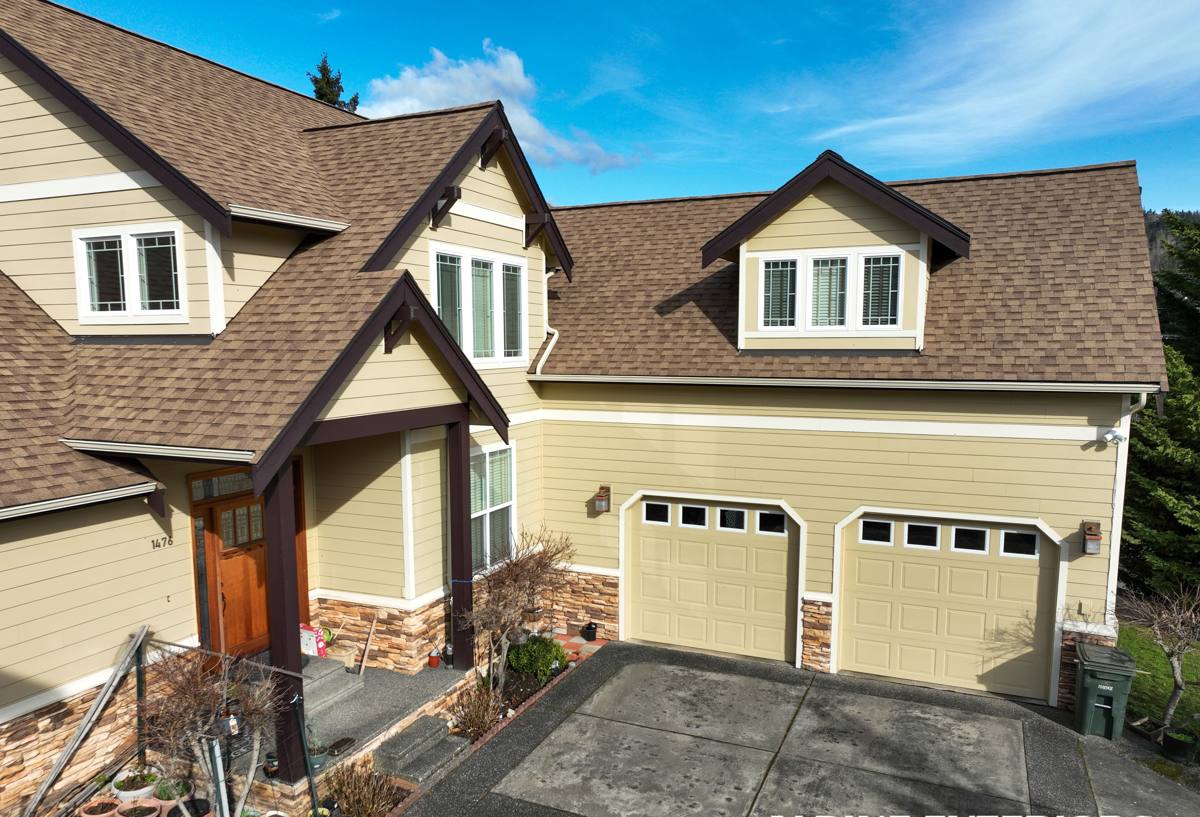
Signs You Should Have Your Roof Checked After a Storm
Not every sign of storm damage is obvious from the ground, and not every homeowner should be getting on a wet, sloped roof after a storm to check it themselves. Here's what to watch for:
- Shingle pieces or granules in gutters, downspouts, or on the ground around the house
- Visible gaps, curling, or missing sections when viewed from the yard or a safe vantage point
- New or worsening water stains on interior ceilings or upper walls
- Damp smell or visible moisture in the attic
- Sagging or soft spots noticeable from inside the attic
- Flashing that looks bent, separated, or missing around chimneys and vents
- Debris — branches, needles, cones — built up in valleys or against the roof plane
If you see any of these after a storm, it's worth getting a roof looked at before the next system moves through. A small gap left through one more storm cycle in this climate tends to become a bigger repair.
What a Correct Storm Damage Repair Involves
A lot of storm repair work done badly is really just cosmetic — replace the obviously missing shingles, call it done, move on. That approach misses what's underneath, and in a climate as wet as Whatcom County's, what's underneath is often the part that actually determines whether the repair lasts.
1. Full Assessment, Not Just a Patch
A proper storm repair starts with checking the areas around the visible damage, not just the damage itself. Wind and water travel — a torn shingle at one spot can mean water has already tracked several feet under the roofing material before it found a way through the deck. We check the surrounding shingles, the underlayment where it's exposed, and the roof deck itself for soft spots or moisture.
2. Underlayment and Deck Condition
If water got under the shingles, the underlayment is the next line of defense, and it's worth checking whether it did its job or whether it's also compromised. If the roof deck has taken on moisture, that has to be addressed before new shingles go back down — covering a wet deck with new roofing just traps the problem.
3. Flashing Repair
Flashing failures are one of the most common causes of storm leaks that keep coming back after a "repair." If flashing around a chimney, skylight, or wall intersection was bent or pulled loose, it needs to be properly resealed or replaced — not just pushed back into place and caulked over.
4. Matching Materials
Where shingles need replacing, matching the existing material as closely as possible matters both for appearance and for performance — mismatched shingle types can age and expand differently, creating new weak points at the seams between old and new.
5. Moss and Debris Clearing
Since moss and organic debris compound storm damage in this climate, a thorough repair includes clearing moss and buildup from the repaired area and, where it makes sense, the rest of the roof — not to sell an unrelated service, but because leaving it means the next storm has the same setup for damage.
How We Approach a Storm Repair Call in Cordata
Because we work regularly in Cordata and the surrounding Whatcom County neighborhoods, we're familiar with how the local terrain, tree cover, and exposure affect different properties. A home tucked into mature trees deals with different debris and moisture patterns than one on a more open lot, and that shapes what we look for.
Our Process
- Initial contact and description. We ask what you've noticed — visible damage, leaks, stains — so we know what to prioritize.
- On-site inspection. We walk the roof and check the attic where accessible, looking past the obvious damage to the surrounding area.
- Written assessment. You get a clear explanation of what's damaged, what's causing it, and what repair options make sense — no pressure toward a full replacement if a repair will genuinely hold.
- Repair work. We fix the deck, underlayment, flashing, and roofing material as needed, matching materials where possible.
- Follow-up check. We confirm the repair is holding, particularly important given how quickly the next storm can arrive in this region.
Repair vs. Replacement: How to Think About It
Storm damage doesn't automatically mean a full roof replacement, and it doesn't automatically mean a simple patch will do either. The right call depends on a few factors:
| Factor | Leans Toward Repair | Leans Toward Replacement |
|---|---|---|
| Age of roof | Under 10-15 years, otherwise in good shape | Nearing or past expected lifespan |
| Extent of damage | Localized to one section or slope | Widespread across multiple slopes |
| Deck condition | Dry, solid decking under damaged area | Soft, rotted, or repeatedly wet decking |
| Prior moss/moisture history | Minor, addressed with cleaning | Long-term moss mat with widespread granule loss |
| Number of past repairs | First or second storm repair | Repeated patch jobs in the same areas |
We'll always tell you honestly which side of that table your roof falls on. A roof that can be properly repaired doesn't need to be replaced, and we'd rather do a repair right than push a bigger job that isn't necessary.
Why Storm Damage Repair Shouldn't Wait in This Climate
In a drier climate, a homeowner might reasonably wait a few weeks to schedule a roof repair after a storm. In Whatcom County, that gap matters more. The wet season here isn't a single event — it's a long stretch of one system after another, often with only short breaks between them. A gap in the roofing system that's left open through even one more heavy rain event can let enough water into the deck and insulation to turn a straightforward shingle repair into a deck replacement, or worse, interior damage that spreads into drywall and framing.
Salt air off the Salish Sea is also worth factoring in. It doesn't cause storm damage directly, but it does accelerate corrosion on exposed metal flashing and fasteners, which means storm-damaged flashing in this area tends to be further along in wear than the same damage would be further inland. That's part of why we check flashing condition carefully rather than assuming a quick reseal will hold for years.
What to Do Immediately After Storm Damage
Before a contractor even gets on-site, there are a few things that help protect your home and make the repair go smoother:
- If it's safe to do so, take photos from the ground of any visible damage — this helps with insurance and gives a repair crew a head start on what to expect
- Check the attic for signs of water intrusion if you can safely access it
- Avoid walking on the roof yourself, especially if it's wet or you can see visible damage — storm-damaged roofing can be unstable underfoot
- Contact your insurance provider if the damage looks significant, and keep documentation of the date and conditions of the storm
- Get a repair scheduled promptly rather than waiting to see if a small issue gets worse — in this climate, it usually does
Why Local Experience Matters for This Kind of Repair
Storm damage repair isn't a one-size-fits-all job. A crew that works Cordata and the rest of Whatcom County regularly has seen how local roofs age under this specific combination of salt air, sustained rain, and moss pressure — and knows the difference between damage that's purely storm-related and damage a storm exposed that was already building underneath. That distinction changes what an honest repair recommendation looks like, and it's something you mostly get from doing the work in this area over time rather than from a general roofing background alone.
We also know that storm repair calls often come in waves, right after a system moves through, and we plan for that so Cordata homeowners aren't stuck waiting weeks with an open gap in their roof during the wettest part of the year.
If your roof has storm damage — or you're not sure whether what you're seeing is storm-related — we're glad to take a look and give you a straight answer. Fill out the form below for a free, no-pressure estimate.