 Whatcom County
 Blaine sits at the northwest corner of Whatcom County, wedged between Semiahmo Bay and the Canadian border, which means homes here take on a version of Pacific Northwest weather that's a little more aggressive than what you'd find further inland. The salt air off the Strait of Georgia and Drayton Harbor works differently on a house than plain rain does. Combine that with long, wet winters and a moss season that seems to start earlier every year, and Blaine exteriors are under more or less constant low-grade attack. Most of it isn't dramatic. It's slow, cumulative wear that shows up as paint failure, soft trim, streaking, and siding that looks tired years before it should.
We're a Whatcom County exterior contractor working in siding, roofing, windows, and decks, and Blaine is part of our regular service area. This page walks through what the local climate actually does to a house, how we approach siding work here, and why we've standardized on one product line rather than offering the full menu of options you'll see advertised elsewhere.
What Salt Air Actually Does to a House
Salt air is corrosive in ways that aren't always obvious from the street. It's not just about metal rusting, though that happens too — fasteners, flashing, and hardware near the water take a beating. Salt-laden moisture also settles into porous or absorbent siding materials and paint films, accelerating the breakdown of the finish. Homes closer to Semiahmo Bay and Drayton Harbor tend to show chalking, fading, and coating failure sooner than homes a few miles inland, even when both were painted or finished at the same time with the same product.
This is one of the reasons wood-based and wood-adjacent siding products are a tougher sell in a town like Blaine. Any product that depends on a field-applied or factory-applied coating to keep moisture out is racing against an environment that's actively working to break that coating down. Once the finish starts to go, the substrate underneath is exposed to salt air, rain, and condensation — and that's when the real damage starts.
Driving Rain and Wind-Driven Moisture
Blaine gets weather off the water, and that means rain doesn't always fall straight down. Wind-driven rain pushes moisture sideways into siding laps, around window and door trim, and into any gap in the water-resistive barrier behind the cladding. On a well-built wall with good flashing details, this is manageable. On a wall where the siding material itself struggles with moisture, or where the original installation cut corners on flashing and caulking, wind-driven rain finds every weakness over time.
This is a big part of why installation quality matters as much as the material itself. We've seen good siding fail early because of poor flashing or missing kick-out flashing at roof-wall intersections, and we've seen average siding hold up reasonably well because the water management behind it was done correctly. In Whatcom County, and especially in a coastal town like Blaine, you need both: a material that tolerates moisture exposure, and a crew that installs it so water is directed away from the wall assembly rather than trapped against it.
Moss, Mildew, and the Long Wet Season
Moss doesn't just grow on roofs here — it takes hold on north-facing siding, under eaves, and anywhere shade and moisture combine for months at a time. Mildew and algae staining follow the same pattern. For homeowners, this usually shows up as dark streaking or a greenish cast on shaded wall sections, particularly on siding that holds moisture rather than shedding it.
A factory-applied finish that resists moisture absorption gives mold, mildew, and moss less to grab onto. It won't stop biological growth from landing on a wall entirely — nothing does — but it makes a real difference in how deeply it takes hold and how easily it washes off during routine maintenance, versus becoming embedded in a porous or degrading surface.
Why We Only Install James Hardie Fiber Cement
We don't install LP SmartSide, vinyl, Cemplank, Allura, primed spruce, or cedar. That's a deliberate standard, not an oversight, and it's worth explaining honestly rather than just asserting it.
Vinyl
Vinyl siding is affordable and low-maintenance in mild conditions, but it's a thin plastic product that can warp in heat, crack in cold, and fade over time with no way to refinish it short of replacement. In a coastal environment with wind-driven rain, vinyl's seams and lap joints are also more prone to moisture intrusion behind the panel than a properly installed fiber cement system.
Wood-Based and Engineered Wood Siding (including LP SmartSide)
Engineered wood products have improved over the years and can perform well when maintained diligently, but they remain wood-based at the core, meaning they're more sensitive to sustained moisture exposure than fiber cement. In a salt-air, high-rainfall market like Blaine, that sensitivity translates into a shorter practical lifespan and a maintenance schedule most homeowners underestimate when they buy.
Primed Spruce and Cedar
Solid wood siding is a real material with real character, and some homeowners want it for that reason. But it demands the most upkeep of any option on this list — regular refinishing, vigilant caulk maintenance, and quick attention to any coating failure — and in this climate, the window between "needs attention" and "has a moisture problem" can be short.
Other Fiber Cement Brands (Cemplank, Allura)
These are legitimate fiber cement products and not something we'd disparage. Our standardization on James Hardie is about consistency of supply, factory finish quality, warranty structure, and the fact that our crews are trained and experienced specifically on Hardie's installation requirements. Running one system lets us install it correctly every time rather than switching specs between jobs.
What James Hardie Brings to a Coastal Town
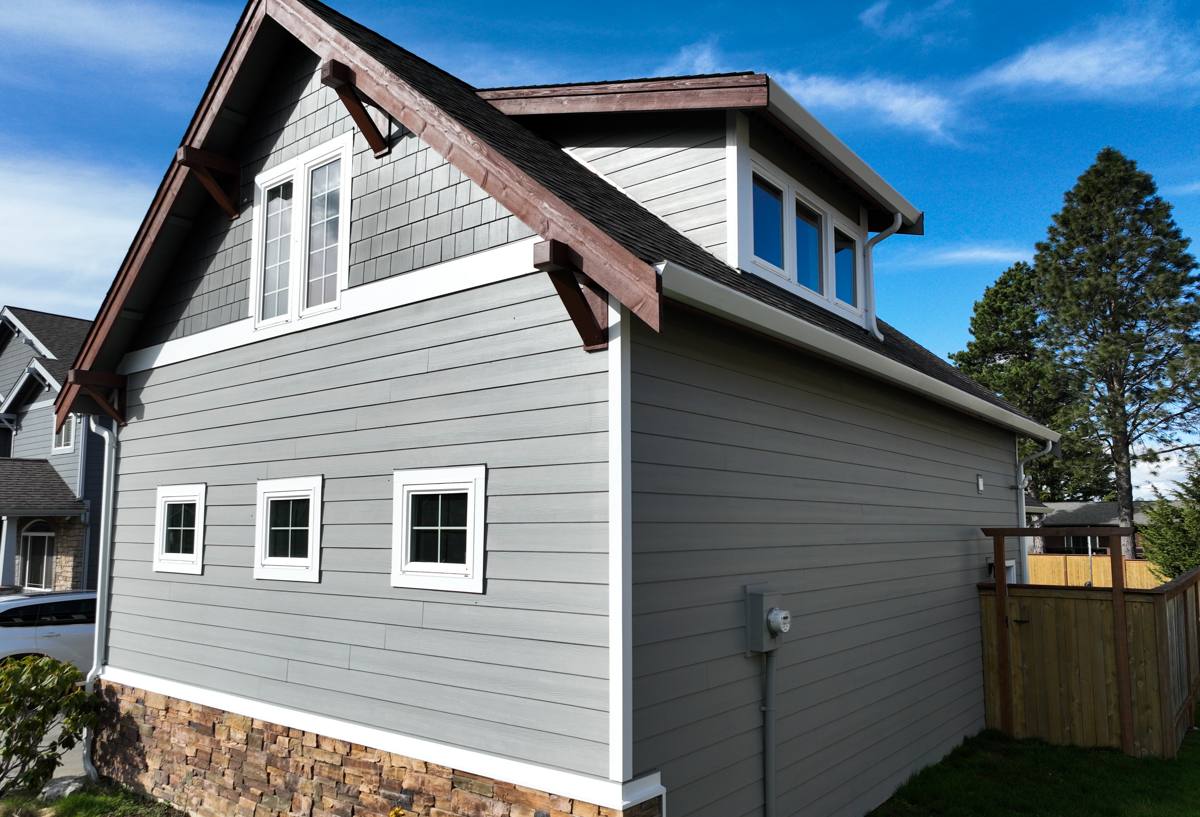
James Hardie fiber cement siding is non-combustible, dimensionally stable, and engineered for climate zones — including HardieZone HZ10, built for Pacific Northwest-style wet, moderate climates. A few specific things matter for Blaine:
- ColorPlus factory finish: baked-on color applied under controlled conditions, which holds up better against fading and coating failure than most field-applied paint, especially in salt air.
- Moisture resistance: fiber cement doesn't swell, rot, or delaminate the way wood-based products can when exposed to sustained wet conditions.
- Non-combustible core: a material advantage that matters regardless of coastal location, and a growing consideration for insurance and resale.
- Dimensional stability: less expansion and contraction across wet winters and drier summers means caulk joints and paint lines hold up longer.
- Transferable warranty: a real backing that follows the product, which matters if you sell the home before the siding's functional life is up.
How We Approach a Blaine Siding Job
Every project starts with an honest look at the existing wall assembly, not just the visible siding. We check for soft spots, trapped moisture, and flashing problems that need to be corrected before new siding goes on — installing a better product over an unresolved moisture problem just hides it. From there:
- On-site assessment of existing siding, trim, and flashing condition
- Confirmation of proper water-resistive barrier and house wrap detailing
- Correct flashing at windows, doors, and roof-wall intersections
- Installation to James Hardie's fastening and clearance specifications
- Final inspection of caulk joints, trim, and paint lines before walkthrough
We also handle roofing, windows, and decks, which matters on a coastal property because these systems interact. A roof-wall flashing detail affects how water moves down the siding. A window that isn't flashed correctly can undermine even the best siding installation around it. A deck ledger board attached to the wall is a common point of hidden rot if it wasn't detailed properly when the siding went in. Having one crew that understands how these systems work together, rather than coordinating separate specialists who don't talk to each other, tends to produce a tighter result.
Comparing Siding Options for a Coastal Whatcom County Home
| Material | Moisture Tolerance | Maintenance | Typical Lifespan | Refinishing |
|---|---|---|---|---|
| Vinyl | Fair; seams vulnerable | Low, but no repair option | 20-30 years | Not possible — replace only |
| Cedar / Primed Spruce | Poor without diligent upkeep | High; frequent refinishing | Highly variable | Yes, ongoing |
| Engineered Wood (LP SmartSide) | Moderate | Moderate | 20-30 years with upkeep | Yes, periodic |
| James Hardie Fiber Cement | Strong | Low | 30-50+ years with proper install | Rarely needed with ColorPlus |
Signs Your Blaine Home May Need Siding Attention
- Paint chalking, fading, or peeling faster than expected, especially on sides facing the water
- Dark streaking or greenish staining that returns quickly after cleaning
- Soft or spongy spots when pressed near the base of walls or under windows
- Visible gaps or cracked caulk at trim, corners, and window edges
- Warping, buckling, or panels that no longer sit flat
- A musty smell near exterior walls, which can point to moisture behind the siding
Why a Local Crew Matters Here
A contractor who mostly works inland doesn't necessarily think about salt exposure, kick-out flashing at roof intersections facing the prevailing weather, or how quickly moss establishes on a shaded north wall a few blocks from the water. Working across Whatcom County, including Blaine and the surrounding coastal areas, means we see these conditions repeatedly and build our installation approach around them rather than treating them as an afterthought. That local pattern recognition is worth more than it sounds like on paper — it's the difference between a siding job that's technically correct and one that's actually built for where it sits.
If your Blaine home is showing signs of wear, or you're planning ahead for a siding, roofing, window, or deck project, we're happy to take a look and give you a straightforward, no-pressure estimate. There's no obligation — just an honest read on where your home stands and what it would take to fix it right.