 Whatcom County
 Siding for Barkley Homes, Built for This Corner of Whatcom County
Barkley is one of Bellingham's newer planned neighborhoods, sitting inland from Bellingham Bay but still well within reach of the marine weather pattern that governs exterior work across Whatcom County. Homes here face the same three pressures that show up on tear-offs all over this region: salt-tinged air carried in off the water, rain that arrives sideways more often than straight down, and a moss season long enough that it barely qualifies as seasonal. A siding system that wasn't chosen with that combination in mind tends to reveal it within a handful of winters, usually as softening trim, rust bleeding from fastener heads, or a green tint creeping up a shaded wall.
We work throughout Whatcom County, and Barkley's mostly newer construction gives us a slightly different starting point than the older infill housing we see closer to downtown Bellingham. Newer doesn't mean immune, though. Builders working on a schedule and a budget don't always spec the same climate-rated materials and flashing detail a homeowner would choose on their own, and a well-built newer home can still be sitting behind a siding product that isn't suited to this climate long-term. We install siding, roofing, windows, and decks, because those four systems tend to fail together — a roof-to-wall flashing gap or a poorly sealed window sill often shows up first as siding damage a few feet away. On the siding side specifically, we install James Hardie fiber cement exclusively, and this page walks through why, along with what a project actually looks like for a Barkley home.
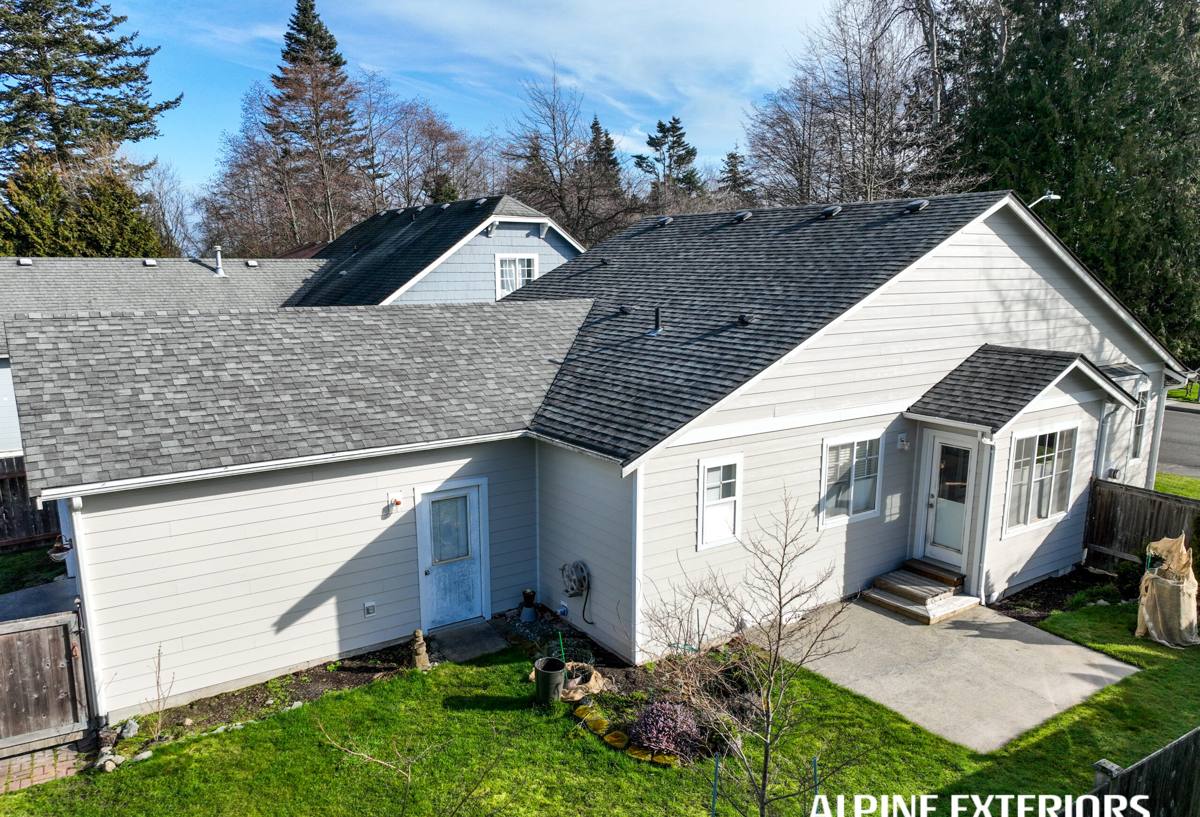
What This Climate Does to a House Over Time
Salt Air
Barkley's distance from Bellingham Bay is short enough that salt-laden air still reaches the neighborhood regularly. It's a slow corrosive process on fasteners, flashing, and lower-grade trim hardware, which is exactly why it's easy to dismiss — the damage accumulates for years before rust streaks or loosened trim make it visible.
Driving Rain
Storms in this part of the Pacific Northwest typically come in with real wind behind them, which pushes rain sideways into siding laps, window flashing, and every seam where two building elements meet. A siding assembly rated for calm, straight-down rainfall can still leak here if the house wrap and flashing weren't detailed for wind-driven moisture. That distinction, more than the siding material itself, is usually what separates a wall assembly that lasts decades from one that starts leaking within a few wet seasons.
A Long Moss Season
Mild temperatures, consistent humidity, and heavy tree cover across Bellingham give moss and algae a growing window that runs close to year-round on shaded, north-facing surfaces. Moss doesn't just look bad — it holds moisture against the wall far longer than open air would, and on a moisture-sensitive substrate that sustained dampness is what eventually turns into soft spots and rot rather than staying a surface-level nuisance.
Why We Install Only James Hardie Fiber Cement
Facing those three pressures, we made a deliberate decision to install one siding system rather than carry a catalog of brands. Spreading a crew thin across several products means shallower expertise in each one; standardizing on a single system means every install gets done to the same high standard. James Hardie's fiber cement resists the swelling and edge-softening that wood-based products can show under sustained moisture exposure, it's non-combustible, and its ColorPlus finish is factory-applied and cured under controlled conditions rather than painted on site — which matters in a climate where field-applied paint has a narrow, unreliable curing window.
| Product | Trade-off in this climate |
|---|---|
| Vinyl siding | Prone to warping and cracking under UV and temperature swings; panel seams give wind-driven rain a way in |
| LP SmartSide / engineered wood | Wood-strand core is more sensitive to moisture at cut edges and fastener points than fiber cement |
| Primed spruce or cedar | Requires ongoing paint and moisture upkeep to avoid rot; a heavier long-term cost than the sticker price implies |
| Other fiber cement brands | May not offer a climate-specific HZ-style formulation or the same factory-finish warranty depth as James Hardie |
None of that means these products can't be installed well elsewhere — they're trade-offs we've decided not to install and then have to stand behind in a climate this consistently wet. Hardie's HZ5 formulation, engineered for regions with heavy moisture exposure and freeze-thaw cycling rather than desert heat or hurricane wind, is a close match for what Barkley homes actually deal with year-round.
How a Siding Project Runs on a Barkley Home
Inspection and Estimate
Every project starts with a real look at the house — current siding condition, any signs of trapped moisture, and how sun, shade, and wind exposure vary wall to wall. The estimate comes from that inspection, not a flat per-square-foot number quoted sight-unseen.
Tear-Off and Substrate Check
Once old siding comes off, we check the sheathing underneath before anything new goes up. Installing new siding over damaged sheathing just buries a problem that keeps getting worse behind the wall — we'd rather find and price it honestly now than have it resurface later as a bigger job.
Weather Barrier and Flashing Detail
Most of the siding failures we see in Whatcom County trace back to water getting behind the cladding, not through it. That makes the house wrap, window flashing, and every wall penetration the part of the job that's easiest to rush and hardest to inspect once new siding is up, so we treat it as the most important step rather than an afterthought.
Installation to Manufacturer Spec
James Hardie publishes specific fastening patterns, clearances, and caulking guidance, and following it exactly is what keeps the manufacturer's warranty intact and the siding performing as engineered. Correct nail spacing, proper gapping at butt joints, and keeping the bottom edge clear of grade all matter more in a wet climate than a dry one, where small shortcuts don't get exposed as quickly.
ColorPlus Finish and Final Detailing
Because the color coat is factory-applied and cured, touch-up at cut edges uses Hardie's matched touch-up product rather than field-mixed paint. That keeps the finish consistent and avoids introducing a weaker, unbaked paint layer at exactly the joints most exposed to weather.
James Hardie Product Lines We Work With
James Hardie makes several distinct profiles, and which one fits a given Barkley home usually comes down to its architectural style and how much wall surface sits exposed to direct weather.
| Product line | Typical use |
|---|---|
| HardiePlank lap siding | The most common choice for traditional and craftsman-style homes; horizontal lap profile in several widths and textures |
| HardieShingle | A shingle-style profile for homes wanting a staggered or straight-edge textured look |
| HardiePanel | Vertical panel siding, often used for accent sections, gables, or more contemporary designs |
| HardieTrim | Fiber cement trim boards for windows, corners, and fascia that match the siding's durability |
Color runs through Hardie's ColorPlus palette, engineered to hold its finish under sustained UV exposure without the fading that field-applied paint typically shows within its first several years.
Roofing, Windows, and Decks While We're There
Because water intrusion at a roofline, window, or deck ledger board so often ends up as siding damage a few feet away, it makes sense for one crew to handle all four systems instead of coordinating between separate contractors who each only see their own piece of the house. If we're already at a Barkley home replacing siding, checking flashing at roof-to-wall transitions or around window openings adds very little to the project and can catch a problem before it turns into a much larger repair. The same logic applies to deck ledger connections, a common and often-overlooked source of hidden moisture damage against the house.
Signs a Barkley Home's Siding Needs Attention
- Soft or spongy spots when pressed, especially near the bottom courses or under windows
- Persistent moss or dark streaking on north-facing or heavily shaded walls
- Paint that's peeling, bubbling, or wearing unevenly — often a sign of moisture trapped behind the surface
- Visible gaps, warping, or separation at seams and corner boards
- Rust staining running down from nail heads or metal trim
- A musty smell or visible staining on interior walls sharing an exterior wall with a problem area
What Affects Siding Cost on a Barkley Property
| Factor | Why it matters |
|---|---|
| Home size and wall complexity | More corners, dormers, and cutouts mean more material waste and labor time than a simple footprint |
| Sheathing condition | Rot found during tear-off adds repair scope that can't be priced until the old siding is off |
| Siding profile and accessories | Lap width, trim detail, and any shingle or panel accents affect both material and labor cost |
| Access and site conditions | Tight setbacks or limited staging space can add time and equipment cost |
| Tear-off vs. new construction | Removing and disposing of old siding is a labor step new-construction siding doesn't require |
We walk through these factors during the estimate rather than quoting a flat number sight-unseen, since two homes of similar size can land at meaningfully different costs depending on condition and complexity.
Why a Local Crew Matters
A contractor who works this specific climate regularly, not occasionally, tends to catch details a generic install misses: which lots hold shade and moss longest, how much clearance a given wall needs at grade, which flashing details tend to fail first through a Bellingham winter. We handle permitting as part of the project too, which matters in a county where requirements and processing can vary by jurisdiction and scope. A local crew is also easier to reach years down the line if a warranty question or minor issue comes up — not a name from an out-of-area lead service that stops answering once final payment clears.
Maintenance Checklist for Barkley Homeowners
- Rinse siding annually, especially on shaded or north-facing walls where moss tends to build up
- Keep gutters clear so overflow doesn't run down the siding face or pool at the base of a wall
- Trim back vegetation that keeps a section of wall in constant shade and moisture
- Check caulking at trim joints and penetrations every year or two, since gaps let water behind siding long before any visible damage shows
- Check the bottom courses of siding periodically for softness or discoloration, since ground-level moisture exposure is the most common failure point
- Address small issues, like a loose piece of trim or a cracked caulk joint, promptly, since minor gaps are cheap to fix and expensive to ignore
If your Barkley home's siding is showing wear, or you're just planning ahead, we're glad to walk the property with you and put together a straightforward estimate — no pressure, no hard sell. Use the form below to request a free estimate.