 Whatcom County
Windows in Barkley Take a Different Kind of Beating
Barkley sits close enough to the water and the marine weather patterns that roll through Whatcom County that its homes deal with a specific combination of stresses most window manufacturers don't design for on a nationwide basis: salt-laden air, wind-driven rain that hits window assemblies sideways rather than straight down, and a long stretch of the year where moisture just sits against the building envelope instead of drying out. None of that is dramatic on its own. It's the accumulation that causes problems — seals that fail a few years early, frames that hold moisture longer than they should, and hardware that corrodes faster than it would fifty miles inland.
Homes in this area were also built across a range of decades, so we see everything from older aluminum-framed single-pane units to builder-grade vinyl windows installed during a remodel that was done to a budget rather than to the climate. Replacing a window here isn't just a swap — it's a chance to correct whatever the original installation got wrong for this specific environment.
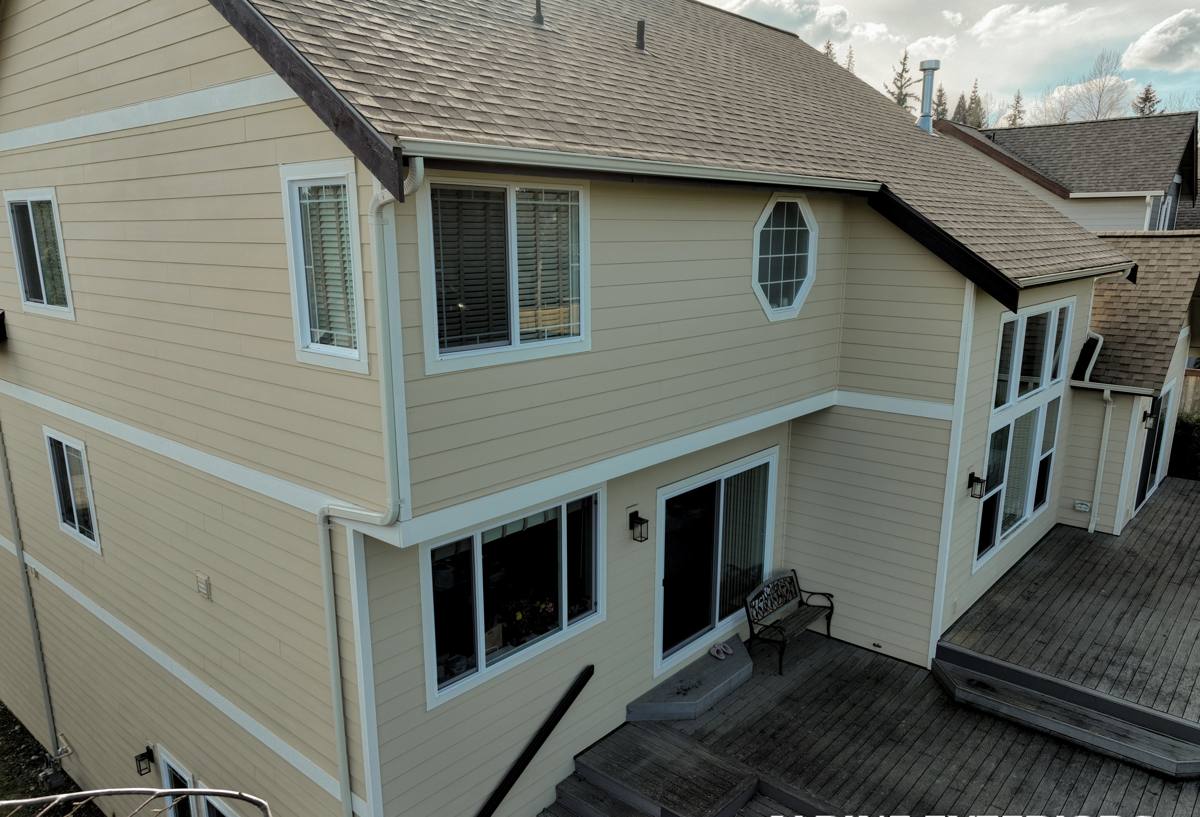
Signs Your Windows Are Losing the Fight
Most homeowners don't think about window replacement until something forces the issue, but by the time a window is obviously failing, it's often been letting moisture into the wall assembly for a while. Here's what we look for and what you can check yourself:
- Fogging or a permanent haze between panes on double- or triple-glazed units — this means the seal has failed and the gas fill (or just the dry air) has been replaced by humid air
- Soft or discolored trim, sill, or drywall near the window, especially on walls that face prevailing wind and rain
- Visible moss or dark streaking on the frame or the siding directly below the window — a sign water is running down the face of the wall instead of shedding cleanly
- Windows that are hard to open, don't latch fully, or rattle in wind — often a sign the frame has racked slightly or the hardware has corroded
- A noticeable draft or cold spot near the window even when it's fully closed
- Noticeably higher heating bills compared to similarly sized homes nearby
Any one of these can be a minor fix. Several together, especially paired with visible moisture damage, usually means the window and the flashing around it need to be replaced as a unit, not patched.
What a Correct Window Replacement Actually Involves
The window itself is only part of the job. The bigger factor in how long a replacement lasts — especially in a climate that sees this much horizontal rain — is how the opening is prepared and sealed before the new unit ever goes in.
Removal and Inspection
We remove the old window carefully and inspect the rough opening before doing anything else. This is where we find out whether the wall sheathing, sill, and framing underneath are sound or whether there's hidden rot or old water staining that needs to be addressed first. Skipping this step is the single most common reason a "new" window ends up with the same problems as the old one within a few years.
Sill Pan and Flashing
A sill pan creates a sloped, waterproof pocket at the bottom of the opening so any water that does get past the window has somewhere to go — out, not into the wall. Flashing tape and building paper are integrated in the correct shingle-lap order (each layer overlapping the one below it) so water sheds down and out rather than working its way behind the siding. This detail matters more here than in drier climates, because wind-driven rain will find any shortcut in the flashing sequence.
Setting, Shimming, and Insulating
The new window is set level and plumb, shimmed at the manufacturer's specified points (not just wherever it happens to sit tight), and fastened per the manufacturer's instructions — which matters for both structural performance and warranty coverage. The gap between the window frame and the rough opening is insulated with a low-expansion foam or backer rod and sealant, never packed solid with standard spray foam, which can bow the frame and cause the window to bind or fail to seal properly.
Interior and Exterior Sealing
Exterior caulking is applied at the correct joints only — sealing every seam on all four sides can actually trap moisture that gets in from elsewhere, which is a common mistake on older installations in this area. Interior trim is reset and sealed with attention to keeping the air barrier continuous.
Choosing a Window Frame for This Climate
There's no single "best" window material for every home, but some perform noticeably better than others under salt air and constant rain exposure. We'll talk through your specific situation, but here's the general trade-off picture we walk Barkley homeowners through:
| Frame Material | How It Handles Salt Air & Moisture | Maintenance | Typical Trade-Offs |
|---|---|---|---|
| Vinyl | Good — won't corrode or rot, though cheaper vinyl can become brittle with UV and temperature cycling over many years | Low | Limited color options once installed; quality varies a lot between manufacturers |
| Fiberglass | Very good — dimensionally stable, resists both moisture and salt corrosion well | Low | Higher upfront cost than vinyl |
| Wood-clad | Fair to good if the cladding is intact — real wood underneath is vulnerable if any water gets behind the cladding | Moderate to high | Highest maintenance sensitivity; we're cautious recommending exposed wood on rain-facing walls here |
| Aluminum (older/uncoated) | Poor — aluminum conducts cold and can corrode or pit over time near salt air, this is largely why so many original aluminum windows in the area are being replaced now | Low, but doesn't stop degradation | Highly conductive, so it performs poorly for energy efficiency even when structurally fine |
We don't push a single brand or material on every job. What we will steer you away from is any product or detail where the maintenance burden or moisture sensitivity is genuinely mismatched with what this climate demands — that's a professional judgment call, not a sales pitch.
Glass and Hardware Details Worth Knowing About
The frame gets most of the attention, but glass package and hardware decisions matter just as much for a long-term result in this area.
Double-pane glass with a low-E coating and an argon or krypton fill is the standard baseline for energy performance today, and it's worth it here given the number of gray, overcast months. Triple-pane is available and does offer a further step up in insulation and sound dampening, but it adds weight and cost — we'll tell you honestly whether that upgrade makes sense for your specific window sizes and orientation rather than defaulting to upselling it.
Hardware — locks, hinges, and operators — should be stainless steel or another corrosion-resistant alloy on any home this close to salt air. Standard zinc-plated hardware can start showing surface corrosion within a few years in coastal-influenced areas, even if the window itself is performing fine. It's a small line-item difference in cost that has an outsized effect on how the window operates a decade from now.
Our Window Replacement Process
- On-site assessment — we look at each window individually, not just the house as a whole, since sun exposure and rain exposure can vary significantly wall to wall
- Honest scope and options — we tell you which windows need full replacement versus which could be serviced, and walk through frame and glass options suited to your budget and the wall's exposure
- Written estimate — clear pricing, no vague allowances
- Scheduling — we plan around the weather where we can, since a dry install window matters for sealing quality
- Removal, prep, and flashing — done to the standard described above, including addressing any hidden rot found in the opening
- Installation and sealing — set, insulated, and sealed correctly inside and out
- Walkthrough — we test every window with you before we consider the job done
What Window Replacement Typically Costs
Pricing depends on window size, frame material, glass package, and how much prep work the opening needs — a straightforward swap into a sound opening costs less than one where we find rot or an out-of-square frame underneath. Broad ranges help with planning, but every home is different enough that we'd rather give you an exact number after a walkthrough than a number that doesn't hold up.
| Factor | Why It Moves the Price |
|---|---|
| Window size and type (single-hung, casement, etc.) | Larger and more complex operating hardware costs more in both material and labor |
| Frame material | Vinyl, fiberglass, and wood-clad sit at different price points as noted above |
| Glass package | Double-pane low-E is standard; triple-pane and specialty coatings add cost |
| Condition of the rough opening | Hidden rot or water damage found during removal adds repair scope before the new window can go in |
| Number of windows done at once | Doing several windows in one visit is more efficient per window than one-off replacements |
Why It's Worth Hiring a Crew That Already Works in Barkley
A window replacement crew that works across Whatcom County regularly already knows how local wind and rain patterns tend to load a wall, which sides of a house typically take the worst of it, and what kind of hidden moisture damage tends to show up in homes of a given age or construction type in this area. That's not something you can fully compensate for by reading a manufacturer's install manual — it comes from having opened up enough walls in this specific climate to know where problems actually hide.
It also means faster, more accurate estimates, because we're not guessing at how the local weather has treated your home — we've seen the pattern before on the next street over.
Keeping New Windows Performing for the Long Haul
A correctly installed window still benefits from basic upkeep, especially here where moss and moisture are a constant presence for months at a time:
- Rinse frames and tracks periodically to clear salt residue and organic buildup before it holds moisture against the frame
- Check exterior caulking once a year for cracking or separation, particularly on walls that face prevailing wind and rain
- Clear debris and moss from window wells and sills so water doesn't pool against the frame
- Operate every window a few times a year, even ones you don't normally open, so hardware doesn't seize
- Watch for any soft trim or new staining after a hard storm, and address it early rather than waiting
If you're weighing whether your current windows need attention or full replacement, we're happy to take a look and give you a straight answer either way. Reach out for a free, no-pressure estimate — there's a form below.