 Whatcom County
 Siding in Fairhaven: A Neighborhood Built Right Against the Water
Fairhaven sits close enough to Bellingham Bay that the water is part of daily life for the people who live there — and part of what your siding has to fight every single day. Homes in this part of Whatcom County deal with a combination that's tough on exteriors: salt-laden air rolling off the bay, driving rain that comes in sideways during winter storms, and a long, damp shoulder season that gives moss and algae months to get established on anything that stays wet. A lot of Fairhaven's housing stock is older, too, which means many homes are due for a second or third round of siding in their lifetime — and the material chosen this time matters more than it did the last.
We're a local siding, roofing, window, and deck contractor working throughout Whatcom County, and Fairhaven is a neighborhood we know well. This page walks through what the climate actually does to exteriors here, how our siding process works, and why we install James Hardie fiber cement exclusively rather than offering a menu of siding brands.
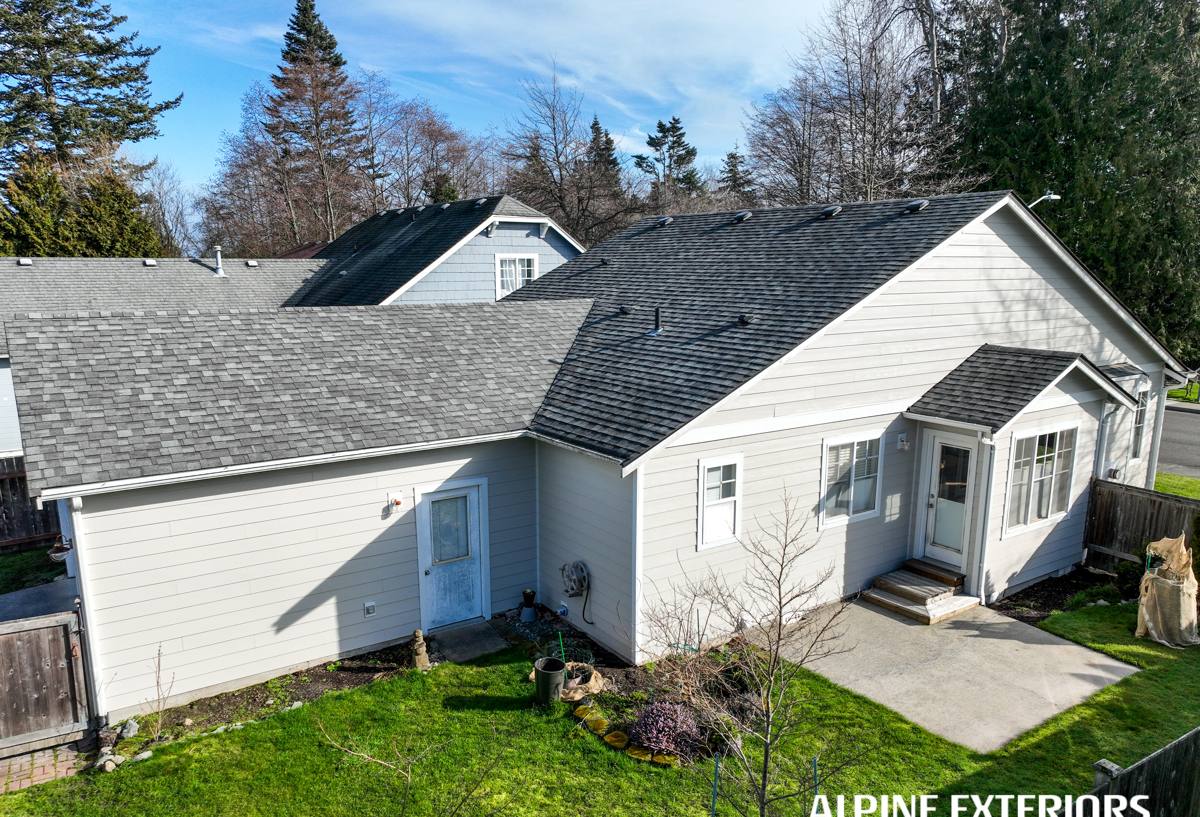
What Fairhaven's Climate Does to a House
Salt Air and Marine Moisture
Proximity to the bay means airborne salt and near-constant marine humidity. Salt accelerates corrosion of fasteners and trim metal, and it interacts with cheaper siding coatings in ways that shorten their useful life. It also means paint films are working harder here than they would twenty or thirty miles inland — moisture doesn't just fall as rain, it's often just sitting in the air.
Driving Rain
Whatcom County storms frequently come with real wind behind them, which pushes rain horizontally into wall assemblies rather than letting it run straight down and off. That means the siding on a home's west- and south-facing walls, and anything under an eave that isn't especially deep, takes a harder hit than the same product would on a calmer site. Seams, laps, and butt joints are where driving rain finds weaknesses — which is why installation detail matters as much as the product itself.
Moss and Algae Season
Shade from mature trees, marine humidity, and short winter days add up to a long window — often several months — where siding surfaces simply don't dry out fast enough between rain events. That's exactly the environment moss, algae, and mildew need. Materials that hold moisture at the surface, or that have seams and edges where organic growth can get a foothold, will show it here faster than they would in a drier climate.
How These Conditions Show Up on Real Homes
- Green or black streaking on north-facing walls and anywhere shaded by trees or neighboring structures
- Paint or coating failure appearing first at butt joints, corners, and fastener heads
- Soft or swollen siding near grade level or in low-airflow areas where water sits longest
- Rust bleed from corroding fasteners or trim hardware, especially closer to the water
- Caulk joints failing years before the siding itself, letting moisture behind the cladding
None of this is unusual for the area — it's what a marine climate does over time. The question isn't whether a home's siding will be tested, it's whether the material and the installation were built to handle it.
Why We Install Only James Hardie Fiber Cement
We used to get asked why we don't offer vinyl, LP SmartSide, or other fiber cement brands like Cemplank or Allura. The honest answer is that after years of doing tear-offs and repairs across Whatcom County, we standardized on one product system because it holds up better in this specific climate, not because it's the cheapest or the easiest to install.
Where the alternatives fall short here
Vinyl siding is affordable and easy to install, but it's a thin plastic product that expands and contracts with temperature swings, can crack in impacts, and relies on its color being baked all the way through — which fades over time regardless. In a marine environment, the panels themselves generally don't rot, but the seams and the way vinyl is hung (with expansion gaps, not sealed joints) make it a weaker barrier against driving rain than a properly installed fiber cement system.
LP SmartSide is an engineered wood product. It performs reasonably well when it's kept dry and coated correctly, but it's still wood at its core — meaning any breach in the coating or a joint that isn't sealed right becomes an entry point for moisture, and wood-based siding swells and deteriorates once water gets behind the surface. In a climate with this much sustained dampness, that's a real long-term risk, not a hypothetical one.
Primed spruce and cedar are traditional choices with real aesthetic appeal, but they're also organic material that needs consistent refinishing to keep water out, and they're naturally more attractive to moss and mildew in shaded, humid conditions. Cedar in particular can look excellent for years and then require real money in maintenance to keep looking that way.
Other fiber cement brands like Cemplank and Allura are legitimate products chemically similar to Hardie's — cement, sand, and cellulose fiber. Our decision to install Hardie specifically comes down to their factory-applied ColorPlus finish, their HZ5 product engineering for the Pacific Northwest's moisture profile, and the depth of their installer network and warranty support in this region. It's a narrower choice, but it's one we can stand behind on every job.
What James Hardie gets right for this area
- Non-combustible — fiber cement doesn't burn, which matters given wildfire smoke seasons are now a regular part of Pacific Northwest summers
- HZ5 engineering — Hardie's zone-specific formulation for the Pacific Northwest is built around this region's rain and humidity, not a generic national spec
- ColorPlus factory finish — baked-on, backed by its own finish warranty, and far more consistent than field-applied paint on wood or engineered wood siding
- Dimensionally stable — doesn't expand and contract the way vinyl or wood products do, which keeps seams and caulk lines intact longer
- Strong transferable warranty — real coverage that can matter to a future buyer if the home sells
Comparing the Options Side by Side
| Material | Moisture Behavior | Maintenance | Typical Lifespan Locally |
|---|---|---|---|
| Vinyl | Panel resists rot; seams and gaps are the weak point | Low, but fading and cracking over time | 15–25 years before replacement is common |
| LP SmartSide / engineered wood | Vulnerable once coating or joints are breached | Regular caulk/paint upkeep required | 15–25 years, shorter if maintenance lapses |
| Primed spruce / cedar | Absorbs moisture readily; needs to dry between storms | High — refinishing on a regular cycle | Highly variable, maintenance-dependent |
| James Hardie fiber cement | Engineered for wet climates; stable at seams | Low — occasional wash, no refinishing cycle | 30+ years with correct installation |
These are general ranges based on typical performance in this climate, not guarantees — actual results depend heavily on installation quality, sun and shade exposure, and upkeep.
Installation Detail Matters as Much as the Product
A lot of the siding failures we see in Whatcom County aren't a failure of the material — they're a failure of the install. Fiber cement siding, including James Hardie, has to be installed to spec to deliver on its warranty and its real-world performance: correct fastener placement, proper clearances at grade and at roof lines, correctly flashed and caulked joints, and house wrap or weather-resistant barrier detailing that actually manages water rather than trapping it. In a driving-rain, high-humidity environment like Fairhaven's, cutting corners on flashing or caulking shows up as a problem within a few years, not a few decades.
This is also where a local crew earns its keep. A contractor who works Whatcom County exteriors regularly has already seen how a given wall orientation, roofline, or shade pattern behaves over a Pacific Northwest winter, and adjusts the install accordingly — rather than following a generic national installation checklist that wasn't written with this climate in mind.
Our Process for a Fairhaven Siding Project
1. On-Site Assessment
We walk the exterior, check for existing moisture damage, evaluate trim and flashing condition, and look at sun/shade exposure on each wall — all of which affect the plan.
2. Scope and Estimate
We put together a written estimate covering siding, and where relevant, any trim, flashing, or moisture-damaged sheathing that needs attention before new siding goes on. No pressure, no rushed decisions.
3. Installation
Proper weather-resistant barrier and flashing detail, correctly fastened Hardie panels or lap siding per manufacturer spec, and attention to every joint and penetration — because that's where marine climates find weaknesses first.
4. Final Walkthrough
We review the finished work with the homeowner and make sure everything meets both our standard and theirs.
Beyond Siding: Roofing, Windows, and Decks
Siding rarely fails in isolation from the rest of the exterior. A roof that's shedding water onto a wall, windows with failed flashing, or a deck ledger board holding moisture against the house all put extra strain on siding nearby. Because we handle roofing, windows, and decks in addition to siding, we can look at a Fairhaven home's exterior as one connected system rather than patching one piece while an adjacent problem keeps working against it.
A Quick Checklist for Fairhaven Homeowners
- Check north- and shade-facing walls each fall for moss or algae buildup
- Look at caulk lines around trim, windows, and corners — cracked or missing caulk is an early warning sign
- Watch for soft spots or discoloration near the bottom courses of siding, especially near grade
- Note any rust streaking from fasteners or trim hardware
- If your current siding needs repainting or recaulking more than once every several years, it's worth having it evaluated rather than just keeping up the maintenance cycle
Let's Talk About Your Home
Every home in Fairhaven sits a little differently — some closer to the water, some more shaded, some with more wind exposure than others — and that affects what your siding needs to hold up. If you're noticing moss, failing paint, or general wear on your current siding, or you're planning ahead for a replacement, we're happy to come take a look. We'll give you a straightforward, no-pressure estimate and an honest read on what your home actually needs. Reach out using the form below to get started.