 Whatcom County
 Why Fairhaven Siding Takes a Different Approach
Fairhaven sits close enough to Bellingham Bay that salt-laden air, wind-driven rain off the water, and a long wet season all reach the siding on your home before they reach homes further inland in Whatcom County. That combination is harder on exterior materials than people expect. Salt air accelerates corrosion on fasteners and trim metal. Driving rain finds the smallest gaps at laps, corners, and penetrations. And the moss and algae that thrive in our long gray stretch from fall through spring don't just look bad — they hold moisture against the wall longer than a dry climate ever would.
None of this means Fairhaven is an unusually difficult place to side a house. It means the install has to respect the conditions instead of ignoring them. A siding job that would hold up fine in a drier part of the state can fail early here if the water management, fastening, and product choice weren't right to begin with.
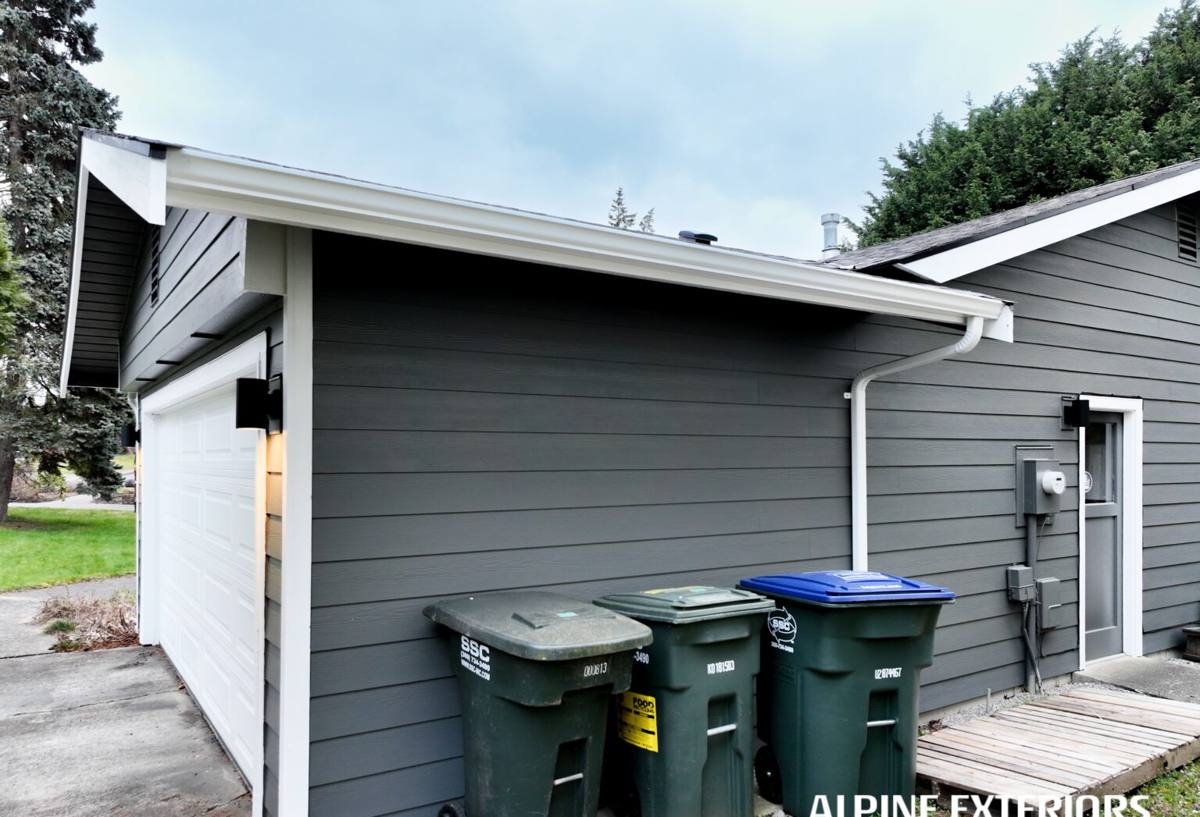
What Fairhaven Homes Actually Need From Their Siding
Moisture Management First
The biggest factor in siding longevity near the water isn't the siding material itself — it's what's behind it. A correctly built wall assembly includes a drainage plane (weather-resistive barrier), properly lapped and taped seams, flashing at every window, door, and penetration, and a rainscreen gap where conditions call for it. Siding is the last line of defense, not the only one. When we quote a Fairhaven job, the water management plan gets as much attention as the siding brand.
Material That Won't Absorb What It's Exposed To
Wood-based products swell, cup, and eventually rot when they take on repeated moisture cycles, and salt air speeds up the deterioration of a lot of paints and coatings. Whatever goes on the wall needs to be dimensionally stable when wet, resistant to moisture intrusion at the core, and finished with a coating built to hold color and integrity through repeated wet-dry cycles, not just look good on install day.
Fastening and Hardware That Can Take Salt Air
Corrosion-resistant fasteners and trim hardware matter more here than in a drier inland town. Stainless or hot-dip galvanized fasteners rated for the exposure, and trim details that don't trap water against bare metal, are a small line item that prevents a big future problem — rust streaking, loosened boards, and failed connections years before they should happen.
A Practical Checklist for What a Correct Fairhaven Install Includes
- Weather-resistive barrier installed and lapped correctly, shingle-style, over the sheathing
- Flashing at every window, door, deck ledger, and wall penetration — no exceptions
- Rainscreen or drainage gap behind the siding where wall assembly and code call for it
- Corrosion-resistant fasteners driven to manufacturer spec, not overdriven or underdriven
- Factory-finished siding with a coating warranty against fading and peeling, not field-painted wood
- Proper clearance from grade, decks, and roof lines to keep splashback and standing water off the siding
- Caulking and sealant only where the manufacturer specifies it — not as a substitute for flashing
Why We Install Only James Hardie Fiber Cement
We don't install vinyl, LP SmartSide, primed spruce, cedar, or other fiber cement brands like Cemplank or Allura. That's a deliberate standard, not a sales preference, and it matters even more in a marine-influenced climate like Fairhaven's.
Fiber cement as a category resists moisture absorption and dimensional swelling far better than wood-based siding, which is the failure mode we see most often near the water. James Hardie's HardieZone system goes a step further by engineering specific product formulations for climate exposure — the HZ10 line used in the Pacific Northwest is built for our wet, moderate-humidity conditions rather than a one-size-fits-all national spec.
James Hardie's ColorPlus finish is baked on in a factory-controlled process, which gives it more consistent coverage and better fade and moisture resistance than field-applied paint, and it carries its own finish warranty separate from the substrate warranty. The material itself is non-combustible, which is a genuine advantage for wildfire-adjacent risk even in a wetter part of the state, and it holds up to the freeze-thaw and wet cycles Whatcom County sees through the winter without the swelling and rot risk of wood-based panel products.
We're not going to tell you other products are junk — vinyl and engineered wood both have legitimate use cases and price points that work for some homeowners. But we standardized on one product line because we'd rather install one system correctly and stand behind it fully than spread our crews thin across several materials with different failure modes, different warranty structures, and different installation tolerances. Hardie is what we've found delivers the best long-term result for homes in this specific climate, and it's the only thing we put our name on.
How Our Fairhaven Siding Process Works
1. On-Site Assessment
We look at your current siding and wall assembly, check for existing moisture damage, note drainage and grading issues around the foundation, and identify anything — old flashing, rotted sheathing, undersized overhangs — that needs to be addressed before new siding goes on. Covering up an existing moisture problem with new siding just delays the damage.
2. Detailed Written Estimate
You get a scope that spells out the Hardie product line, profile, and color, the underlying weather-resistive barrier and flashing plan, and the fastening approach — not just a square-footage price. This is also the point where any deck ledgers, trim carpentry, or structural repairs get scoped separately so there are no surprises mid-job.
3. Tear-Off and Prep
We remove the old siding, inspect the sheathing underneath for rot or damage, repair or replace anything compromised, and install the water-resistive barrier and flashing system correctly before a single piece of new siding goes up.
4. Installation to Manufacturer Spec
James Hardie has specific fastening patterns, clearances, and joint treatments for each product line, and following them to the letter is what keeps the manufacturer's warranty valid. This is also where the difference between a crew that regularly installs Hardie and one that occasionally does it really shows up.
5. Final Walkthrough
We walk the finished job with you, check caulking and trim details, confirm clearances from grade and hard surfaces, and make sure you understand basic maintenance going forward.
What Correct Installation Costs You If It's Skipped
| Detail Skipped or Done Wrong | What Happens in Fairhaven's Climate |
|---|---|
| Missing or poor window/door flashing | Water intrusion behind siding, hidden sheathing rot, mold risk |
| No rainscreen/drainage gap where needed | Trapped moisture against the wall, slower drying between rain events |
| Standard fasteners instead of corrosion-resistant | Rust streaking, loosened boards, premature fastener failure |
| Field-painted wood siding instead of factory finish | Faster fading, peeling, and repainting cycles from salt air and moisture |
| Siding installed too close to grade or decks | Constant splashback keeps the bottom courses wet, inviting moss and rot |
| Overdriven fastener nailing | Voided manufacturer warranty and boards that can crack or work loose |
Dealing With Moss and Algae Long-Term
No siding material is moss-proof — moss and algae grow on the surface film of grime and moisture, not by consuming the material underneath, so this is really a maintenance question more than a product question. Where siding choice matters is how the material and finish respond to the cleaning that moss control requires. James Hardie's factory finish tolerates gentle washing far better over time than field-applied paint, and the material itself won't take on damage from routine cleaning the way some wood-based sidings can. Keeping gutters clear, trimming back vegetation that shades the wall, and washing the siding periodically with a soft approach — not high-pressure blasting that can drive water behind laps — goes a long way toward keeping growth in check between major cleanings.
Why a Fairhaven-Familiar Crew Matters
A crew that regularly works this part of Whatcom County has already seen how the local exposure plays out over years, not just on install day. That means knowing which wall orientations take the worst of the wind-driven rain, where moss tends to build up fastest, and which older homes in the area are more likely to have flashing or sheathing issues hiding under the existing siding. It also means we're a known, findable local business if you ever have a warranty question or a maintenance issue down the road — not a crew that worked one job in the neighborhood and moved on.
Get a Straightforward Estimate
If your Fairhaven home's siding is showing moss buildup, fading, soft spots, or you're just planning ahead, we're glad to take a look and give you an honest read on what it needs. The estimate is free, there's no pressure, and you'll get a clear explanation of what we find and why we recommend what we recommend — fill out the form below to get started.