 Whatcom County
 Building New in Barkley: What Whatcom County Weather Actually Does to Windows
Barkley sits close enough to Bellingham Bay that salt-laden air is a constant, low-grade stressor on exterior materials — it accelerates corrosion on hardware, fasteners, and lesser window frames faster than homeowners inland ever have to think about. Layer on the driving rain that comes sideways off Whatcom County storms, plus a moss season that can run from October through May in shaded, north-facing exposures, and you get a climate that punishes shortcuts. On a new build, this matters more than on a remodel, because whatever gets built into the wall assembly around each window opening is going to be sealed behind siding and trim for decades. There's no "we'll fix it later" on a new-construction window install — you get one shot at the flashing, the sill pan, and the air seal before the wall closes up.
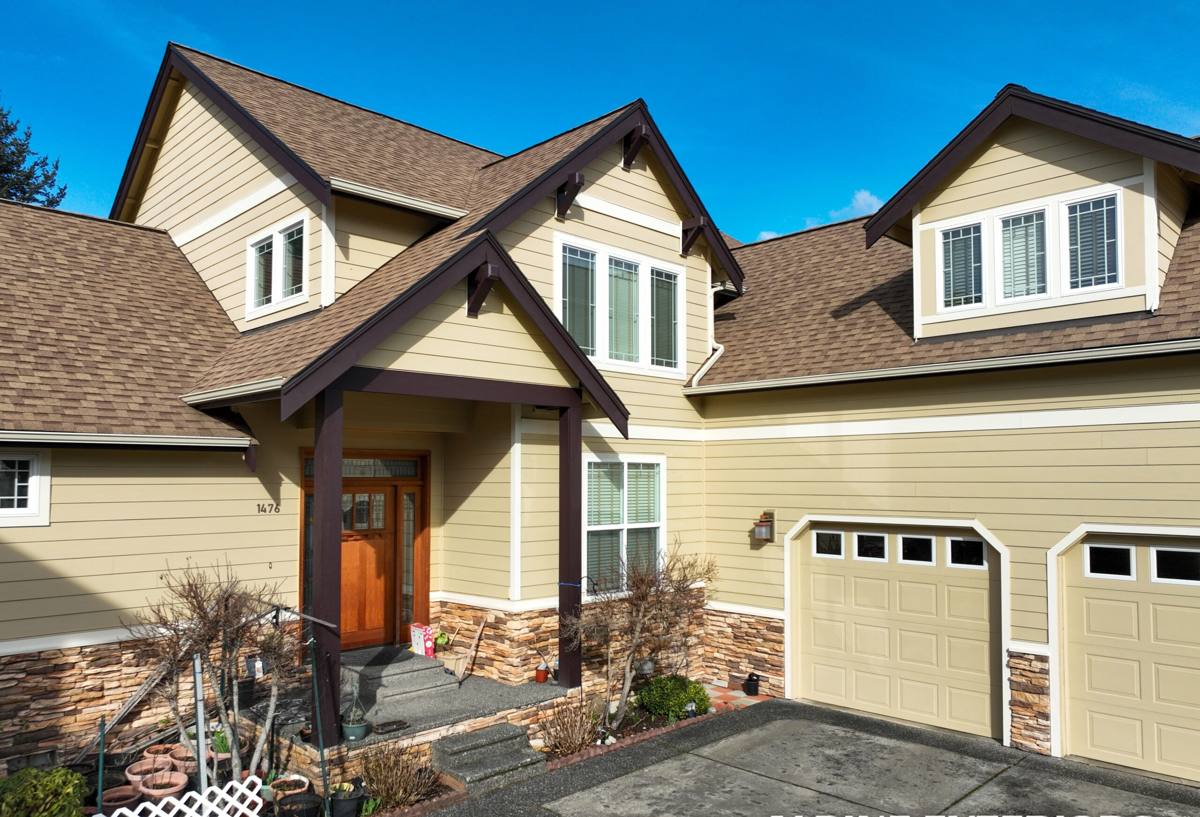
What "New-Construction" Windows Actually Means
New-construction windows are built with a nailing flange (also called a nail fin) around the perimeter of the frame. That flange gets integrated directly into the wall's weather-resistive barrier (WRB) and flashing system before siding goes on — it's a fundamentally different install method than a replacement window, which gets fitted into an existing finished opening from the outside without disturbing the wall assembly. On a Barkley new build, this is the correct window type almost every time, because it lets us build a proper shingle-lap flashing sequence: sill pan first, then the window, then side flashing, then head flashing, each layer overlapping the one below it so water always sheds outward and down, never behind the layer beneath it.
Getting this sequence backwards — even by one layer — is one of the most common causes of hidden water intrusion in new construction, and it's invisible from the outside until the sheetrock or sheathing starts showing damage years later.
Rough Opening Prep
Before a window ever goes into the opening, we check that the rough opening is square, level, and sized correctly with the manufacturer's tolerances — typically a small gap (often around 1/4 to 1/2 inch) on all sides for shimming and expansion. We also confirm the sheathing and WRB are lapped correctly at that point in the wall before the window arrives, since fixing sequencing errors after the fact is far more expensive than catching them during framing walk-through.
Getting the Flashing Right: The Part That Determines Whether Windows Leak
Flashing is the unglamorous part of a window install, and it's the part that actually keeps water out. Whatcom County's wind-driven rain means water gets pushed sideways and even slightly upward against exterior walls during storms — a flat, gravity-only flashing detail that would be adequate in a drier climate isn't reliable here.
- Sill pan flashing — a sloped, dammed pan under the window that catches any water that gets past the frame and directs it back outside, not into the wall cavity.
- Jamb (side) flashing — tape or flexible flashing that laps over the nailing flange on both sides, tying into the WRB.
- Head flashing — installed last, lapping over the top flange and the WRB above it, often with a drip cap or diverter to kick water away from the top of the frame.
- Backer rod and sealant — a compatible, weatherable sealant at the interior and exterior gaps, sized correctly rather than just caulked over as an afterthought.
Every layer in that sequence has to overlap the one below it — shingle-style — so gravity always carries water outward. We also check compatibility between the window manufacturer's flashing instructions and whatever WRB and tape the builder has spec'd, since not every tape adheres reliably to every housewrap in cold, damp installation conditions, which is common on Whatcom County job sites much of the year.
Choosing Window Frame Material for a Damp, Salt-Air Climate
Frame material affects how a window holds up to years of moisture cycling, condensation, and salt air. There's no single "best" answer for every build — it depends on budget, the home's design, and how much long-term maintenance the owner wants to take on.
| Material | Moisture & Salt-Air Resistance | Maintenance | Typical Cost Position |
|---|---|---|---|
| Vinyl | Very good — won't corrode or rot, handles damp climates well | Low — no painting or sealing needed | Lower to mid |
| Fiberglass | Excellent — dimensionally stable, resists moisture and salt exposure | Low — factory finish holds up well | Mid to higher |
| Wood-clad (exterior clad, interior wood) | Good exterior protection if cladding and flashing are correct; interior wood needs a dry, sealed environment | Moderate — exterior is low-maintenance, interior wood benefits from periodic finish care | Higher |
| Aluminum | Fair — durable but conducts cold and can show condensation in our damp winters without a thermal break | Low, but condensation management matters | Mid |
For most Barkley-area new builds, we steer clients toward vinyl or fiberglass unless the design specifically calls for a wood interior look — both hold up well to salt air and repeated wet-dry cycling without the upkeep that solid wood or bare aluminum frames demand in this climate.
Energy Performance: U-Factor and Solar Heat Gain for Our Climate Zone
Whatcom County falls in a marine climate zone where heating load matters more than cooling load most of the year. Washington's state energy code sets minimum performance requirements for new-construction windows, and those requirements are generally more demanding than what you'd see in a milder or drier region — so the window package spec'd for a Barkley build needs to meet code, not just "look similar" to what worked somewhere else. Two numbers matter most:
- U-factor — how well the window resists heat loss; lower is better for our heating-dominated climate.
- Solar heat gain coefficient (SHGC) — how much solar heat passes through the glass; less critical here than in sunnier climates, but still relevant on south- and west-facing elevations.
We work from whatever window schedule the builder or architect has specified, but if a spec looks off for our climate zone or a value seems mismatched to the orientation of the home, we'll flag it before ordering — swapping glass packages after windows are built is expensive and slow.
Our Install Process on New-Construction Sites
New-construction window work happens on the builder's schedule, which means coordination matters as much as install quality. Our general sequence on a Barkley job:
- Confirm rough openings against the approved window schedule before windows are ordered.
- Verify WRB is installed and lapped correctly at each opening prior to window set.
- Install sill pan flashing, set the window plumb, level, and square, and fasten per manufacturer spec.
- Complete jamb and head flashing in proper shingle-lap sequence.
- Seal and insulate the interior gap per code and manufacturer instructions.
- Document each opening (often with photos) before siding covers the flashing work — useful for the builder, the inspector, and the homeowner's records.
That documentation step matters more here than people expect. Once siding goes on, the flashing work is invisible for the life of the house — having a record of what's behind the wall is worth having if a moisture issue ever needs to be traced years down the line.
New-Construction Window Checklist for Homeowners Working with a Builder
- Confirm the window schedule lists U-factor and SHGC values, not just brand and size.
- Ask whether sill pan flashing is included in the install scope — it's sometimes skipped to save time.
- Confirm the WRB and flashing tape are documented as compatible by the manufacturer.
- Ask for photos of flashing work before siding closes over it.
- Confirm frame material matches the home's exposure — more shelter needed on north/west walls facing prevailing weather.
Why a Local Whatcom County Crew Matters on This Job
New-construction window flashing isn't complicated in theory, but it's easy to get subtly wrong in a way that only shows up years later. A crew that works Whatcom County regularly has already seen how local wind-driven rain, salt air, and moss growth interact with different flashing details and frame materials over time — that's knowledge you don't get from a manufacturer's install manual alone. We also know the practical realities of building here: how often job sites are working in damp conditions that affect tape adhesion, which local inspectors focus on which details, and how Barkley's mix of infill and newer-build lots tends to be laid out relative to prevailing weather exposure.
Common Mistakes We See on New Builds in This Climate
A few issues show up repeatedly on new-construction sites in wetter coastal climates like ours, regardless of who built the house:
- Skipping or under-building the sill pan, relying on sealant alone to keep water out.
- Flashing installed out of sequence, so water gets directed behind a layer instead of over it.
- Housewrap and flashing tape combinations that aren't verified compatible, leading to adhesion failure in damp install conditions.
- Ignoring moss and algae growth potential on shaded elevations when selecting sill and trim details, leading to trapped moisture over time.
None of these are exotic problems — they're just details that get missed when a crew is moving fast on a schedule and isn't specifically used to building for this climate.
Coordinating with Your Builder's Timeline
Window install on a new build has to happen in a fairly tight window between framing/WRB completion and siding start — too early and the wall isn't ready, too late and it holds up the whole exterior schedule. We work directly with builders and general contractors on Barkley-area projects to slot window install where it fits, and we flag any rough-opening or sequencing issues as early as possible so they don't turn into delays once siding crews are standing by.
If you're building in Barkley or elsewhere in Whatcom County and want a straightforward look at what a correct new-construction window install involves for your specific plans, we're happy to walk through the window schedule with you or your builder. Reach out for a free, no-pressure estimate using the form below.