 Whatcom County
 Why Bellingham Siding Takes a Different Approach
Bellingham sits where the marine climate of the Salish Sea meets the wet, mossy hillsides of Whatcom County, and that combination is hard on exterior siding. Homes close to the water deal with salt-laden air that accelerates corrosion on fasteners and trim. Homes tucked under tree cover deal with shade, damp bark mulch beds, and moss that creeps up siding from the bottom edge. Almost every house in the area deals with driving rain that comes in sideways during fall and winter storms, testing every seam, corner, and flashing detail a siding installer puts in. A siding job that would hold up fine in a dry inland climate can fail here in five to ten years if it wasn't built for this specific environment.
That's the lens we bring to every Bellingham siding installation: not "what siding looks good," but "what siding and what installation detailing will actually survive a Whatcom County winter, year after year, without babysitting."
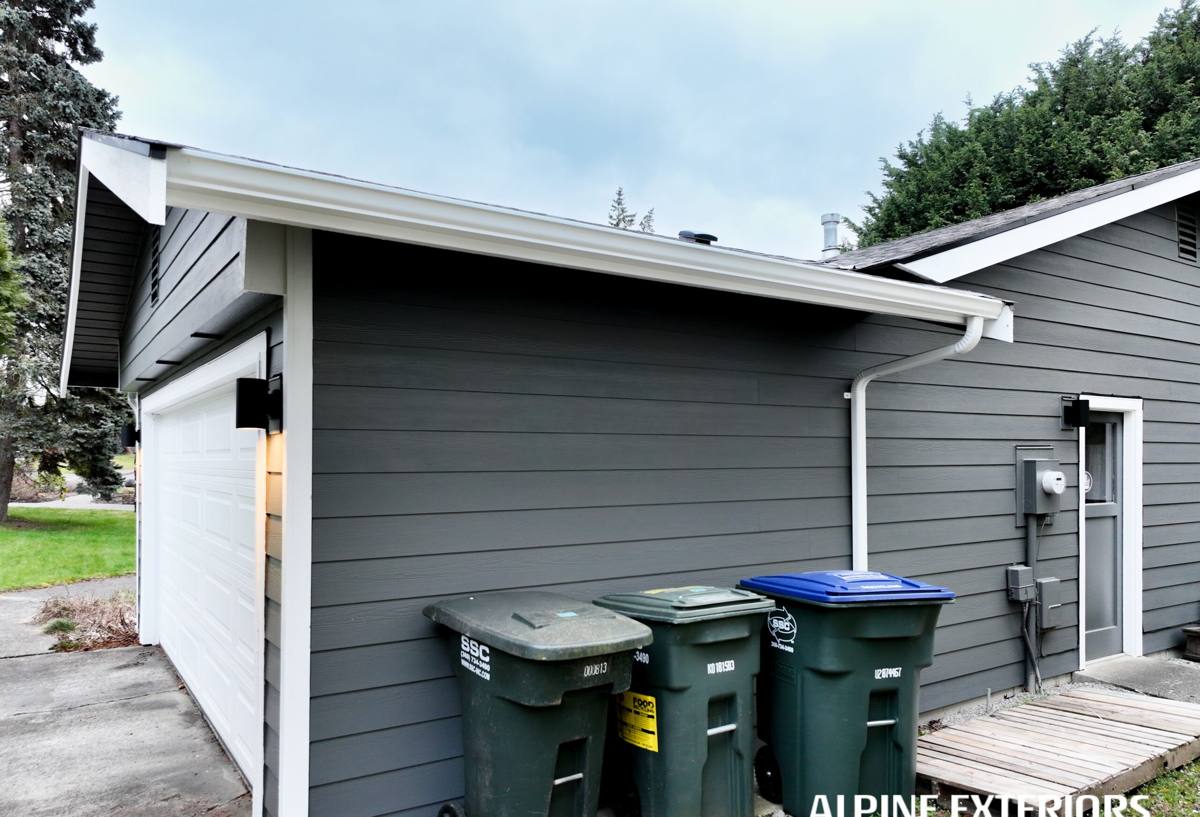
What Whatcom County Weather Does to Siding Over Time
Moisture Is the Constant Threat
Bellingham gets a long stretch of wet months where siding rarely gets a chance to fully dry out between rain events. Materials and installation methods that trap moisture behind the cladding, or that swell and soften when saturated, are working against the climate instead of with it. Any siding installed here needs a drainage plane behind it and correct flashing at every window, door, and penetration so water that gets behind the siding has somewhere to go.
Moss and Organic Growth
Shaded siding, especially on north-facing walls and under mature trees, stays damp longer and is more prone to moss, algae, and mildew staining. This is partly a maintenance issue and partly a material issue — some siding materials hold onto moisture and organic growth more than others, which affects how often a homeowner has to wash or repaint.
Salt Air Near the Water
Properties closer to Bellingham Bay and the surrounding coastline see accelerated wear on exposed metal fasteners, trim, and paint film. Salt air breaks down cheap coatings faster and can pit unprotected metal over time.
Wind-Driven Rain
Winter storms off the coast push rain horizontally into wall assemblies, not just straight down. Siding systems and installation details that only account for gravity — rather than wind-driven water intrusion — are more likely to leak at corners, seams, and around windows.
What a Correct Siding Installation Involves Here
A siding installation is only as good as what's underneath it and how it's detailed at the transitions. In Whatcom County's climate, that means being deliberate about a few things most homeowners never see once the job is done:
- Weather-resistive barrier: A continuous, properly lapped water-resistive barrier behind the siding, not just wrapped and stapled loosely.
- Rainscreen or drainage gap: A small air gap behind the siding lets any moisture that does get in drain and dry instead of sitting against the wall sheathing.
- Flashing at every penetration: Windows, doors, hose bibs, vents, and light fixtures all need proper head flashing and kick-out flashing so water is directed out and away from the wall, not down into it.
- Correct fastening: Fastener type, spacing, and depth matter for both wind resistance and long-term durability, especially in coastal-influenced neighborhoods where corrosion resistance counts.
- Caulking and sealant only where it belongs: Sealant is a backup, not the primary defense — over-reliance on caulk to "seal" gaps that should be flashed is a common shortcut that fails within a few years.
- Factory-finished color and coating: A finish applied and cured in a factory setting holds up more consistently to UV, moisture cycling, and salt air than field-applied paint.
Skipping any one of these doesn't usually show up as a problem on day one. It shows up as a soft spot behind a window, a moss-streaked wall, or peeling paint three, five, or eight years down the road — which is exactly why installation quality matters more than the siding brand printed on the invoice.
Why We Install James Hardie Fiber Cement — And Nothing Else
We standardized this company on James Hardie fiber cement siding, exclusively. We don't install vinyl, LP SmartSide, cedar, primed spruce, or other fiber cement brands like Cemplank or Allura. That's a deliberate professional decision, not a sales preference, and it comes down to how these materials perform specifically in a climate like Bellingham's:
- Non-combustible: Fiber cement doesn't burn, which matters in a region that has seen more wildfire smoke and fire risk awareness in recent years.
- Moisture-stable: Fiber cement doesn't swell, rot, or delaminate from prolonged wet exposure the way wood-based products can if a seal ever fails.
- Factory ColorPlus finish: Hardie's ColorPlus coating is baked on at the factory and backed by its own finish warranty, which holds up better against the area's damp, low-sun conditions than field-applied paint.
- Climate-engineered product lines: Hardie makes HZ5-rated products specifically formulated for wetter, harsher climate zones like the Pacific Northwest — the material itself is built for exactly the conditions Whatcom County produces.
- Strong transferable warranty: A well-documented, transferable warranty matters to homeowners planning to sell, and it reflects the manufacturer's confidence in long-term performance.
Vinyl siding is affordable and low-maintenance in mild climates, but it can warp in temperature swings and doesn't offer the fire resistance or rigidity of fiber cement. LP SmartSide and cedar are wood-based products — durable when perfectly maintained, but vulnerable at cut edges and seams if moisture gets in, which is a real risk in a climate this wet. We'd rather install one product correctly, to spec, than offer five options and let material selection become a race to the lowest bid.
Our Bellingham Installation Process
| Step | What Happens |
|---|---|
| 1. On-site assessment | We walk the property, check existing siding and sheathing condition, note shade patterns, drainage, and any moisture damage before quoting. |
| 2. Tear-off and sheathing check | Old siding comes off and we inspect the sheathing underneath for rot or soft spots before anything new goes up. |
| 3. Weather barrier and rainscreen | A continuous water-resistive barrier and drainage gap are installed to manage moisture behind the new siding. |
| 4. Flashing details | Windows, doors, and penetrations get proper flashing before siding installation begins. |
| 5. Hardie installation | Panels or planks are installed to manufacturer spec — correct fastener type, spacing, and clearances. |
| 6. Trim and finish | Trim, caulking, and touch-up are completed, followed by a final walkthrough with the homeowner. |
Signs Bellingham Homeowners Should Watch For
You don't need to wait for a full siding failure to start planning a replacement. These are common signs we see on Whatcom County homes that indicate the current siding is losing the fight against the climate:
- Moss or dark streaking that comes back within weeks of being washed off
- Soft or spongy spots when you press on the siding, especially near the bottom edge or under windows
- Paint that's peeling, bubbling, or chalking well before you'd expect a repaint to be due
- Visible warping, cupping, or gaps opening up between boards or panels
- Rust streaks below fasteners or trim
- A musty smell near exterior walls, which can indicate moisture trapped behind the siding
Cost Factors for a Bellingham Siding Project
Every home is different, so we don't quote a number until we've seen the property, but a few factors consistently drive the price on siding installation jobs in this area:
| Factor | Why It Affects Cost |
|---|---|
| Home size and wall complexity | More square footage and more corners, gables, and dormers mean more material and labor. |
| Condition of existing sheathing | Rot or moisture damage found during tear-off may need repair before new siding can go up. |
| Siding profile chosen | Lap siding, panel systems, and shingle-style Hardie products carry different material and labor costs. |
| Trim and detail work | Homes with more windows, trim boards, and architectural detail take more time to flash and finish correctly. |
| Site access | Steep lots, limited driveway access, or multi-story walls affect staging and labor time. |
Why a Crew That Already Works Bellingham Matters
Installation quality is the single biggest variable in how long siding lasts, and installation quality depends heavily on whether a crew understands the conditions they're building for. A crew that regularly works in Whatcom County already knows to prioritize drainage details on shaded, moss-prone walls, to pay extra attention to corrosion-resistant fasteners near the water, and to detail flashing for wind-driven rain rather than just vertical rainfall. That's not something you can fully specify on a bid sheet — it comes from having done the work here, repeatedly, in these conditions.
We're not asking homeowners to take installation quality on faith. We're glad to walk through exactly what our process covers, show you the flashing and drainage details we use, and explain why we only put Hardie fiber cement on Bellingham homes.
If your siding is showing its age, or you're planning ahead for a replacement, we're happy to take a look and give you a straightforward, no-pressure estimate — just fill out the form below.