 Whatcom County
Why Barkley Siding Takes a Different Kind of Beating
Barkley sits close enough to the water and the weather patterns that move through Whatcom County that its siding problems tend to follow a pattern we see over and over: it's rarely one dramatic failure. It's a slow accumulation of moisture, salt, and organic growth that homeowners don't notice until paint is peeling, a board feels soft, or a green haze has crept across a north-facing wall. Understanding why that happens is the first step to fixing it correctly instead of just patching the symptom.
Salt Air and Coastal Exposure
Even homes that aren't right on the water get some exposure to salt-laden air moving off the Puget Sound and Bellingham Bay. Salt is hygroscopic — it pulls moisture out of the air and holds it against whatever surface it lands on. On siding, that means paint films break down faster, fasteners corrode sooner, and any exposed or under-protected wood substrate stays damper longer than it would further inland. Over years, that constant low-grade moisture exposure is what turns a small caulk failure into a rotted panel edge.
Driving Rain and Wind-Driven Moisture
Whatcom County storms don't just drop rain straight down — wind pushes it sideways, and siding that isn't detailed correctly at laps, corners, and penetrations will let that wind-driven moisture find its way behind the cladding. Once water gets behind siding, it doesn't dry out quickly in our climate. It sits against sheathing and framing, and that's where the real damage — soft wood, mold, failed fasteners — actually happens, even if the face of the siding still looks okay from the driveway.
The Long Moss Season
Whatcom County's moss season runs long — shaded, north-facing, and tree-covered walls in Barkley can stay damp for months at a stretch. Moss and algae hold water against the siding surface, which accelerates paint failure and, on wood-based products, feeds rot. It also traps debris in laps and joints, which is exactly where water intrusion tends to start.
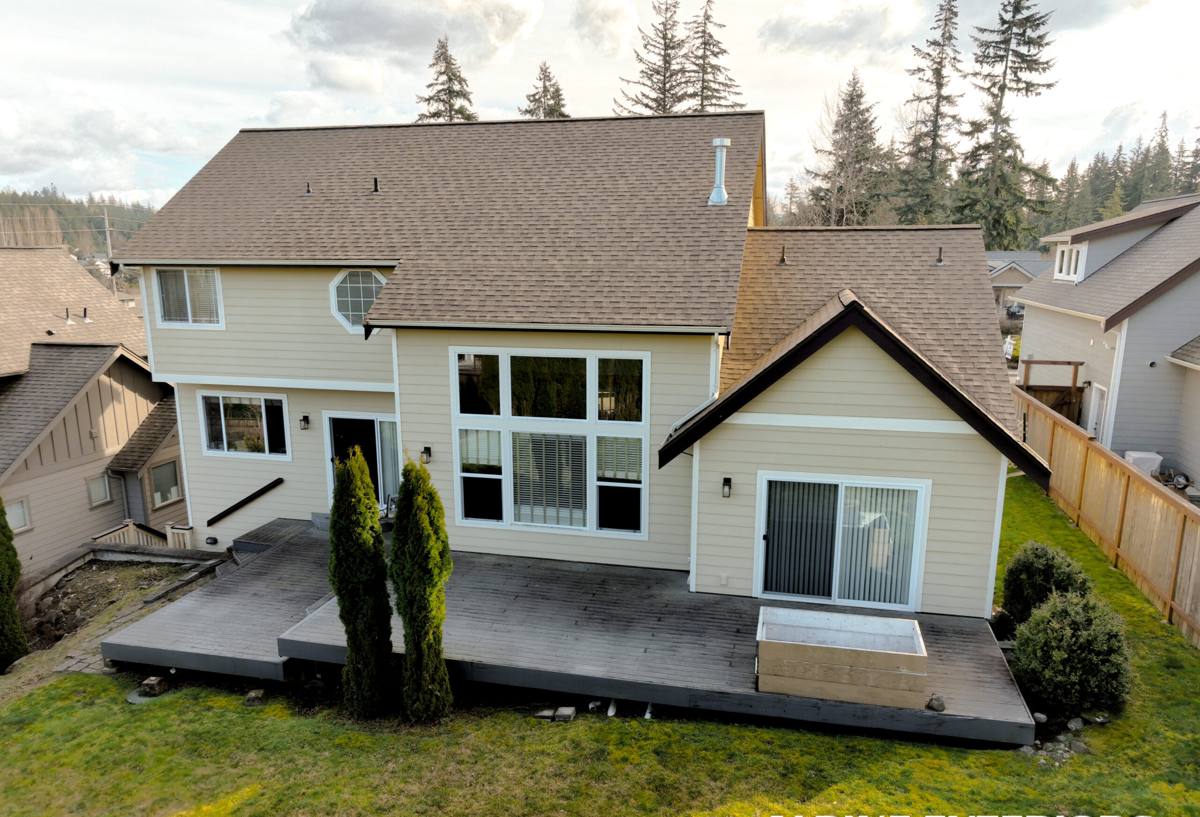
Signs Your Siding Needs Repair
Most siding repair calls we get in Barkley start with one of these observations. None of them require a professional eye to spot — they just require someone to actually look.
- Paint that's peeling, bubbling, or alligatoring in patches rather than evenly across the whole wall
- Soft or spongy spots when you press on a board, especially near the bottom courses or around windows
- Visible gaps at seams, corners, or trim where caulking has shrunk or pulled away
- Persistent moss, algae, or dark staining that keeps coming back after cleaning
- Warping, cupping, or buckling boards, particularly on shaded or wind-exposed elevations
- Musty smell or visible staining on interior walls that back up to an exterior wall with siding issues
- Fastener heads showing rust streaks or backing out of the siding surface
What a Correct Repair Actually Involves
A repair that just covers up the visible damage without addressing why it happened will fail again — often within a season or two, especially given how much moisture Barkley walls are exposed to. A correct repair follows a specific sequence.
Diagnosing the Real Cause
Before any board comes off, we figure out where the water is actually getting in. That might be a failed kick-out flashing above a roof-to-wall intersection, a window that was never properly flashed, a gap at a butt joint, or simply age-related material failure. Replacing the visible board without fixing the entry point means the new material fails the same way the old one did.
Matching Materials Correctly
When we repair a section of siding, we want the patch to disappear — not stand out as an obviously newer, differently-textured, or mismatched panel. That means matching plank width, exposure, and texture as closely as possible, and being upfront with homeowners when an exact match isn't realistic so they can decide whether to blend it or plan for a broader replacement.
Sealing and Flashing Details
This is where most amateur repairs — and a fair number of professional ones — cut corners. Proper repair means correct flashing at any penetration or transition, appropriate sealant only where sealant belongs (not as a substitute for flashing), and fastening patterns that match manufacturer specifications so the repaired section performs the same as the surrounding original installation.
Repair vs. Replacement: How We Decide
Not every damaged section needs a full re-side, and not every homeowner needs to hear "you need all new siding" when a targeted repair will hold up fine. Here's generally how the decision breaks down.
| Factor | Favors Repair | Favors Replacement |
|---|---|---|
| Extent of damage | Isolated to one or two wall sections | Spread across multiple elevations |
| Underlying cause | Identifiable, fixable moisture source | Systemic issue (bad original install, wrong product for the site) |
| Material condition | Surrounding siding is sound | Surrounding siding shows widespread aging or failure |
| Material match | Close match available or a discontinued line isn't a dealbreaker | Discontinued profile/color with no acceptable match |
| Age of siding | Well within expected service life | Near or past the material's realistic lifespan |
We'll always tell you honestly which side of that table your house falls on, even if the answer is "this is a $400 repair, not a $20,000 project."
Why We Only Repair and Install James Hardie Fiber Cement
We made a decision as a company to work exclusively with James Hardie fiber cement siding, and we don't install LP SmartSide, vinyl, Cemplank, Allura, primed spruce, or cedar. That standard applies to repair work too — when we patch or replace a section, we're using Hardie product, and we recommend it as the long-term answer whenever a homeowner is deciding what to replace failing siding with.
The reasoning is practical, not brand loyalty for its own sake. Fiber cement is non-combustible, which matters in a region where wildfire smoke and ember exposure have become a real seasonal concern even west of the Cascades. Hardie's ColorPlus factory-applied finish holds up better against the kind of UV and moisture cycling we get here than field-applied paint, which means fewer repaint cycles and less of the paint-failure pattern that drives a lot of our repair calls in the first place. Hardie also engineers specific product lines (their HZ5 designation, for example) for regions with higher moisture exposure — which describes Barkley and the rest of Whatcom County well. And the warranty is transferable, which matters to homeowners who may sell before the siding's service life is up.
What This Means for a Partial Repair
If your existing siding is a different material — vinyl, wood, an older cement product — we'll be straightforward about whether a same-material patch makes sense as a stopgap, or whether it's worth converting the damaged section (or the whole elevation) to Hardie now rather than repairing something we wouldn't install new. That's your call, and we'll lay out the honest tradeoffs either way.
Our Siding Repair Process in Barkley
- On-site inspection. We look at the damaged area and the surrounding wall, roofline, and grading to find the actual moisture source, not just the symptom.
- Honest assessment. We tell you whether you're looking at a repair, a partial replacement, or a full re-side, and why — including cost-factor tradeoffs like the ones above.
- Fix the cause first. Any flashing, sealant, or drainage issue behind the siding gets corrected before new material goes up.
- Repair or replace the damaged section. Using James Hardie product matched as closely as possible to your existing siding's profile and reveal.
- Final detailing. Correct fastening, caulking only where appropriate, and a check that the repair sheds water the way the rest of the wall does.
Common Repair Scenarios We See Around Barkley
Certain patterns show up repeatedly on Barkley homes given the mix of tree cover, wind exposure, and building ages in the area: moss-driven paint and board failure on shaded north and east walls; water staining below window sills where original flashing was minimal or missing; soft siding near ground level where splashback and poor drainage keep the bottom courses wet longer than the rest of the wall; and corner or trim board separation where caulk joints have simply aged out after years of expansion and contraction. None of these are unusual or a sign of a poorly built house — they're the predictable result of Whatcom County weather working on siding over time, and every one of them is fixable when addressed properly.
Why a Crew That Already Works Barkley Matters
Siding repair done right depends on understanding how a specific house sits in a specific microclimate — how much shade it gets, which walls take the wind-driven rain, how close it is to salt air exposure, and how the local moss season affects that particular lot. A crew that regularly works Barkley and the surrounding Whatcom County neighborhoods has already seen how these houses age, which trouble spots repeat, and which repair shortcuts don't hold up here even if they'd be fine somewhere drier. That local pattern-recognition is the difference between a repair that lasts and one you're calling us back about in two years.
If you're seeing paint failure, soft boards, persistent moss staining, or gaps opening up at your siding's seams, we're happy to take a look and give you a straight answer about what it actually needs. Reach out for a free, no-pressure estimate using the form below.