 Whatcom County
 Why Cordata's Deck-Building Conditions Are Different
Cordata sits among the mature tree cover and quieter, established streets on the north side of Bellingham, and that setting shapes what a deck actually has to survive. Big conifers and deciduous trees mean shade that lingers into the afternoon, needles and leaf litter that collect in gaps and corners, and surfaces that stay damp long after a storm has passed elsewhere in Whatcom County. Add the region's long, low-intensity rainy stretch from fall through spring, and you get a deck-building environment that punishes anything installed without real drainage and airflow in mind.
Homeowners often ask us why a deck that looks fine in July starts showing green film, soft spots, or fastener staining by the following February. The answer is almost always moisture that had nowhere to go. Whatcom County's damp season isn't a once-a-year event — it's months of low sun angle, high humidity, and slow-drying wood and composite surfaces. A deck built for a drier climate, or built by a crew unfamiliar with how this area behaves, will show its weaknesses here faster than almost anywhere else in the state.
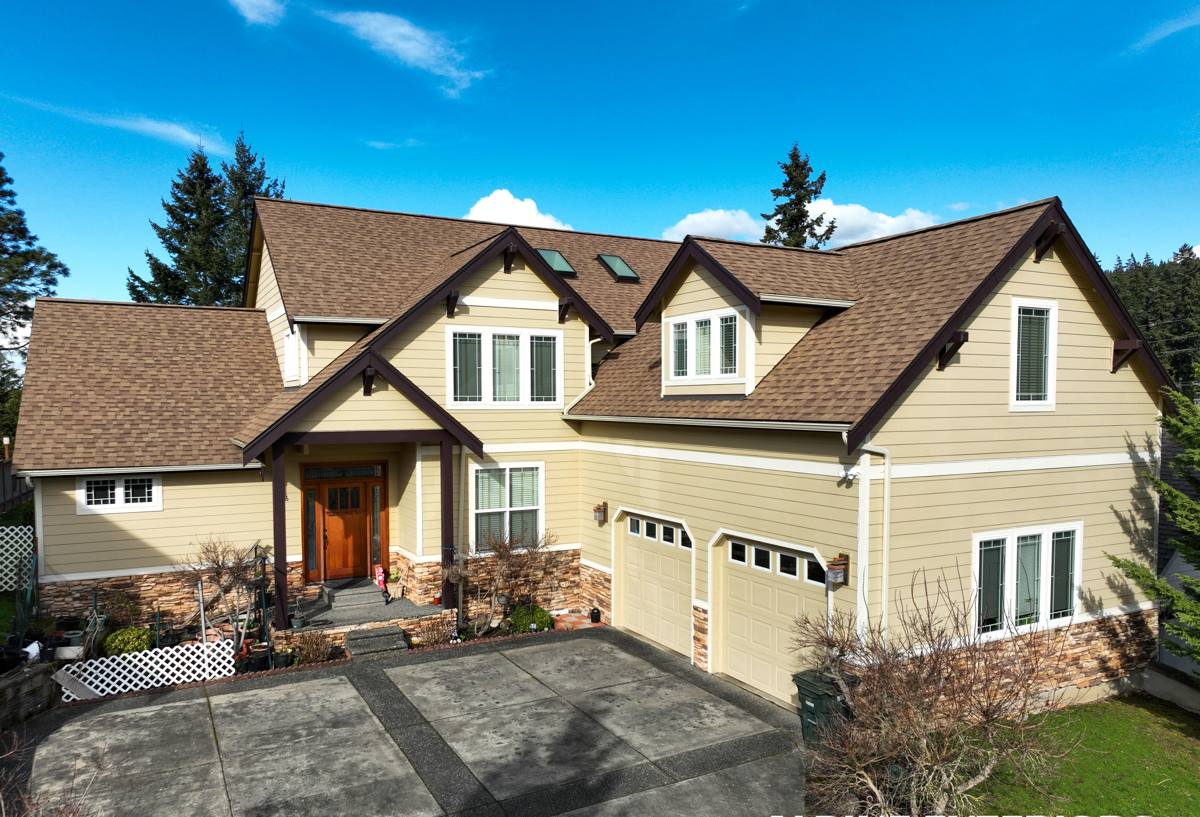
What Local Homes Actually Need From a Deck
Moisture Management First
Every decision on a Cordata deck — board spacing, joist protection, ledger flashing, fastener choice — should start from the same question: where does the water go once it lands? Composite decking doesn't rot the way wood does, but it still needs to shed water off the surface and out from underneath. Boards installed tight, over a substructure with no drainage plane, will trap moisture against the framing even if the decking itself is fine.
Shade-Tolerant Surface Choices
Under heavy tree canopy, a deck rarely gets the direct sun exposure that helps surfaces dry out and resist algae and moss growth. That makes surface texture and color choice more than a cosmetic decision — some composite finishes shed grime and dry faster than others, and lighter colors show pollen and moss spores less than very dark boards in shaded yards.
Structural Wood That's Actually Protected
The composite boards are only part of the deck. The framing underneath — joists, beams, posts, ledger — is still almost always dimensional lumber, and in a damp, shaded lot that lumber needs real protection: proper flashing, joist tape or a comparable barrier, and ventilation so the underside of the deck isn't sitting in still, moist air all winter.
What a Correct Composite Deck Install Involves
- Ledger board flashed and sealed against the house so water can't track behind the siding at the attachment point
- Joists wrapped or taped along the top edge to keep standing water out of end grain and fastener holes
- Post bases set on the footings with a capillary break, not resting directly on wet concrete or soil
- Board gapping sized correctly for the composite manufacturer's spec and adjusted seasonally for expansion
- Hidden or approved fastening system matched to the specific composite product, not a generic deck screw
- Airflow maintained underneath the deck — skirting, if used, vented rather than sealed tight to the ground
- Stair stringers and rail posts anchored with hardware rated for exterior, wet-climate exposure
Skipping any one of these doesn't usually cause an immediate problem. It shows up eighteen months to three years later as a soft spot near the house, a rail post that's gone slightly loose, or staining that won't scrub off. Those are almost always substructure or flashing issues, not a failure of the composite board itself.
Composite vs. Other Decking Materials in This Climate
| Material | Behavior in Whatcom County damp/shade | Maintenance burden |
|---|---|---|
| Capped composite | Resists moisture absorption and rot; surface can still grow moss film if not cleaned | Low — periodic wash, no staining or sealing |
| Uncapped composite (older generation) | Can absorb moisture at cut edges and swell over time in wet, shaded lots | Moderate — needs closer inspection of edges and fasteners |
| Pressure-treated wood | Prone to splintering, cupping, and mildew staining under constant shade and moisture | High — annual cleaning, periodic staining/sealing |
| PVC decking | Fully moisture-resistant surface but can feel and flex differently underfoot; higher material cost | Low — similar washing routine to composite |
We install capped composite on the large majority of Cordata decks for a straightforward reason: it holds up to the shade-and-moisture combination this neighborhood sees without the annual upkeep wood demands, and it costs less over the life of the deck than most homeowners expect once you account for wood's recurring maintenance.
Where Composite Is the Wrong Call
There are situations — a very tight budget, a small utility deck, or a homeowner who genuinely enjoys the upkeep and look of real wood — where we'll say composite isn't the right fit and tell you honestly. It's not our default recommendation for every job; it's our recommendation for homes that want low maintenance in a climate that makes wood maintenance a real, recurring chore.
The Substructure and Drainage Work Nobody Sees
The visible composite boards get the attention, but the framing underneath is what determines whether the deck is still solid in ten years. On a shaded, damp lot like a typical Cordata property, we pay particular attention to:
- Grading under the deck so water drains away from the house rather than pooling under the structure
- Footing depth and placement set to local frost and soil conditions, not a generic minimum
- Ledger attachment sealed with the right flashing tape and membrane, since this is the single most common source of hidden rot on older decks we've opened up
- Joist spacing tightened where needed for the specific composite board's span rating
This is also where corners get cut on rushed jobs. A deck can look identical from the top with correct or incorrect substructure work — the difference only shows up years later, usually as a warranty problem for the homeowner rather than the installer.
How Our Process Works
1. On-Site Assessment
We walk the property, look at drainage patterns, tree cover, sun exposure, and how the deck will tie into the house, and talk through what you actually want to use the space for.
2. Material and Layout Discussion
We go over composite options, colors, and railing systems suited to a shaded, damp lot, and lay out board direction and spacing to work with your yard rather than against it.
3. Permitting and Prep
Decks of most sizes require a permit in Whatcom County jurisdictions; we handle that paperwork and the inspection scheduling so it's not on your plate.
4. Build
Demolition of the old structure if needed, footings, framing with moisture protection, then composite installation with the fastening system specified for that product line.
5. Final Walkthrough
We walk the finished deck with you, point out any manufacturer maintenance notes specific to your board choice, and make sure rail, stair, and gap spacing all meet code before we call it done.
Living With a Composite Deck Through Moss Season
Composite decking does not need staining, sealing, or sanding, but "low maintenance" doesn't mean "no maintenance," especially with the moss and algae pressure that comes with a long Whatcom County wet season under tree cover. A realistic seasonal routine:
- Sweep leaves and needles off regularly in fall — trapped debris holds moisture against the board surface
- Rinse and soft-brush the deck a couple of times through the wet months if it's heavily shaded, using a composite-safe cleaner rather than a pressure washer on high pressure
- Check railing posts and stair connections once a year for any looseness
- Clear gaps between boards where debris and moss film tend to build up fastest
Homes with heavier canopy and less direct sun will need this routine more often than an open, sunny lot. That's simply the trade-off of a shaded yard, and it's far less work than maintaining a wood deck in the same conditions.
What Affects the Cost of a Composite Deck Project
| Factor | Why it matters |
|---|---|
| Deck size and shape | Square footage and the number of angles/cutouts drive material and labor time |
| Composite product tier | Entry-level, mid-tier, and premium capped boards vary significantly in material cost and warranty length |
| Substructure condition | Replacing rotted or undersized existing framing adds cost but is not optional for a safe, lasting deck |
| Railing and stair system | Composite, cable, or metal rail systems range widely in price and installation complexity |
| Site access and grading | Sloped or hard-to-access lots common in wooded neighborhoods add labor time |
| Permit and inspection scope | Larger or attached decks require more inspection steps, which affects scheduling and cost |
We give a firm, itemized estimate before any work starts so you know exactly what's driving the number — there's no version of this project where "composite decking" alone tells you the price without knowing these factors.
Why a Crew That Already Works Cordata Matters
A deck built by a crew that hasn't worked in this specific mix of shade, moisture, and mature-lot drainage tends to make the same predictable mistakes: undersized ventilation under the deck, ledger flashing that assumes a drier climate, or composite spacing that doesn't account for how much this area's humidity swings seasonally. We work these conditions regularly across Whatcom County, and that shows up in details like footing depth, flashing choices, and how we lay out drainage under the structure — the parts of the job that aren't visible on day one but determine whether the deck is still tight and dry in year eight.
It also means straight answers grounded in what actually happens to decks in this area, not a sales pitch borrowed from a drier region.
Questions Worth Asking Before You Hire
- Will you flash and seal the ledger board, and with what product?
- What fastening system does the composite manufacturer require, and will you use it?
- How will the underside of the deck be ventilated given the amount of shade on this lot?
- What's the manufacturer's warranty on the specific composite line you're quoting, and what voids it?
- Are footings sized for this soil and frost condition, or a generic minimum?
- Is the permit included in your quote, and who schedules the inspections?
If a contractor can't answer these clearly, that's worth noting before you sign anything.
If you're weighing composite decking for a Cordata property, we're happy to walk the site, talk through what your specific yard and sun exposure call for, and put together a straightforward, no-pressure estimate — just fill out the form below.