 Whatcom County
Fiber Cement Siding for Cordata Homes
Cordata sits close enough to the water and to the wooded, low-lying terrain around it that its homes take a specific kind of weather beating. It's not dramatic storm damage — it's the slow, cumulative kind: salt-tinged air moving in off the Strait and the bay, driving rain that hits siding sideways for weeks at a stretch in fall and winter, and a moss season that seems to start earlier and run later every year. Siding in this neighborhood doesn't fail all at once. It fails a little at a time, in ways that are easy to miss until a repaint won't hold anymore or a soft spot shows up at a butt joint.
Fiber cement siding, installed correctly, is built for exactly this kind of exposure. We install one fiber cement product — James Hardie — on every home we side in Cordata and the rest of Whatcom County, and this page walks through what that actually means for a house in this specific area: what the climate does to siding here, what a correct fiber cement job involves, and why the installation matters as much as the material.
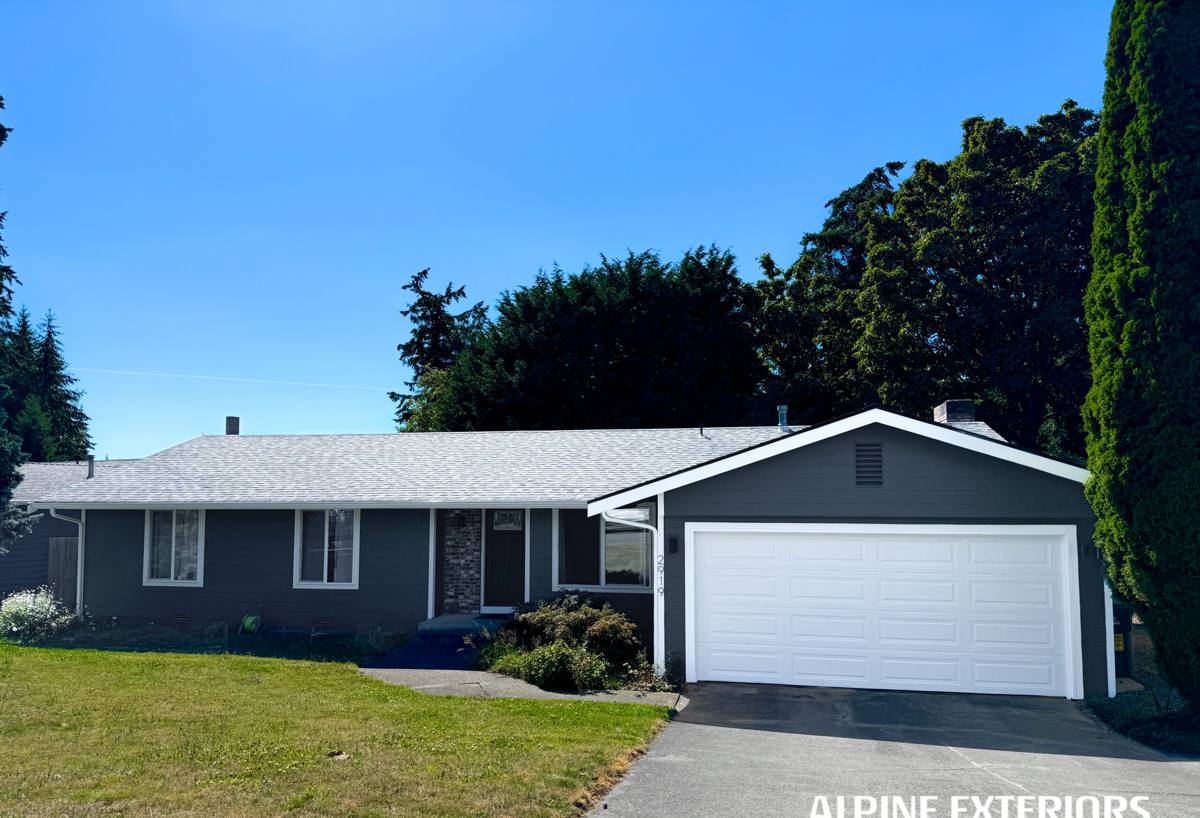
What Cordata's Climate Actually Does to Siding
Salt Air
Homes closer to Bellingham Bay and the Strait of Georgia pick up a low but steady dose of salt-laden air. Salt is hygroscopic — it pulls moisture out of the air and holds it against whatever surface it settles on. On wood-based siding products, that means the surface stays damp longer than it should, which accelerates rot, finish breakdown, and fastener corrosion. On vinyl, salt film dulls the surface and gets into every laps and seam. Fiber cement doesn't absorb salt the way wood fiber does, and it doesn't corrode. It's not immune to the effects of a damp coastal microclimate, but it doesn't feed on the moisture the way organic siding materials do.
Driving Rain
Whatcom County doesn't just get a lot of rain — a good portion of it comes in sideways, pushed by wind off the water. That matters more than annual rainfall totals. Driving rain finds every gap in flashing, every under-caulked seam, every place where siding wasn't held off the wall assembly with proper clearance. A siding material can be technically water-resistant and still let a house take on moisture if the installation details — house wrap, flashing, weep paths, fastener placement — aren't right. This is why we talk about installation as much as we talk about the product itself.
Moss and Sustained Dampness
The long, mild, wet stretch from fall through spring is moss season here, and it's longer than in most of the country. Moss and algae don't just look bad — they hold moisture against the siding surface for extended periods, which is hard on paint film, caulk joints, and any substrate that isn't dimensionally stable. Homes in Cordata that sit near tree cover or in shaded, low-airflow spots see this worst. A siding material's finish needs to resist that kind of biological growth, and the substrate underneath needs to tolerate repeated wet-dry cycling without swelling, cupping, or losing its shape.
Why We Only Install James Hardie
We get asked fairly often why we don't offer LP SmartSide, vinyl, Cemplank, Allura, or wood siding as options. Each of those products has legitimate uses and reasonable installers who stand behind them. Our answer isn't that they're bad products — it's that after years of siding homes in this specific climate, we standardized on one system because it consistently performs the way our clients need it to, with the least long-term maintenance burden.
- Non-combustible core: Hardie's fiber cement composition doesn't support flame spread the way wood-based or engineered-wood products can.
- ColorPlus factory finish: Baked-on, warranted color that resists the fading and chalking that field-applied paint struggles with in a wet, low-UV climate.
- Climate-engineered HZ5 formulation: Hardie's Pacific Northwest product line is engineered for wet-freeze climates specifically, which matters more in Whatcom County than in most of the country.
- Dimensional stability: Fiber cement doesn't swell, cup, or delaminate with repeated wet-dry cycling the way engineered wood products can if a seam or cut edge is exposed.
- Transferable warranty: A meaningful factor for resale in a neighborhood where homes turn over and buyers ask about the siding's age and condition.
We're not going to tell a homeowner that vinyl is "bad" — it's inexpensive and low-maintenance in the right application. But vinyl expands and contracts significantly with temperature swings, and it can crack or become brittle over time, especially at low temperatures. LP SmartSide is a genuinely engineered wood product with real strengths, but it's still wood-based, and wood-based products are more sensitive to sustained moisture exposure than fiber cement — which is exactly the exposure Cordata homes get most of the year. Given that trade-off, fiber cement is what we're willing to put our name behind here.
What a Correct Fiber Cement Job Involves
The material is only half the equation. Most siding failures we get called out to inspect — regardless of brand — trace back to installation shortcuts, not product defects. A correct job includes:
Water Management Behind the Siding
Properly lapped and taped house wrap, correctly integrated window and door flashing, and a drainage plane that lets any incidental moisture get out instead of trapping it against the sheathing. This is the layer nobody sees once the job is done, and it's the layer that determines whether the wall assembly stays dry for the next 30 years.
Proper Clearances and Fastening
Hardie siding needs to be held off roof lines, decks, and grade by the manufacturer's specified clearances so water sheds away instead of wicking up into the plank ends. Fasteners need to be the correct type, driven to the correct depth, and placed according to Hardie's published fastening schedule — not just "close enough."
Caulking and Joint Treatment
Butt joints, trim intersections, and penetrations (hose bibs, vents, electrical) are where driving rain gets in if they're sealed wrong or not sealed at all. We use sealants rated for the exposure and detail joints so they shed water rather than collect it.
Painting and Field Cuts
Any field-cut edge on Hardie board needs to be primed and sealed before installation — an unsealed cut edge is one of the few places fiber cement can take on moisture. This is a small step that's easy to skip and important not to.
Our Process for a Cordata Siding Project
| Step | What Happens |
|---|---|
| 1. On-site assessment | We walk the exterior, check for existing moisture damage, rot, or failed flashing, and assess exposure (sun, wind, tree cover, proximity to water). |
| 2. Scope and product selection | We recommend the appropriate Hardie plank profile, exposure, and ColorPlus finish for the home's style and the site's exposure conditions. |
| 3. Written estimate | A clear, itemized quote — no vague allowances, no pressure to sign same-day. |
| 4. Tear-off and sheathing check | Old siding comes off, and we inspect the sheathing underneath for rot or damage before anything new goes up. |
| 5. Water management install | House wrap, flashing, and drainage details go in first and get inspected before siding starts. |
| 6. Siding installation | Hardie planks installed to manufacturer spec — clearances, fastening, joint treatment. |
| 7. Final walkthrough | We walk the finished job with the homeowner and address anything before calling it complete. |
Signs a Cordata Home May Need Siding Attention
- Paint that's peeling, bubbling, or chalking faster than it used to, especially on shaded or north-facing walls
- Soft spots or slight give when you press on siding near the bottom courses or around window trim
- Persistent moss or dark streaking that comes back within weeks of cleaning
- Visible gaps or cracked caulk at butt joints and trim intersections
- Warping, cupping, or bowing in individual boards
- A musty smell or visible staining on interior walls that share an exterior wall with affected siding
None of these on their own mean a full re-side is necessary — sometimes it's a repair, sometimes it's a sign to plan ahead before it becomes one. Worth a look either way.
Cost Factors for a Cordata Fiber Cement Project
We don't publish blanket per-square-foot pricing because it varies too much by home to be honest — but these are the real factors that move a quote up or down:
| Factor | Why It Matters |
|---|---|
| Home size and wall complexity | More corners, dormers, and trim details mean more labor and material waste. |
| Existing siding removal | Tear-off of old siding (and disposal) adds cost versus a bare-sheathing new build. |
| Sheathing repair | Rot found once old siding comes off needs to be addressed before new siding goes on — this is the most common source of change orders. |
| Plank profile and exposure | Different Hardie profiles (lap width, smooth vs. woodgrain) carry different material costs. |
| Trim and accessory work | Corner boards, window trim, and fascia detailing add labor time beyond the flat wall area. |
| Access and site conditions | Steep grades, limited staging area, or multi-story sections affect labor time and equipment needs. |
Why Local Experience in Cordata Matters
A crew that already works this part of Whatcom County knows what to expect before the tear-off even starts. They know which orientations take the worst of the driving rain, where moss tends to build up fastest, and how much clearance to plan for around grade and landscaping that's often more established and closer to the house than in newer developments. That's not something you can fully account for from a general specification sheet — it comes from having done the work here repeatedly and seeing what holds up and what doesn't.
It also matters for accountability. A local contractor is easy to reach if a question comes up two years after the job, and has a reputation in the community that depends on the work actually lasting — not just looking good at handoff.
Get a Free Estimate
If your Cordata home's siding is showing its age, or you're planning ahead before winter's driving rain and moss season set in again, we're happy to take a look and give you an honest, no-pressure assessment. The estimate is free, and there's no obligation to move forward — just a clear picture of what your home needs and what it would take to do the job right with James Hardie fiber cement siding. Use the form below to get started.