 Whatcom County
 Why Bellingham Roofs Wear Out Differently
Bellingham sits where marine air off the bay meets steady Pacific storm systems and a wet, mild winter that seems to stretch on for months. That combination is hard on a roof in ways that don't show up the same way in drier inland climates. A shingle rated for 25 or 30 years in Arizona doesn't automatically get 25 or 30 years here — it gets whatever the moisture, wind, and organic growth in Whatcom County decide to leave it.
Salt Air and Marine Exposure
Homes closer to Bellingham Bay and the Salish Sea shoreline deal with airborne salt that accelerates corrosion on exposed metal — flashing, fasteners, vents, and gutter hardware. Standard galvanized fasteners and thin flashing can start showing rust streaks and pinholing years before they would inland. It's not dramatic, but it's steady, and it's one of the first things we check on a replacement in these areas.
Driving Rain, Not Just Rain
Whatcom County doesn't just get a lot of rainfall — it gets wind-driven rain that comes in sideways during fall and winter storms. That matters because a roof only has to shed water straight down to perform on paper, but a real Bellingham roof has to resist water being pushed sideways and upward under shingle edges, around penetrations, and into valleys. Underlayment choice and flashing detail carry a lot more weight here than in calmer climates.
The Long Moss Season
Shade from mature conifers, cool temperatures, and near-constant moisture from roughly October through May give moss and algae months to establish themselves on north-facing slopes and anywhere debris collects. Moss isn't just cosmetic — it holds water against the roofing material, lifts shingle edges as it grows, and traps organic debris that keeps that section of roof wet long after the rest has dried out.
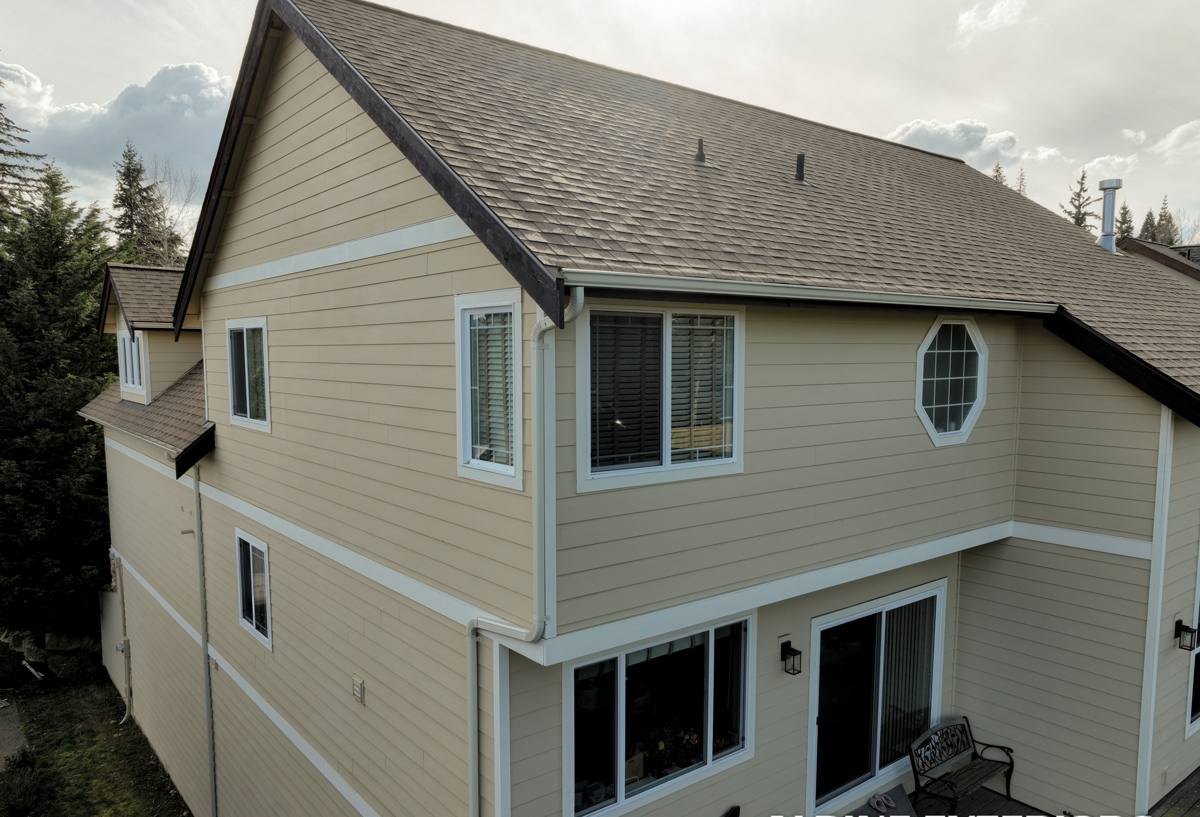
What a Correct Roof Replacement Actually Involves
A roof replacement is more than swapping old shingles for new ones. Done right, it's a system of layers that all have to work together, and skipping or shortcutting any one of them is usually where the next leak or premature failure comes from.
Full Tear-Off and Deck Inspection
We remove the existing roofing down to the deck rather than layering over it. That's the only way to actually see what's underneath — and on older Bellingham homes, that's often where moss-related moisture damage shows up: soft spots, delaminated plywood, or rot around old penetrations that were never properly flashed. Any damaged decking gets replaced before anything new goes down; installing new roofing over a compromised deck just hides the problem for a few years.
Ice-and-Water Shield Where It Matters Most
Even though Whatcom County doesn't see the ice-dam problems of a true snow climate, self-adhering waterproof underlayment at eaves, valleys, and around chimneys and skylights is still one of the most important upgrades on an older home. These are the exact spots where wind-driven rain gets pushed under the roofing surface, and a membrane here backstops the shingles instead of relying on them alone.
Flashing That's Built for Wind-Driven Rain
Step flashing at walls, counter-flashing at chimneys, and kick-out flashing where a roofline meets a sidewall are common places where budget re-roofs cut corners — usually by reusing old flashing or relying on caulk instead of proper metal work. Caulk fails; correctly lapped and integrated flashing doesn't need to rely on it. This is one of the most common causes of slow, hard-to-trace leaks we find on older homes in this area.
Balanced Attic Ventilation
A roof deck that can't breathe traps moisture from inside the house against the underside of the sheathing, especially during the long stretch of cool, damp months. That trapped moisture leads to rot, mold, and a shortened lifespan for the new roof from the inside out. A correct replacement includes checking that intake (soffit) and exhaust (ridge or other) ventilation are balanced, not just present.
Choosing Roofing Material for a Bellingham Home
There's no single "best" roofing material for every home — it depends on the roof's pitch, exposure, budget, and how much maintenance the homeowner wants to take on. Here's how the common options actually compare for this climate.
| Material | Moss & moisture resistance | Typical lifespan here | Maintenance | Rough installed cost |
|---|---|---|---|---|
| Architectural asphalt shingle (algae-resistant) | Good, with copper/zinc granules that slow algae and moss growth | 20-30 years | Periodic moss treatment on shaded slopes | Moderate |
| Standard 3-tab asphalt | Fair — no algae-resistant granules, ages faster in shade | 15-20 years | More frequent moss/algae treatment | Lower |
| Metal (standing seam or panel) | Very good — sheds moisture fast, little surface for moss to grip | 40+ years | Low; check fastener and coating condition over time | Higher |
| Cedar shake | Requires diligent upkeep in a wet marine climate | Varies widely with maintenance | High — regular treatment and inspection | Higher |
For most Bellingham homes, we recommend algae-resistant architectural asphalt shingles as the practical middle ground — real moss resistance without the cost jump of metal, and a good warranty structure from major manufacturers. Metal is a strong choice for homes with heavy tree cover or steep, hard-to-access roofs where reduced maintenance matters more than upfront cost. We're honest with homeowners about cedar: it can look great, but it demands a level of ongoing maintenance in this climate that most people don't want to keep up with, and we'd rather set that expectation up front than sell a product that needs more attention than most homeowners are prepared to give it.
Ventilation and Moisture: The Part Homeowners Don't See
Because Whatcom County's climate keeps humidity elevated for so much of the year, attic moisture management deserves more attention here than in drier regions. Signs of a ventilation problem often show up as dark staining on sheathing, a musty attic smell, or moisture on the underside of the roof deck in cooler months. When we replace a roof, we evaluate the existing intake and exhaust venting as part of the job — not as an optional add-on — because a new roof installed over an unbalanced ventilation system will show the same moisture problems again within a few years.
Our Roof Replacement Process
- On-site inspection: We walk the roof and attic, check the deck, flashing, and ventilation, and photograph anything that affects the scope or price before we quote it.
- Written estimate: A clear breakdown of materials, labor, and any deck repair contingencies — no vague allowances that turn into surprise change orders.
- Material selection: We walk homeowners through shingle or metal options suited to their roof's exposure, shade, and budget.
- Tear-off and deck repair: Full removal of old roofing, deck inspection, and replacement of any damaged sheathing.
- Underlayment and flashing: Self-adhering membrane at vulnerable areas, new flashing at all penetrations, walls, and valleys.
- Roofing installation: Installed to manufacturer specification for fastening pattern and exposure, which matters for both wind resistance and warranty coverage.
- Ventilation check and cleanup: Confirm intake/exhaust balance, then a full site cleanup including magnetic sweep for stray fasteners.
- Final walkthrough: We go over the finished roof with the homeowner before calling the job complete.
Signs Your Bellingham Roof May Need Replacing
Not every roof problem means a full replacement — sometimes a repair is genuinely the right call, and we'll tell you that if it's true. But these are the signs that usually point toward replacement rather than patching:
- Heavy moss growth returning quickly after cleaning, especially on north-facing slopes
- Shingles that are cupping, curling, or losing granules in the gutters
- Soft spots or visible sagging anywhere on the roof plane
- Daylight visible through the attic roof deck or staining on the sheathing
- Repeated leaks around the same chimney, skylight, or wall intersection despite past repairs
- A roof that's already had one layer of shingles installed over the original and is now failing again
- Rising energy bills that track with attic moisture or ventilation problems
Permits and Timing in Whatcom County
Roof replacement in Bellingham and unincorporated Whatcom County typically requires a permit, and requirements can differ slightly depending on jurisdiction. We handle that process as part of the job rather than leaving it to the homeowner to sort out. On timing: while roofing can be done for most of the year here, the drier stretch from late spring through early fall gives the most working days without weather delays, and scheduling during that window ahead of the wet season is usually the least stressful option for homeowners who have flexibility.
Why Hire a Crew That Already Works in Bellingham
A roofing crew that only occasionally works this far north treats Whatcom County's climate as an afterthought — they bring whatever materials and details work in a drier or milder market and hope it holds up here. A crew that works Bellingham roofs regularly already knows which slopes hold moss the longest, which older neighborhoods tend to have deck rot behind old flashing, and which material choices actually pay off over time in this specific climate instead of just on paper. That local pattern recognition is the difference between a roof that looks fine at handoff and one that's still performing in year fifteen.
If your roof is showing its age or you're just planning ahead, we're happy to take a look and give you a straightforward, no-pressure estimate — use the form below to get started.