 Whatcom County
 Why Bellingham Siding Has to Work Harder Than the Average House
A house in Bellingham sits in a specific kind of exposure. You've got salt-laden air coming off the water, long stretches of driving rain that hits siding sideways instead of just falling straight down, and a moss season that, depending on the year, can run from early fall through late spring. Any one of those on its own is manageable. All three together, applied to a house year after year, is what separates siding that looks good at year two but rough at year eight from siding that still looks tight at year twenty.
Salt air is corrosive to exposed metal fasteners and hardware, and it accelerates the breakdown of finishes that aren't rated for it. Driving rain finds every gap, seam, and under-lapped joint and pushes water where gravity alone wouldn't take it. And moss and algae need exactly what Whatcom County has in abundance during much of the year: shade, moisture, and mild temperatures. Moss doesn't just look bad — it holds water against a wall surface longer than it would otherwise sit there, and organic material breaking down on a siding surface is not something you want happening for months at a time.
This is the backdrop for every siding decision on a Bellingham home. It's not about picking a material that looks good in a showroom. It's about picking a material — and an installation — that's actually built for this specific climate.
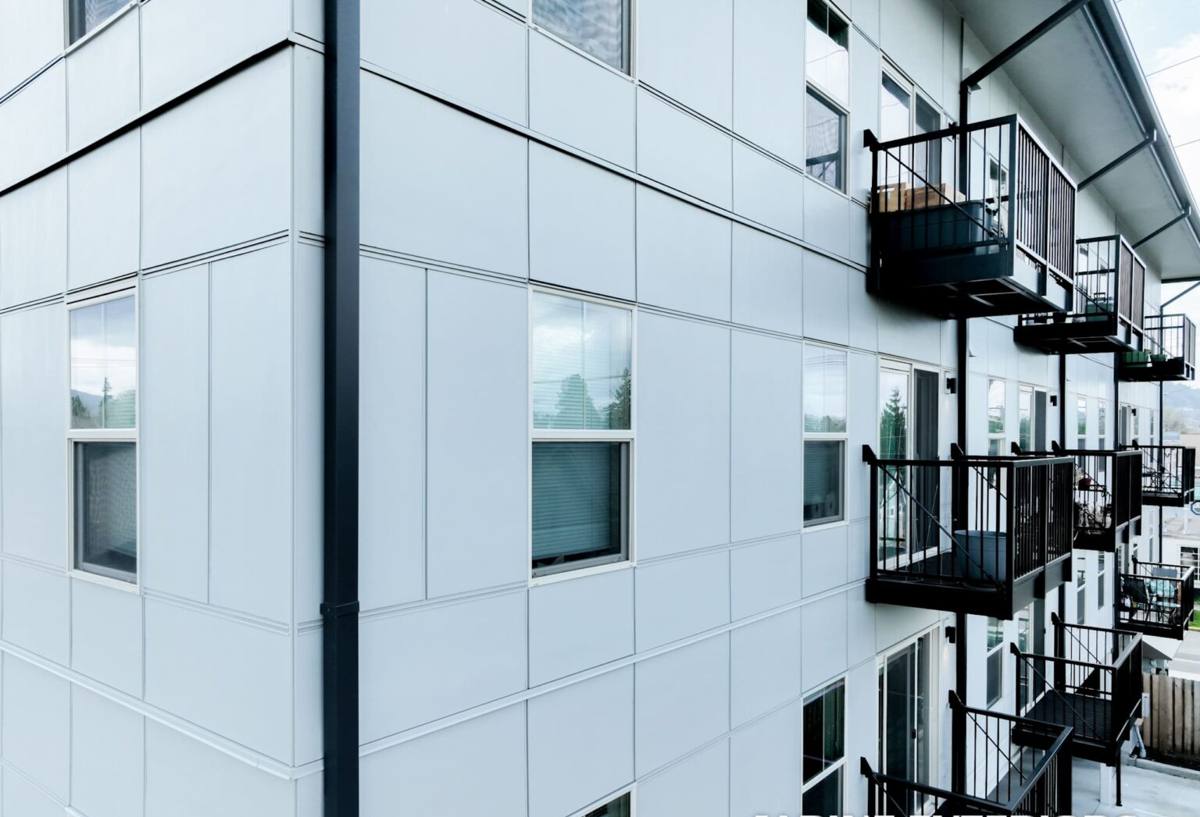
Why Fiber Cement Fits This Climate
Fiber cement siding is a mix of cement, sand, and cellulose fibers, pressed and cured into planks or panels. It doesn't rot, it doesn't feed insects, and it's non-combustible. Those three things alone solve most of the long-term problems that show up on wood and wood-composite siding in a wet, mossy climate.
We install James Hardie fiber cement siding exclusively. We don't install LP SmartSide, vinyl, Cemplank, Allura, primed spruce, or cedar, and that's a deliberate call, not an oversight. Hardie engineers its siding by climate — its HZ5 formulation is built for the wetter, milder regions of the country, including the Pacific Northwest, with moisture and freeze-thaw behavior tuned for exactly the conditions Whatcom County sees. That's a meaningful difference from a generic siding product sold the same way in Phoenix and in Bellingham.
Hardie's factory-applied ColorPlus finish is also part of why we standardized on it. It's baked on under controlled conditions, with better adhesion and UV stability than a field-applied paint job, and it comes with its own finish warranty separate from the product warranty. In a climate with a lot of damp, low-light months, a finish that resists fading, chalking, and moisture intrusion at the surface is doing real work, not just cosmetic work.
What We're Not Installing, and Why
LP SmartSide is a wood-strand product — engineered and treated, but still wood-based at its core, which means it depends on an intact factory coating and careful field sealing at every cut edge to keep water out over the long run. Vinyl is inexpensive and low-maintenance but it flexes, fades unevenly under UV, and doesn't hold up as well to the pressure-washing that moss removal in this climate often requires. Cedar is a genuinely attractive natural material, but it requires ongoing sealing, staining, and vigilance against moisture and insects — maintenance that's harder to keep up with in a place that's damp more months than not. None of these are "bad" products in the abstract. They're just not what we're willing to put our name behind for a Whatcom County exterior, given what this climate does to a wall over ten and twenty years.
What a Correct Fiber Cement Installation Actually Involves
The siding material is only part of the equation. A huge share of whether siding performs in Bellingham's climate comes down to what's happening behind it and at every seam, corner, and penetration.
The Drainage Plane
Correctly installed fiber cement sits over a weather-resistive barrier with a drainage gap behind it, so that any moisture that does get past the siding face has somewhere to go besides the sheathing. This matters more in a driving-rain climate than in a dry one, because wind-driven rain can push water past the outer surface even on siding that's holding up fine visually.
Flashing and Water Management
Every window, door, deck ledger, and roof-to-wall intersection needs flashing detailed so water sheds outward and down, never behind the cladding. This is where a lot of siding failures actually originate — not from the siding material itself, but from a poorly flashed transition that lets water in behind it for years before anyone notices the damage.
Fastening and Clearances
Hardie specifies fastener type, spacing, and penetration depth, along with minimum clearances from grade, roof lines, and hard surfaces. Those clearances aren't arbitrary — they keep the bottom edge of the siding out of standing water and constant splash-back, which is exactly the kind of chronic wet exposure that shortens the life of any siding system.
Joints and Caulking
Butt joints, seams, and trim transitions need to be treated correctly — the right sealant, applied at the right joints, and not relied on as a substitute for proper flashing. Over-caulking is almost as common a mistake as under-caulking, and it can trap moisture instead of shedding it.
Fiber Cement vs. the Alternatives, for This Climate Specifically
| Factor | James Hardie Fiber Cement | Vinyl | Wood/LP Composite |
|---|---|---|---|
| Moisture behavior | Resists moisture intrusion; HZ5 formulated for wet climates | Doesn't absorb water, but seams and panel flex can let water track behind it | Vulnerable at cut edges and coating breaks; prone to swelling |
| Moss/algae resistance | Hard, dense surface; cleans without damage | Can be pressure-washed but scratches/cracks under aggressive cleaning | Surface can degrade with repeated moss removal |
| Salt air exposure | Factory finish holds up well; not a food source for organisms | Finish can chalk and fade faster near the water | Coating breakdown accelerated by salt exposure |
| Fire performance | Non-combustible | Combustible, can melt/deform near heat | Combustible |
| Long-term maintenance | Periodic wash, recaulk as needed, no repainting for the life of ColorPlus finish | Low maintenance but replacement (not repair) when damaged | Recurring sealing/staining or coating touch-up |
None of this means every non-Hardie product fails in this climate — plenty of vinyl and wood siding installations hold up reasonably well. It's a question of margin: how much room for error the material and the installation give you when the weather isn't cooperating for eight months of the year.
Our Process on a Bellingham Home
- On-site assessment: We look at the current siding, the wall assembly where it's accessible, moisture staining, and problem areas like deck ledgers, window heads, and roof-wall intersections.
- Tear-off and inspection: Once the old siding is off, we inspect the sheathing and framing underneath for rot or moisture damage before anything new goes up. This step catches problems that aren't visible from outside.
- Weather barrier and drainage plane: We install a proper weather-resistive barrier and drainage gap system before any siding goes on.
- Flashing at every penetration: Windows, doors, and any wall penetration get flashed to shed water outward, following Hardie's published installation details.
- Siding installation to spec: Fastening, clearances, and joint treatment follow James Hardie's installation instructions, which is also what keeps the product warranty intact.
- Final walk-through: We review the finished work with you before calling the job done.
Cost Factors on a Fiber Cement Siding Job
Every house is different, but the main variables that move the price on a Bellingham fiber cement project are consistent:
| Factor | Why It Affects Cost |
|---|---|
| Tear-off and disposal | Removing and hauling away old siding, especially multiple layers or hazardous materials, adds labor and disposal cost |
| Sheathing/framing repair | Hidden moisture damage found during tear-off has to be repaired before new siding goes up |
| House size and wall complexity | More corners, dormers, and trim details mean more cutting, flashing, and labor time |
| Siding profile and finish | Lap width, panel style, and ColorPlus color selection can shift material cost |
| Accessory work | Trim, fascia, soffit, and window/door flashing upgrades done at the same time add scope but often save a separate mobilization later |
We're not going to throw out a number here that means nothing without seeing the house — broad ranges without an actual look at your walls, trim, and access are more likely to mislead than help. What we can tell you is that fiber cement generally costs more upfront than vinyl and is comparable to or less than a properly maintained cedar installation over time, once you factor in what cedar actually costs to keep looking right.
Living With Fiber Cement Siding in Whatcom County
Fiber cement is low-maintenance, not no-maintenance. In this climate, a few habits go a long way:
- Rinse siding periodically to keep moss and algae from establishing, especially on north-facing and shaded walls
- Keep gutters clear so overflow isn't running down the siding face during heavy rain
- Keep vegetation and sprinklers from holding moisture directly against the wall
- Check caulking at trim and penetrations every couple of years and touch up as needed
- Address any impact damage or chipped finish promptly rather than letting it sit exposed
Why Hiring a Crew That Already Works Bellingham Matters
Correct fiber cement installation isn't unique to Bellingham — the Hardie install spec is the Hardie install spec anywhere. What's local is knowing how this climate actually behaves on a wall: which orientations get the worst wind-driven rain, how long moss takes to establish on a shaded elevation here versus a drier region, and what kind of flashing and clearance decisions actually hold up through a Whatcom County winter. A crew that works this area regularly has already seen what goes wrong when those details get skipped, and builds around it as a matter of habit rather than guesswork.
If your current siding is showing moss that keeps coming back, soft spots near trim or grade, or a finish that's chalking and fading faster than it should, we're happy to take a look and give you a straight, no-pressure assessment. Reach out for a free estimate using the form below and we'll walk the property with you.