 Whatcom County
Siding in Columbia Has to Answer to the Weather, Not Just Look Good
Homes in the Columbia area don't get a mild, dry summer and call it even for the year. Whatcom County runs on a marine climate — long stretches of low clouds, steady drizzle, and enough humidity that siding rarely gets a real chance to dry out between weather systems. Add salt-laden air moving in off the water and a moss season that can stretch from fall into late spring, and you have a set of conditions that will find every weakness in a siding product or an installation shortcut, usually within the first five to ten years.
That's the lens we use on every Columbia project. Before we talk about colors or trim profiles, we're thinking about how the assembly behind the siding sheds water, how the panels handle repeated wet-dry cycles, and how the finish is going to hold up against organic growth and airborne salt. Siding here isn't just an exterior finish — it's the first line of defense for the wall assembly underneath it.
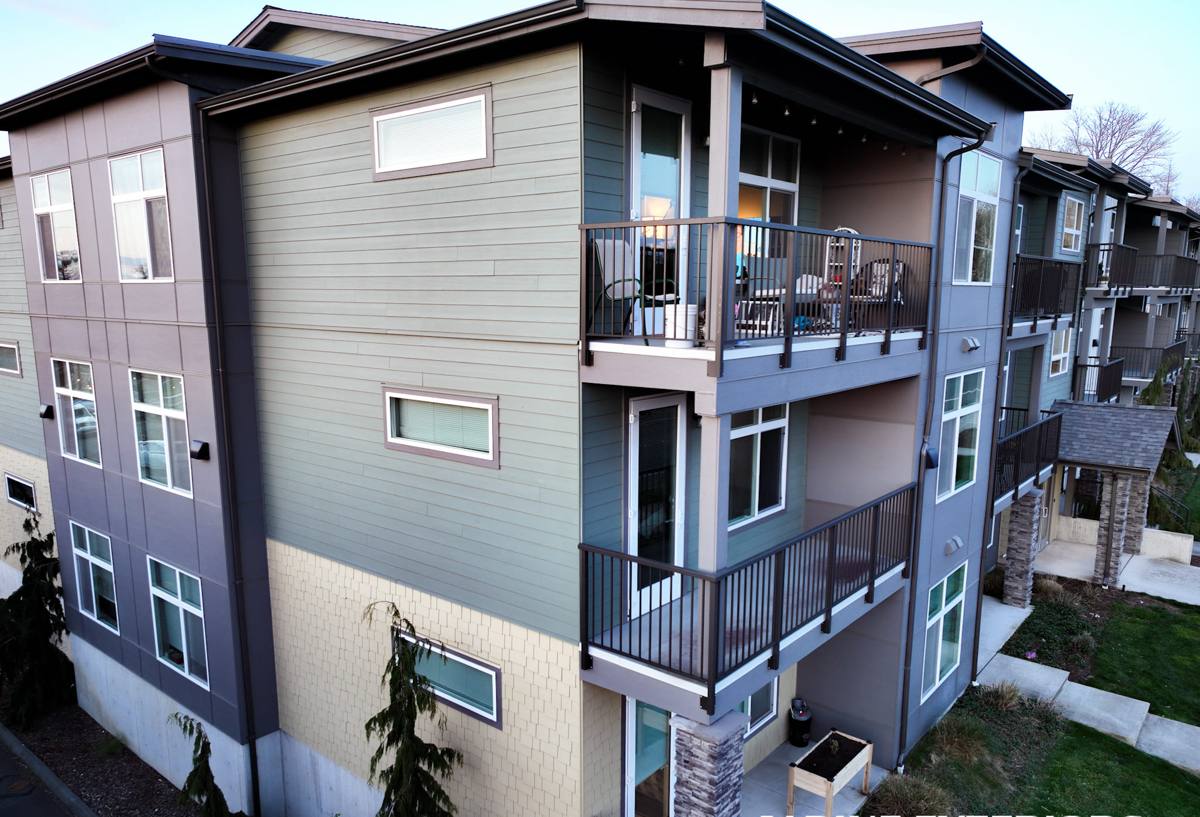
What Salt Air, Driving Rain, and Moss Actually Do to Siding
Each of these three factors wears on a house in a different way, and most siding failures we see in this region are the result of two or three of them working together over time.
Salt Air
Airborne salt is corrosive to exposed metal fasteners, flashing, and trim hardware, and it accelerates the breakdown of lower-grade paint finishes. On wood and engineered wood products, salt-laden moisture can also work its way into cut edges and seams, feeding rot from the inside out.
Driving Rain
Wind-driven rain doesn't just fall on siding — it gets pushed sideways and upward, into laps, seams, and any gap where flashing or caulking wasn't done correctly. A siding product with poor dimensional stability will gap and shrink over repeated wet cycles, opening exactly the kind of paths driving rain is looking for.
Moss and Organic Growth
A long moss season means extended periods where siding surfaces stay damp and shaded, which is ideal for moss, algae, and mildew growth. Beyond the cosmetic issue, sustained organic growth holds moisture against the siding surface far longer than it would otherwise sit there, which shortens the life of any product that isn't built to resist moisture absorption.
Why We Install James Hardie and Nothing Else
We made a decision as a company to install only James Hardie fiber cement siding, and we don't treat that as a marketing line — it's a standard we hold to on every job, including in Columbia. Fiber cement is non-combustible, dimensionally stable, and doesn't feed moisture the way wood-based products can. James Hardie backs its siding with engineered product lines (HardieZone HZ5 and HZ10) specifically built for regional climate conditions like the ones found across the Pacific Northwest, plus a factory-applied ColorPlus finish that's baked on under controlled conditions rather than field-painted.
We get asked why we don't also offer vinyl, LP SmartSide, or cedar. The honest answer is maintenance burden and moisture behavior. Vinyl can warp and fade, and it doesn't hold paint if a homeowner ever wants to change the color. Engineered wood products carry more risk at cut edges and seams if installation isn't precise. Cedar looks great on day one but demands an ongoing maintenance schedule — refinishing, sealing, and vigilant moisture management — that most homeowners don't want to keep up with for the life of the house. In a climate like Whatcom County's, those trade-offs show up faster than they would somewhere drier. We'd rather install one product correctly and stand behind it than offer four and hope one works out.
What a Correct James Hardie Installation Actually Involves
James Hardie siding performs the way it's rated to perform only when it's installed to the manufacturer's specifications. A lot of the problems homeowners eventually deal with aren't product failures — they're installation shortcuts that don't show up until years later.
- Proper clearances: siding held at least 6 inches above grade and roofing, with the manufacturer's minimum gap maintained at all penetrations
- Correct fastener pattern and type: corrosion-resistant fasteners driven at the spacing and depth Hardie specifies, not just "close enough"
- Flashing at every horizontal joint, window, and door: so water is directed out and away from the wall assembly rather than trapped behind the siding
- A weather-resistive barrier installed underneath, with proper overlap and sealing
- Factory-cut edges used wherever possible, with any field-cut edges properly sealed since raw cut edges are more vulnerable to moisture intake
- Caulking used only where Hardie's install guide calls for it — over-caulking traps moisture just as often as under-caulking lets it in
None of this is exotic. It's a checklist of details that either get followed or they don't, and skipping even one of them can undercut the durability that's the entire reason to choose fiber cement in the first place.
James Hardie Product Lines We Install
Most Columbia homes end up using some combination of lap siding for the main field, panel or shingle siding for accent areas, and trim to finish window, door, and corner details. Here's how the common product lines compare.
| Product | Typical Use | Notes for This Climate |
|---|---|---|
| HardiePlank Lap Siding | Primary wall covering | Most common choice; wide range of widths and textures, good water-shedding profile |
| HardiePanel Vertical Siding | Accent walls, gables, modern facades | Clean lines; needs correct joint treatment since seams run vertically |
| HardieShingle Siding | Accent areas, dormers | Traditional look with fiber cement's moisture resistance instead of natural shingle upkeep |
| HardieTrim Boards | Corners, window and door surrounds, fascia | Pairs with lap or panel siding; keeps a consistent, factory-finished look at every edge |
What Drives Cost on a Columbia Siding Project
Every house is different, but the same handful of factors tend to move the price up or down on projects in this area.
| Factor | Why It Matters |
|---|---|
| Amount of existing damage behind old siding | Rot or moisture damage found during tear-off has to be repaired before new siding goes on |
| House size and wall complexity | More corners, gables, and penetrations mean more flashing, trim, and cutting time |
| Product mix | Combining lap siding with panel or shingle accents adds material and labor variety |
| Existing siding type being removed | Removing old vinyl is usually faster than removing wood or a prior fiber cement installation |
| Access and site conditions | Tight lots, mature landscaping, or multi-story sections affect scaffolding and staging time |
We give real numbers after we've actually looked at the house — broad ranges quoted sight-unseen tend to be wrong in one direction or the other, and we'd rather you have an accurate figure than a fast one.
How We Work on Columbia Projects
Our process doesn't change based on neighborhood, but knowing the area helps us plan more accurately from the first visit.
1. On-Site Assessment
We walk the exterior, check the condition of the current siding and any water damage at trim, corners, and penetrations, and take measurements.
2. Written Scope and Estimate
You get a clear breakdown of product lines, colors, trim details, and cost — no vague allowances that turn into surprises later.
3. Tear-Off and Inspection
Once old siding comes off, we inspect the sheathing and framing underneath. Any moisture damage gets addressed before a single piece of Hardie goes up — covering damage over never ends well.
4. Weather Barrier and Flashing
This is the step that determines how the house performs in driving rain, and it's where we spend the time most crews want to rush through.
5. Installation to Manufacturer Spec
Fastener pattern, clearances, and joint treatment follow James Hardie's published installation guide, not shortcuts.
6. Final Walkthrough
We review the finished work with you directly before calling the job done.
Why Local Experience in Columbia Actually Matters
A crew that's already worked in Columbia and the surrounding Whatcom County area has seen how houses here actually age — where moss tends to build up first, which wall orientations take the worst of the driving rain, and how quickly a poorly flashed joint turns into a real problem in this climate. That's not something you can fully substitute with a generic install checklist. It shows up in small decisions: extra attention to a north-facing wall that never fully dries out, or catching early moss buildup that signals a drainage issue rather than just a cleaning need.
It also matters for scheduling. Siding work in this region has a real weather window, and a crew that knows the local pattern plans installation timing — and the sequence of tear-off, barrier work, and siding installation — around it, rather than getting caught mid-project by a stretch of wet weather.
Maintenance Checklist for Hardie Siding in This Climate
James Hardie siding is low-maintenance compared to wood or vinyl, but "low-maintenance" isn't "no-maintenance," especially with a long moss season in play.
- Rinse siding annually to clear salt residue, pollen, and early moss or algae growth before it takes hold
- Inspect caulking at trim and window edges yearly and re-caulk if it's cracked or pulled away
- Keep gutters clear so overflow doesn't run down the siding face repeatedly
- Trim back vegetation that keeps siding shaded and damp longer than it needs to be
- Check for any nail heads or fasteners showing corrosion and have them addressed promptly
- Watch for paint or finish changes at seams, which can signal moisture getting behind a joint
If your Columbia home's siding is showing its age — or you're planning ahead before the next wet season sets in — we're happy to take a look and give you a straight answer on what it needs. Reach out for a free, no-pressure estimate using the form below.