 Whatcom County
Building New in Everson Means Building for Whatcom County Weather
Everson sits in the Nooksack River lowlands, and if you're framing a new home here you already know the ground stays soft into late spring and the air rarely dries out for long. That combination — flat farmland, river humidity, and the long stretch of marine-influenced weather that moves through all of Whatcom County — puts new-construction windows under more moisture pressure than a lot of builders account for. Driving rain off the Pacific pushes water sideways against exterior walls during winter storms, and the moss season that stretches from fall through spring means anything that traps standing water on a sill or behind a flange stays wet for weeks, not days.
None of that is a reason to over-engineer a window package. It's a reason to get the ordinary things right: correct flashing sequence, correct sill pan, correct fastening, and glass specified for the actual exposure of the wall it's going into. New construction gives you one real advantage over a retrofit — you get to build the water management into the wall assembly before the siding ever goes on. Waste that advantage and you're doing retrofit-style repairs on a house that's barely finished.
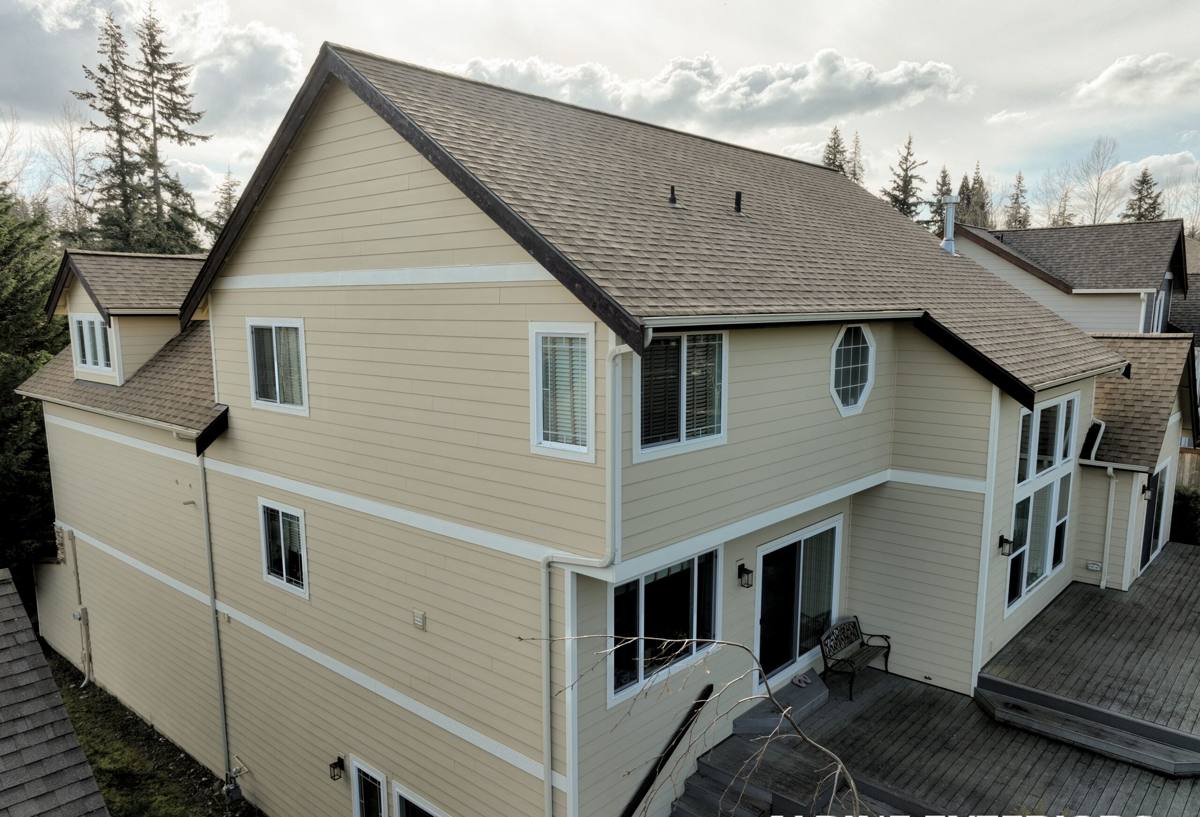
What "Correct" Actually Looks Like on a New-Construction Install
New-construction windows (as opposed to pocket replacements) have a nailing flange that ties directly into the weather-resistive barrier (WRB) on the wall. That flange is the whole point — it's your first line of defense against wind-driven rain — but it only works if the layering around it is done in the right order.
The sequence that actually keeps water out
- Sill pan installed first, sloped slightly to the exterior, so any water that gets past the window has somewhere to go besides the framing below it
- Back-dam or end dams at the sill pan corners so water can't wick sideways into the wall cavity
- Window set, shimmed level and plumb, and fastened per the manufacturer's schedule — not just "enough screws to hold it"
- Flashing tape applied jamb-first, then head, in a shingle-lap order so every layer sheds water down and out, never up and in
- WRB integrated over the head flashing last, maintaining the same shingle-lap principle up the wall
- Sealant used at the right joints only — over-sealing a window so it can't drain if water does get behind it is one of the most common mistakes we see corrected on newer Whatcom County homes
Skip the sill pan or reverse the lap order and the window can look perfect for a year or two — then a wet winter finds the gap. In this county, that "wet winter" isn't a rare event; it's most winters.
Choosing Frame and Glass for Everson's Climate
New construction is also where you have full freedom on frame material and glazing package, since you're not constrained by an existing opening. That decision matters more here than in a drier region because the frame is going to sit under sustained damp air and periodic direct rain load for most of the year.
| Frame Material | Moisture Behavior | Maintenance | Typical Fit for Everson New Builds |
|---|---|---|---|
| Vinyl | Won't rot or corrode; expands/contracts with temperature swings | Low — occasional cleaning | Solid, cost-effective default for most new homes |
| Fiberglass | Very stable dimensionally; handles wet-dry cycling well | Low | Good upgrade where larger openings or dark exterior colors are planned |
| Wood-clad | Interior wood needs the cladding and flashing detail to stay flawless, or moisture finds the wood over time | Higher — relies on the install being perfect | Only where the look is a priority and the owner accepts the added care |
| Aluminum (uninsulated) | Conducts cold and cold-climate condensation readily | Low, but condensation issues are common | We generally steer new builds away from this here for comfort reasons, not brand reasons |
On glass, a dual-pane unit with a Low-E coating tuned for our climate is the standard starting point, and it's what meets Washington's energy code in most assemblies without needing to jump to triple-pane. Triple-pane earns its cost on north-facing walls, larger picture windows, or if the homeowner specifically wants a quieter interior — Everson isn't a high-noise area, but the extra pane does help with condensation resistance on cold, damp mornings, which is a real consideration given how much humidity sits in this valley overnight.
Condensation is a climate issue here, not a product defect
We get calls about interior condensation on new windows more in Whatcom County than in drier parts of the state, and it's almost never the window's fault. Indoor humidity from a new home's curing concrete, drywall mud, and fresh paint combined with our damp outside air pushes dew point conditions on glass surfaces, especially in the first heating season. The fix is ventilation and glazing spec matched to the room, not a different window brand.
Meeting Energy Code Without Overpaying
Washington's energy code sets minimum U-factor requirements for new-construction fenestration, and Whatcom County building departments check for it at inspection. The good news is that a well-specified dual-pane, Low-E window package clears code comfortably on most standard elevations. Where it gets tighter is on large glazing runs — big sliders, corner windows, great-room walls of glass — where the average U-factor for the whole elevation has to be managed, sometimes by upgrading a few key units to triple-pane or a warmer-edge spacer rather than upgrading everything. We run those numbers before the order goes in, not after a failed inspection.
How the Process Runs on a New-Construction Job
- Plan review and rough opening verification — we confirm window sizes against the framing plan before anything is ordered, since a correction after framing is up costs everyone time.
- Energy code and egress check — bedroom egress sizing and elevation U-factor targets get confirmed against the plan set.
- Order and lead time — custom sizes and upgraded glazing packages run longer lead times than stock sizes; we build that into the GC's schedule rather than surprising anyone at dry-in.
- Install at the dry-in stage — sill pans, flashing, and window setting happen once the WRB is on and before siding starts, so the water management layers go in the correct order the first time.
- Inspection-ready documentation — flashing photos and product labels are kept for anything the inspector or the homeowner wants to see later.
- Final adjustment — after the house has gone through a heating cycle, we check operation and seals once, since new framing does settle slightly.
Timing the Install Around Whatcom County Weather
The single biggest scheduling risk on a new build here isn't the window itself — it's the gap between when the WRB goes on and when the windows and siding close the wall up. Everson's exposure to driving rain off passing Pacific systems means an open wall can take on water fast if that gap runs longer than planned. We coordinate directly with the general contractor to sequence window install tight against WRB completion and to have temporary protection ready if a storm is tracking in before siding can close things up. This is a scheduling discipline as much as an installation skill, and it's the kind of thing that only comes from having run this sequence on other Whatcom County builds, not from reading a spec sheet.
Pre-install and during-install checklist
- Rough openings squared, plumb, and sized correctly before windows arrive on site
- WRB installed and lapped correctly before window set begins
- Sill pans and back-dams in place at every opening, no exceptions for "small" windows
- Flashing tape rated for the temperature it's actually being applied in — cold, damp mornings affect adhesion
- Weather window checked before starting a run of openings that can't be closed up same-day
- Fastening schedule followed per manufacturer instructions, not shortcut for speed
- Photos taken of flashing layers before siding covers them, for the homeowner's records
Why It Matters That We Already Work Everson
A crew that's only installed windows in a dry climate will get the fastening and the glass right and still miss the moisture management, because it's never been the thing that decided whether their last ten jobs held up. Everson's combination of river-bottom humidity, sustained rain events, and a moss season that runs most of the year rewards crews who treat flashing sequence and drainage as the actual job, not paperwork around the job. We size lead times against real Whatcom County permit and inspection timelines, we know which elevations on a typical new build take the worst weather exposure, and we don't guess at code minimums because we've run those numbers on homes down the road from yours.
If you're framing a new home in Everson or anywhere else in Whatcom County, we're glad to walk the plan set with you and put together a straightforward, no-pressure estimate — just fill out the form below to get started.