 Whatcom County
 Roof Repair in Samish: Built for This Climate, Not a Generic Playbook
Samish sits in one of the tougher spots in Whatcom County for a roof to survive. You've got salt-laden air coming off the water, long stretches of driving rain that finds every weak seam, and a moss season that can run most of the year in shaded, north-facing sections of a roof. None of that is unique to any one house — it's what every roof in this area is up against, whether it's five years old or thirty. A repair that works on a roof in a dry inland town won't necessarily hold up here, and that's the difference between a fix that lasts and one you're paying for again in two winters.
We work roofs across Whatcom County, and Samish jobs come with a specific pattern: valleys and low-slope sections that trap moisture, fastener corrosion from salt exposure, and moss colonies that hold water against the roofing material long after a storm has passed. A correct repair here accounts for all three, not just the visible leak.
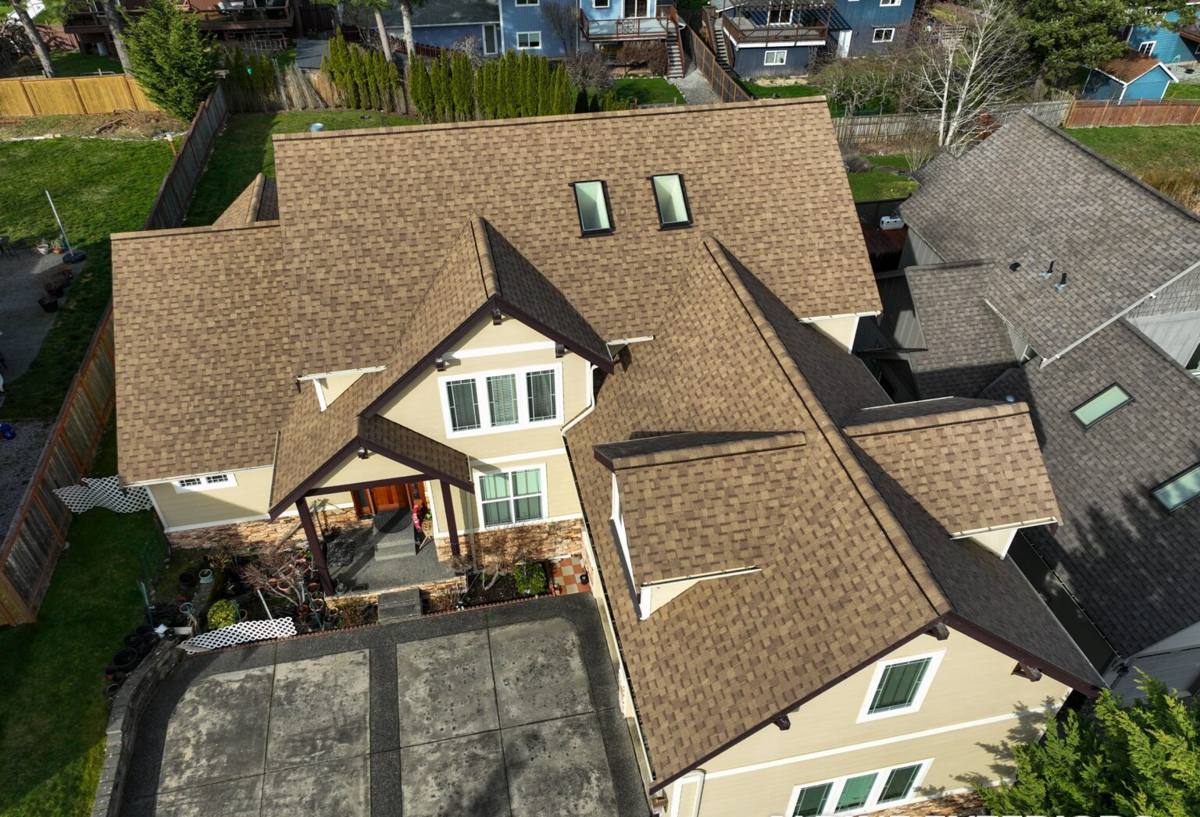
Signs Your Samish Roof Needs Repair, Not Replacement
Most roof problems don't start as a hole — they start small and get ignored because nothing is dripping into the living room yet. Watch for:
- Granules collecting in gutters or at downspout outlets (a sign of asphalt shingle wear)
- Dark streaking or green-black patches, which usually means algae or moss taking hold
- Curling, lifting, or cracked shingle edges, especially on south and west-facing slopes
- Rusted or lifted flashing around chimneys, vents, and skylights
- Soft spots or sagging when walked on (we check this, not something to test yourself)
- Daylight visible through the roof deck from inside the attic
- Interior ceiling stains, even faint ones that come and go with weather
Catching these early is what keeps a job a repair instead of a replacement. A roof that's otherwise structurally sound with 8-15 years of life left in the field shingles is almost always a better candidate for targeted repair than a full tear-off — but only if the repair addresses the actual cause, not just the symptom.
When a Leak Isn't Actually a Roof Problem
Not every water stain traces back to the roofing material itself. Flashing failures, clogged or undersized gutters, ice damming in cold snaps, and even siding or window flashing issues higher up the wall can mimic a roof leak. Part of doing this correctly is confirming the source before opening anything up — we've seen homeowners quoted for roof work that wouldn't have fixed the actual problem.
What a Correct Roof Repair Involves
A repair that actually holds in this climate isn't just "replace the shingle you can see." The steps that matter:
- Full-area inspection, not just the reported leak location — one bad spot often means neighboring areas are close behind
- Deck inspection underneath removed shingles, checking for soft, delaminating, or rotted plywood/OSB
- Underlayment condition check, since a failed underlayment under otherwise decent shingles is a common hidden cause of leaks
- Flashing repair or replacement at penetrations — chimneys, vents, skylights — where most coastal leaks actually originate
- Proper shingle tie-in using correct nailing patterns and matching exposure, not just gluing a patch over the gap
- Moss and debris clearing in valleys and low-slope transitions before closing the repair up
- Sealant applied only where appropriate — as a supplement to correct flashing work, never as a substitute for it
Skipping the deck and flashing inspection is the most common shortcut in the trade, and it's exactly why "repaired" roofs leak again the next wet season. If the deck underneath is compromised, no amount of shingle work on top fixes that.
Moss, Algae, and Salt Air: The Samish Roof Triple Threat
These three factors interact, and treating them separately misses the point.
Moss
Moss doesn't just look bad — it lifts shingle edges as it grows, holds moisture against the roofing surface for days after rain, and works its way under tabs where it accelerates granule loss. Once established in a shaded valley or north slope, it spreads unless physically removed and the conditions that let it take hold (usually overhanging branches and inadequate airflow) are addressed.
Algae
Those dark streaks are typically algae, not dirt or age. It's mostly cosmetic on its own, but it retains moisture the same way moss does, and on older shingles it can accelerate granule breakdown.
Salt Air
Metal components — nails, flashing, vent boots with metal collars — corrode faster this close to the water. A repair that reuses corroded fasteners or flashing because it "still looks okay" is a repair with a short clock on it. We use fasteners and flashing rated for coastal exposure on every Samish repair, not just when a homeowner asks for it.
Repair vs. Replacement: How We Help You Decide
| Factor | Favors Repair | Favors Replacement |
|---|---|---|
| Age of roofing material | Under ~15 years (asphalt) | Approaching or past manufacturer lifespan |
| Extent of damage | Localized — one slope, one penetration | Widespread across multiple slopes |
| Deck condition | Solid, no rot found | Soft spots or rot in multiple areas |
| Leak history | First occurrence, clear cause | Repeated leaks in different spots |
| Granule loss | Minor, isolated | Heavy, roof-wide |
| Budget timeline | Extend usable life a few years | Avoid paying for repeat repairs |
We'll tell you honestly which side of this table your roof falls on. If a repair is genuinely the right call, that's what we'll recommend — we're not trying to sell a replacement a roof doesn't need yet, and we're not going to patch something that's going to fail again in a season either.
Our Roof Repair Process
The process is straightforward, and we keep you informed at each step rather than disappearing until it's done:
- Inspection and assessment — we get on the roof (weather permitting) and check the deck, flashing, and full field, not just the reported problem area
- Written scope and estimate — what we found, what we recommend, and why, in plain language
- Scheduling around weather — repair work needs a dry window; we plan around Whatcom County's forecast rather than rushing into a wet roof
- The repair itself — deck, flashing, and shingle work as needed, using materials appropriate for coastal exposure
- Site cleanup — old material, debris, and stray fasteners removed, magnet-swept where applicable
- Walkthrough — we show you what was done and what to watch for going forward
Emergency and Storm-Damage Repairs
When a storm off the water takes shingles or damages flashing, the priority is stopping active water intrusion first — tarping or temporary sealing if needed — then scheduling the permanent repair once materials and a dry window line up. We don't leave a temporary fix as the final answer.
Materials We Use and Why
| Material | Why We Use It / Trade-offs |
|---|---|
| Architectural asphalt shingles | Better wind and impact resistance than 3-tab, wide color range, straightforward repair matching down the road |
| Corrosion-resistant flashing (galvanized/stainless) | Standard flashing corrodes faster in salt air; we treat coastal-rated flashing as the baseline, not an upgrade |
| Synthetic underlayment | Holds up better to repeated wet-dry cycling than older felt products during the repair window |
| Algae-resistant shingle lines | Where full-slope work is involved, these reduce (not eliminate) future algae staining |
On some coastal jobs, homeowners ask about cedar shake or certain low-cost composite options. Our standard is to walk through the real maintenance burden and moisture behavior of those products in a wet, salt-air climate before recommending them for anything beyond a homeowner's clear preference — some materials simply demand more upkeep here than others, and we'd rather you know that upfront than find out after installation.
Why a Crew That Already Works Samish Matters
A roofer who's mostly worked drier inland areas of Whatcom County will assess a Samish roof differently than one who works this stretch regularly. We know which slopes tend to hold moss, which flashing details fail first in salt air, and how much of a buffer to build into scheduling around driving rain. That's not a sales pitch — it changes what gets checked during an inspection and what materials get specified for the repair.
It also means we're not guessing at appropriate fastener and flashing grades for this exposure — we're using what we already know holds up here.
Maintenance That Extends a Repair's Life
A good repair still needs basic upkeep to reach its full lifespan. Homeowners can reasonably handle:
- Clearing gutters and downspouts at least twice a year, more if surrounded by trees
- Trimming back branches that overhang the roof to reduce shade and debris buildup
- Watching for moss regrowth in valleys and shaded slopes after wet winters
- Checking the attic after major storms for new staining or daylight gaps
- Scheduling a professional inspection every couple of years, or after any significant storm
None of this replaces a proper inspection, but it catches problems while they're still small and cheap to fix.
If you're dealing with a leak, visible moss, or just want an honest read on where your roof stands, we're glad to come take a look. The estimate is free, there's no pressure to sign anything on the spot, and if a repair is the right call instead of a full replacement, that's exactly what we'll tell you.