 Whatcom County
Why Decks in Silver Beach Wear Out Faster Than the Manufacturer's Warranty Suggests
Every deck sold in the Pacific Northwest comes with a warranty that assumes reasonably dry, sunny conditions and a homeowner who power-washes on schedule. Whatcom County doesn't offer those conditions. Between the marine-influenced air off the Salish Sea, the long stretch of overcast, drizzly months, and lots that sit in the shade of mature Douglas fir and cedar, a deck here is wet far more often than the warranty paperwork assumes.
Silver Beach in particular tends to sit on tree-covered, sloped lots close to the water, which means decks here get less direct sun and more standing moisture than a deck out in open farmland east of the county. That combination — shade, moisture, and a long moss season that can run from fall through spring — is exactly what breaks down fasteners, rots ledger boards, and turns a walking surface slick and dangerous well before the structure is actually unsafe to the eye.
None of this means Silver Beach is a bad place for a deck. It means a deck built or replaced here needs to be built for these conditions specifically, not built to a generic spec sheet and hoped for the best.
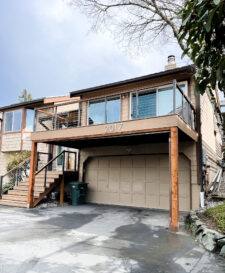
Signs Your Deck Needs Replacement, Not a Repair
We get called out for both repairs and full replacements, and honestly, not every deck that looks rough needs to be torn out. But there's a point where patching boards is just delaying a bigger problem — and often costs more over time than doing the job right once. Here's what tells us a deck is past the point of spot repair:
- Soft or spongy spots in the decking, especially near the house or around post bases
- Rust streaks or crumbling wood around fasteners and joist hangers
- A ledger board that's separating from the house, or visible gaps behind the flashing
- Posts or footings that have shifted, rocked, or sunk into the soil
- Persistent green or black staining that comes back within weeks of cleaning
- Railings that flex noticeably when you lean on them
- A deck older than 15-20 years that's never had the substructure inspected
If you're seeing one or two of these, a repair might buy you time. If you're seeing several, or if the framing underneath is compromised, replacement is the safer and usually more cost-effective call.
What a Correct Deck Replacement Actually Involves
The Structure Comes First
The decking boards are what everyone sees, but the framing underneath is what keeps people safe. A proper replacement means inspecting and, where needed, rebuilding the ledger board attachment, joists, beams, posts, and footings — not just laying new boards over old framing and hoping it holds. In a climate that keeps wood damp for months at a time, framing lumber needs to be rated for ground contact or outdoor exposure, and every connection point needs proper hardware, not just nails.
Flashing Is the Part Nobody Sees and Everybody Needs
Most of the deck failures we investigate in this region trace back to one thing: water getting behind the ledger board where it attaches to the house. Proper ledger flashing — installed correctly, in the right order relative to the house's own weather barrier — is what keeps rainwater from working its way into the rim joist and the wall framing behind it. This is the single most important detail on any deck replacement in a wet climate, and it's also the easiest thing for a rushed crew to shortcut.
Fasteners and Hardware Rated for the Job
Standard hardware corrodes fast in damp, salt-influenced air. Structural connectors, joist hangers, bolts, and screws should be hot-dip galvanized or stainless steel, matched to whatever decking material is going down — mixing incompatible metals accelerates corrosion in both directions.
Drainage and Airflow Underneath
A deck that traps moisture underneath will always outlast a deck that traps moisture underneath by a smaller margin — neither lasts as long as one built with real airflow and drainage in mind. Grading the ground beneath the deck, keeping vegetation clear, and in some cases adding a drainage system for low, enclosed decks all extend the life of the structure significantly.
Choosing Decking Material for a Shaded, Wet Lot
There's no single "best" decking material — there's a best material for your specific lot, your budget, and how much upkeep you actually want to do. On a shaded, moisture-heavy lot like much of Silver Beach, the trade-offs look a little different than they would on an open, sunny lot.
| Material | How It Handles Local Moisture & Moss | Maintenance | Relative Material Cost |
|---|---|---|---|
| Pressure-treated wood | Needs sealing/staining regularly or it grays, cups, and grows moss fast in shade | High — annual cleaning and periodic refinishing | Lowest |
| Cedar | Naturally rot-resistant but still needs maintenance in constant damp shade | Moderate to high | Mid |
| Composite (capped) | Resists rot and moisture absorption well; surface can still get slick with algae if never cleaned | Low — occasional washing | Mid to upper |
| PVC / cellular PVC | Doesn't absorb moisture at all, most resistant to mold staining in deep shade | Lowest | Highest |
For heavily shaded, tree-covered lots, we lean toward capped composite or PVC when budget allows, simply because they don't feed moss and algae the way raw wood fibers do. That said, plenty of homeowners choose wood deliberately for the look and cost, and a well-flashed, well-drained wood deck with a realistic maintenance routine will serve you fine — it just asks more of you every year.
Our Deck Replacement Process
1. On-Site Assessment
We walk the existing deck and look underneath it — not just at the surface boards. That's where we find out whether this is really a replacement job and what the framing situation actually is.
2. Plan, Permit, and Material Selection
We talk through material options honestly, including the trade-offs above, and handle the permitting steps that apply to your project and jurisdiction.
3. Demo and Disposal
Full removal of the old deck, including framing that's being replaced, with the site cleaned up and debris hauled off — not left in a pile for you to deal with.
4. Rebuild
Framing first, with correct flashing and hardware, then decking, then railings and any stairs. We don't move to the next stage until the stage underneath it is right.
5. Final Walkthrough
We walk the finished deck with you, point out how to maintain whatever material you chose, and make sure you're comfortable with the result before we call it done.
Permits and Code Considerations
Deck replacements that involve structural work — new footings, changes to size or height, or attaching to the house — typically require a permit and inspection under local building code, whether the project is inside Bellingham city limits or unincorporated Whatcom County. Requirements can vary depending on the deck's height above grade, its size, and whether it's attached to the house, so this isn't something to assume your way through. A crew that pulls permits and handles inspections as a normal part of the job protects you if you ever sell the house — an unpermitted deck rebuild is a common snag in real estate inspections.
Why Local Experience in Silver Beach Actually Matters
A deck replacement isn't just carpentry — it's carpentry for a specific site. A crew that's worked other properties in Silver Beach and around Whatcom County already knows what the shaded, damp lots in this area do to fasteners and framing over time, has a feel for how the local permitting process runs, and isn't guessing at material choices based on a spec sheet written for a different climate. That familiarity shows up in fewer surprises during the job and a deck that's actually built for the conditions it'll sit in for the next 20-plus years, not just the conditions on the day it's built.
Keeping Your New Deck in Good Shape
Whatever material you choose, a little seasonal attention goes a long way in this climate:
- Clear leaves and debris out of gaps between boards before fall rains set in
- Rinse or sweep off moss and algae growth before it stains the surface
- Trim back overhanging branches to let in more light and airflow where possible
- Check railings and stair connections once a year for any movement
- For wood decks, plan on cleaning and resealing on the schedule your material calls for — don't wait until it looks bad
- Keep gutters and downspouts near the deck clear so runoff isn't draining directly onto it
A deck built right and looked after with these basics will handle a Whatcom County winter far better than one that's neglected until problems show up.
If your deck is showing its age or you're just not sure whether it needs repair or full replacement, we're happy to take a look and give you a straight answer. Reach out for a free, no-pressure estimate using the form below.