 Whatcom County
Siding That Actually Fits Sunnyland's Climate
Sunnyland sits close enough to Bellingham Bay that salt-laden air is a daily fact of life on the exterior of a house, not an occasional nuisance. Add Whatcom County's long wet season, driving rain off the Sound, and the shaded, damp conditions that let moss take hold on north-facing walls and eaves, and you end up with siding conditions that are genuinely harder on a house than most of the Pacific Northwest sees. A siding product and installation that would hold up fine in a drier inland town can fail early here — not because it's a bad product everywhere, but because it wasn't built for this specific combination of salt, moisture, and shade.
This page is about one job, done right, in one neighborhood: fiber cement siding installation and replacement for Sunnyland homes. We're not going to give you a generic rundown of fiber cement in general — you can find that elsewhere on our site. This is about what your house, in this location, actually needs.
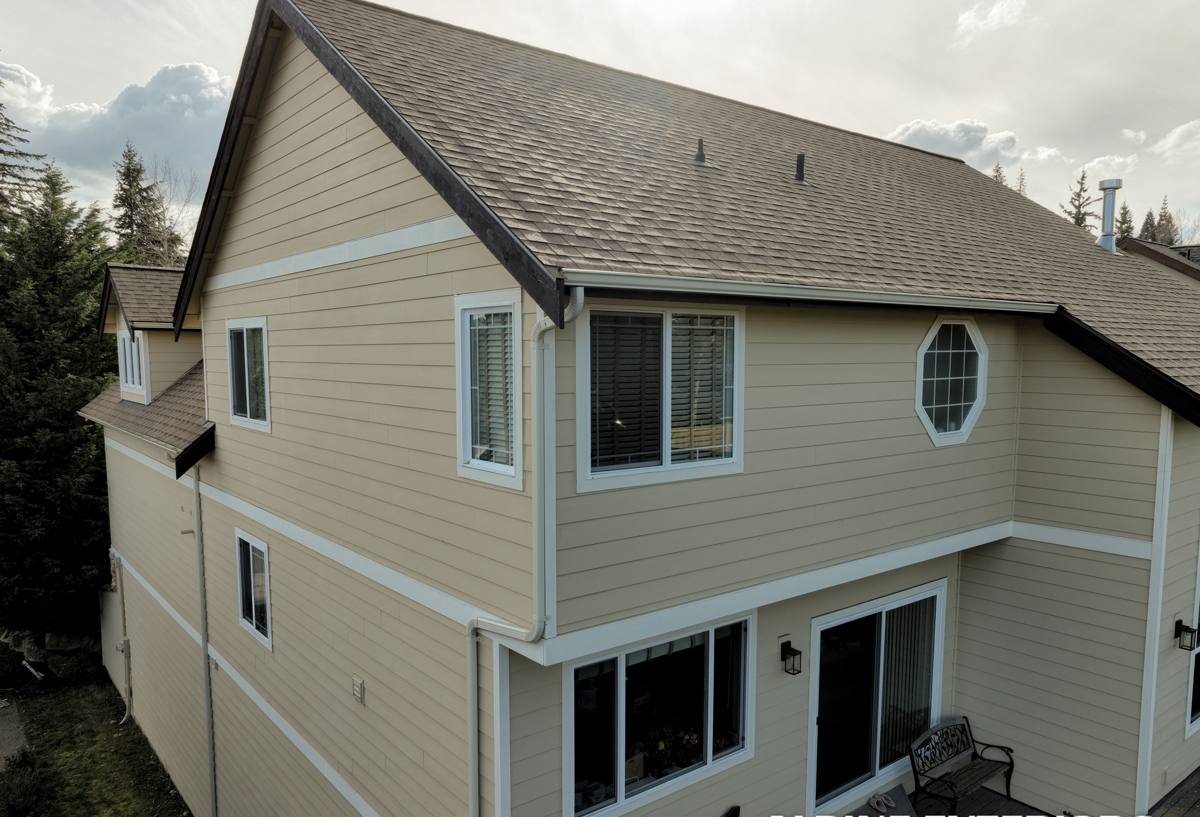
What Salt Air, Rain, and Moss Do to Siding Over Time
Salt Air and Fasteners
Salt air accelerates corrosion on anything metal — nail heads, trim flashing, hose bib fittings, light fixture mounts. Siding itself doesn't rust, but the fasteners holding it up and the metal flashings protecting the seams around it absolutely can, especially on the sides of a house that face open water or get onshore wind. Once a fastener corrodes and loosens, or a flashing pits and starts leaking, the siding above it is only as good as what's failing underneath it.
Driving Rain and Wall Assembly
Whatcom County doesn't just get a lot of rain — a good share of it comes in sideways during fall and winter storms. That matters more than total rainfall totals suggest, because driving rain finds every gap in a wall assembly: unsealed butt joints, siding installed too tight to trim, missing kick-out flashing above door and window heads, caulk used in place of proper flashing. A wall built for light, straight-down rain in a drier climate often just isn't detailed for what hits it here.
Moss, Shade, and Trapped Moisture
Sunnyland has mature tree cover in a lot of yards, which is great for shade and privacy and bad for how long a wall stays wet after a storm. North- and east-facing walls that don't get much sun can stay damp for days, and that's exactly the environment moss and mildew need to establish themselves on siding, trim, and roof lines. Moss holds moisture against the surface it's growing on, which is a slow, steady problem for paint film, caulk joints, and any wood trim nearby — even when the siding material itself is unaffected.
Why We Install Only James Hardie Fiber Cement Here
We don't install vinyl, LP SmartSide, Cemplank, Allura, primed spruce, or cedar. That's a deliberate standard, not a lack of options, and it matters more in a climate like Sunnyland's than it would somewhere drier.
- Non-combustible material — fiber cement doesn't burn, rot, or feed insects, which removes several of the failure modes that wood and wood-composite sidings deal with under sustained moisture exposure.
- Factory-applied ColorPlus finish — baked-on rather than field-applied, so it holds color and resists the fading and chalking that salt air and UV exposure cause faster on site-painted surfaces.
- HZ5 product engineering — Hardie's HZ line is engineered for wetter, harsher climate zones, which is a better match for driving rain and marine-influenced air than a product engineered for a general national climate average.
- A warranty that's actually transferable — this matters in a neighborhood with steady turnover, since a new buyer inherits real coverage rather than a warranty that dies at the sale.
To be fair to the alternatives: vinyl is cheaper up front and low-maintenance in mild climates, and cedar has a look some homeowners genuinely prefer. We're not telling you those products are junk. We're telling you why, after weighing moisture behavior, maintenance burden, and long-term performance in this specific climate, we standardized on one product line and stopped installing the others.
What a Correct Fiber Cement Job Actually Involves
Fiber cement siding is only as good as the assembly behind it. In a climate that pushes rain sideways and keeps walls damp, the details most homeowners never see are the ones that determine whether the siding lasts twenty-plus years or starts showing problems in five.
Water-Resistive Barrier and Flashing
Every wall gets a continuous weather-resistive barrier behind the siding, lapped correctly from bottom to top so water sheds outward instead of working its way behind the cladding. Window and door heads get proper flashing and, where the wall detail calls for it, kick-out flashing to direct water away from the wall at rooflines — a detail that's easy to skip and expensive to fix later.
Fastening and Clearances
Hardie specifies fastener type, spacing, and penetration depth for a reason, and in a corrosive salt-air environment we pay particular attention to using fasteners rated for that exposure. Siding also needs proper clearance from grade, roof lines, and decks — clearances that keep splashback and ponding water from sitting against the bottom courses.
Joints, Caulking, and the ColorPlus System
Butt joints get treated as the vulnerable seams they are, not just butted and caulked. Where the ColorPlus factory finish is cut or drilled, exposed edges get treated with the matching touch-up system so the cut edge doesn't become the one spot on the house that absorbs moisture and fails early.
Our Process for Sunnyland Installations
- On-site assessment — we look at sun exposure, tree cover, prevailing wind and rain direction, and the condition of the existing wall assembly before quoting anything.
- Moisture and substrate check — any rot, existing moisture damage, or failed flashing gets identified and addressed before new siding goes up. Covering a wet wall with new siding just hides the problem.
- Prep and flashing correction — water-resistive barrier, window and door flashing, and kick-out details are installed or corrected to current standards, not just matched to whatever was there before.
- Installation to spec — Hardie siding, trim, and fasteners installed per manufacturer specifications, with attention to fastener corrosion resistance and joint treatment given the local air quality.
- Final walkthrough — we go over the finished work with you, including what routine maintenance looks like for your specific exposure (shade, sun, wind direction).
Cost Factors for Fiber Cement Siding in Sunnyland
Every house is different, and we don't quote sight-unseen, but these are the variables that actually move the number on a Sunnyland job:
| Factor | Why It Matters Here |
|---|---|
| Extent of hidden moisture damage | Shaded, damp walls uncover more sheathing or framing repair than dry-side walls |
| Amount of trim and flashing replacement | Salt-air corrosion often means more flashing needs replacing than siding alone would suggest |
| Wall complexity (dormers, bays, multiple stories) | More corners and transitions mean more flashing detail and labor time |
| Siding profile and accessories chosen | Lap width, trim style, and factory color all affect material cost |
| Access and site conditions | Mature trees, tight lot lines, and sloped yards common in Sunnyland can affect staging and labor |
Maintenance in a Moss-Prone, Salt-Air Neighborhood
Fiber cement is low-maintenance compared to wood, but "low-maintenance" doesn't mean "no maintenance" in this climate. A short seasonal routine goes a long way:
- Rinse siding annually, focused on shaded north- and east-facing walls where moss and grime build up fastest
- Keep gutters clear so overflow doesn't run down the siding face during heavy rain
- Trim back tree branches and shrubs that keep a wall section shaded and damp longer than the rest of the house
- Inspect caulking at trim joints and penetrations once a year, and re-caulk before gaps open up
- Address any moss growth on adjacent roofing promptly, since roof runoff carries spores onto siding below
- Watch for chalking, fading, or lifting at seams as early signs worth a professional look
Why Hiring a Crew That Already Works Sunnyland Matters
A contractor who works this neighborhood regularly already knows which walls face prevailing weather, which lots have the moisture-holding tree cover, and which older homes are likely to have flashing that hasn't been touched since original construction. That's not a marketing point — it's the difference between a quote that accounts for what a house actually needs and one that's copied from a generic estimate template. It also means someone local is available if a warranty question or maintenance question comes up years down the road, rather than a crew that installed the siding once and moved on to the next region.
If you're weighing a siding replacement or repair in Sunnyland, we're happy to walk your property, point out what your specific exposure means for the job, and give you a straight answer on what it involves. Request a free, no-pressure estimate using the form below.