 Whatcom County
 Why Decks in Columbia Take a Beating
Decks in the Columbia area don't fail because the wood was bad or the crew that built them didn't care. They fail because Whatcom County weather is genuinely hard on outdoor structures, and most decks weren't built with that in mind. Salt-tinged marine air, long stretches of driving rain, and a moss season that can run from fall clear through spring all work on a deck at the same time, from different directions. A deck that would last three decades in a dry inland climate can start showing real structural problems in half that time here if it wasn't built correctly for this specific environment.
Salt Air and Metal Fasteners
Even set back from the water, homes in this part of Whatcom County get enough salt-laden air to accelerate corrosion on standard fasteners. Nails and screws rated for general construction start rusting from the inside of the wood outward, which means you often can't see the damage until a board pulls loose or a joist hanger fails. Once corrosion starts on a fastener, it weakens the wood fibers gripping it, and that damage doesn't reverse itself — it only gets replaced or it gets worse.
Rain, Shade, and the Long Moss Season
Driving rain doesn't just fall on a deck, it drives sideways into ledger connections, under railing posts, and into any seam that isn't properly flashed. Combine that with tree cover and the shaded, damp conditions common to many Columbia lots, and you get a moss season that can last most of the year. Moss and algae hold moisture against the wood surface long after the rain has stopped, which is exactly the condition wood rot needs to take hold. A deck that never gets a chance to fully dry out is a deck that's rotting slowly, even if it looks fine from a distance.
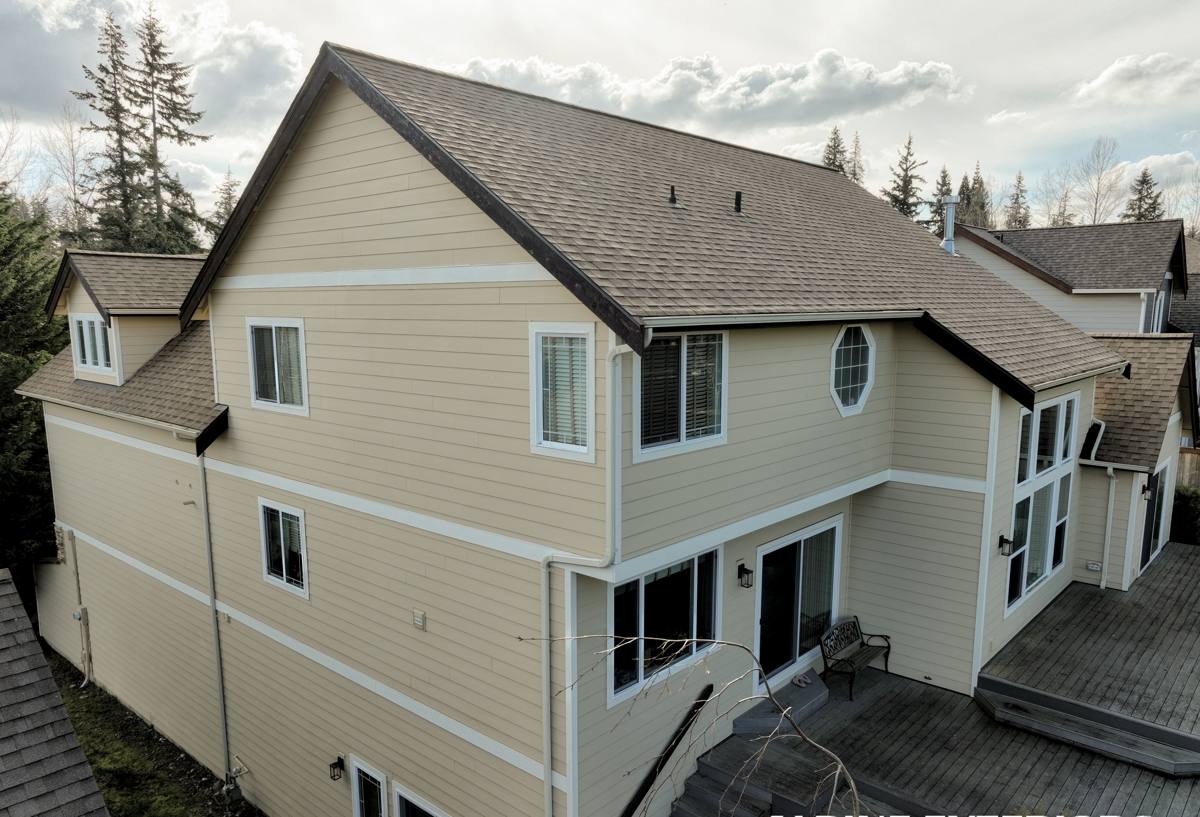
Signs Your Columbia Deck Needs Replacement, Not Just Repair
Not every deck problem means starting over. But there's a point where patching individual boards is just delaying a bigger job and spending money that won't carry forward into the replacement. Here's what tells us a deck has crossed that line:
- Boards that feel soft, spongy, or flex noticeably when you walk across them
- Rust streaking or staining around screw and nail heads
- The ledger board (where the deck attaches to the house) showing gaps, dark staining, or separation from the siding
- A screwdriver that sinks easily into joists or posts when pressed — a sign of internal rot
- Railings or guardrail posts that wobble or have visibly loosened over time
- Moss or algae that returns within days of being cleaned off, even after a dry stretch
- A deck built more than 20 years ago with untreated or minimally treated lumber and no visible flashing at the ledger
If you're seeing two or more of these, a replacement is almost always the more honest recommendation than a repair — and it's usually the more cost-effective one over the next 10-15 years.
What a Correct Deck Replacement Involves
A deck replacement is more than pulling up old boards and screwing down new ones. The parts you don't see — the ledger connection, the framing, the hardware — are what determine whether the new deck actually holds up to another round of Whatcom County winters.
Ledger Board and Flashing
The ledger board is the single most common failure point on decks in wet climates, and it's also the part most likely to get shortcut on a lower-quality job. Proper flashing at this connection directs water away from the house band board instead of letting it wick in behind the siding. In a driving-rain climate, this detail alone can be the difference between a deck that lasts and one that causes hidden water damage to the house itself.
Framing and Hardware
We use hot-dip galvanized or stainless steel hardware rated for coastal and marine-influenced exposure, not standard interior-grade fasteners. Joist hangers, structural screws, and post connectors all take a beating from salt air over time, and using the wrong grade of hardware is one of the most common reasons a deck's structure fails years before its decking surface does. Joist spacing and sizing also get set to current code span tables for the decking material chosen, not just matched to whatever the old deck had.
Footings and Structural Support
Footings need to sit below the frost line and bear on solid, undisturbed soil — not just be poured wherever the old posts happened to be. Post bases should keep the wood post off the concrete footing entirely, since wood sitting directly on concrete wicks moisture continuously and rots from the base up, often invisibly, until the deck starts to lean.
Decking Material Options for Whatcom County Weather
There's no single "best" decking material — there's a best material for your budget, your maintenance appetite, and how much sun or shade your particular lot gets. Here's how the common options actually perform under the conditions Columbia homes deal with:
| Material | Moisture & Moss Behavior | Maintenance | Typical Lifespan |
|---|---|---|---|
| Pressure-treated wood | Absorbs water, needs airflow underneath to dry; prone to moss without regular cleaning | Annual cleaning and periodic sealing/staining | 10-15 years before major issues |
| Cedar | Naturally rot-resistant but still absorbs moisture; moss grows on shaded boards over time | Sealing or staining every 2-3 years | 15-20 years with upkeep |
| Capped composite | Does not absorb water into the core; moss can still grow on the surface but doesn't cause structural rot | Occasional washing, no sealing or staining | 25-30 years, manufacturer-backed |
| PVC decking | Fully water-resistant, best resistance to moss staining and moisture damage | Occasional washing only | 25-30+ years, manufacturer-backed |
Our standard recommendation for Columbia homes with heavy shade or tree cover is capped composite or PVC, simply because the maintenance burden of wood in a long moss season is real and ongoing. That said, some homeowners prefer the look and feel of real wood and are willing to keep up with the cleaning and sealing schedule — that's a legitimate choice as long as you go in with clear expectations.
Our Deck Replacement Process
- On-site assessment — we look at the existing deck's framing, ledger connection, and footings, not just the surface, to confirm replacement is the right call
- Design and material selection — sizing, decking material, railing style, and stair layout worked out with you before anything is ordered
- Permitting — we handle the permit application and inspections through the appropriate local jurisdiction
- Tear-out and haul-away — old decking, railing, and any compromised framing removed and disposed of
- Framing correction — ledger reflashing, joist replacement or resizing, and footing work done to current code
- Decking and railing installation — installed to manufacturer specs, which matters for keeping composite and PVC warranties valid
- Final walkthrough — we go over the finished deck with you before calling the job done
Permits and Codes We Build To
Most deck replacements above a certain height or attached to the primary structure require a permit from the local building department, and skipping that step can create real problems later — from failed home inspections at resale to liability questions if something goes wrong. Guardrails typically need to meet a minimum height requirement with baluster spacing tight enough that a small child couldn't pass through, and stairs have their own rise-and-run and handrail requirements. We pull the permits, schedule the inspections, and build to what the local code requires rather than cutting corners that a future buyer's inspector — or a future insurance claim — would catch.
What Affects the Cost of a Columbia Deck Replacement
Every deck is different, so we won't quote a number without seeing the site, but these are the factors that move the price up or down on most jobs:
| Factor | How It Affects Cost |
|---|---|
| Deck size and shape | More square footage and complex shapes (angles, multiple levels) increase material and labor |
| Decking material | Pressure-treated wood costs least upfront; composite and PVC cost more upfront but less over time |
| Height and stairs | Elevated decks need more substantial framing and railing; stairs add both material and labor |
| Structural repairs needed | Rotted framing, damaged siding, or compromised footings found during tear-out add scope |
| Railing style | Cable, glass, and metal railing systems cost more than standard baluster railing |
| Tear-out and disposal | Larger or multi-level old decks take more labor and disposal fees to remove |
We'll walk through each of these with you during the estimate so you know exactly what's driving the number, not just a total with no explanation behind it.
Why Hire a Crew That Already Works in Columbia
A crew that's worked other decks in this specific area already knows which lots hold moisture longer, where tree cover tends to keep certain sides of a house shaded and slow to dry, and how the moss season here actually behaves month to month. That local knowledge shows up in small decisions — how we frame for drainage, which hardware grade we default to, how we time the tear-out around the wetter months — that a crew unfamiliar with Whatcom County conditions might not think to account for. It also means we're familiar with the local permitting process, so that part of the job moves without unnecessary delays.
If your deck is showing any of the signs above, or you're just not sure whether repair or replacement makes sense, we're happy to come take an honest look. Fill out the form below for a free, no-pressure estimate.