 Whatcom County
 Ferndale's Weather Is Tougher on Siding Than It Looks
Ferndale sits close enough to Bellingham Bay and the Strait of Georgia that homes here deal with a combination most siding products were never engineered for: salt-laden marine air, sustained driving rain off the water, and shaded, moisture-trapping conditions that keep moss and algae active for most of the year. None of these are dramatic events. They're slow, constant pressures that show up over years, not months, and they're exactly why so many older siding jobs in this area age faster than homeowners expect.
Salt air is corrosive to metal fasteners and trim, and it accelerates the breakdown of paint films and caulk. Driving rain, especially in wind events off the water, doesn't just wet the surface of a wall — it pushes moisture sideways and behind poorly flashed joints, seams, and penetrations. And moss doesn't need much: a shaded north wall, a little organic debris in a J-channel, and enough damp days in a row, which Whatcom County has no shortage of.
Any siding material can be made to look fine on installation day. The real test in Ferndale is what it looks like in year eight or ten, after repeated freeze-thaw cycles, salt exposure, and moss growth have had time to work on it.
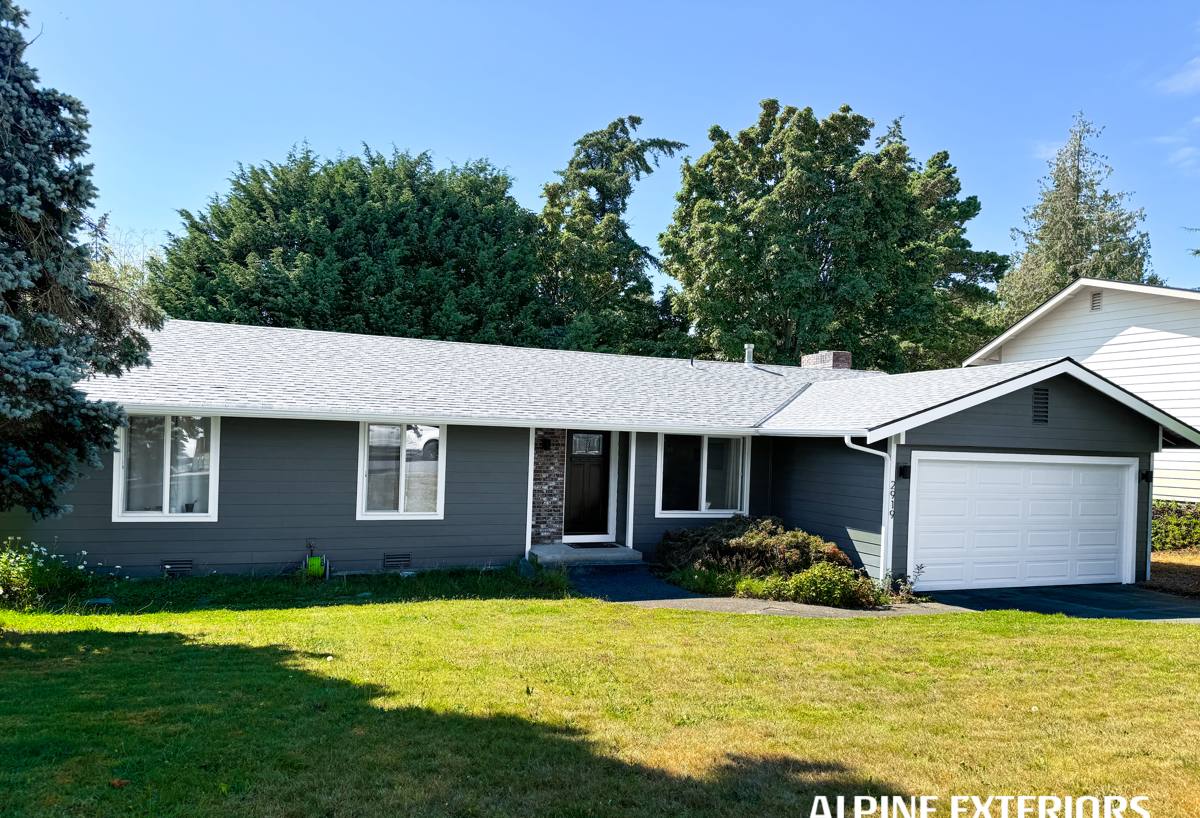
Why We Only Install James Hardie Fiber Cement Here
We standardized on James Hardie fiber cement siding for every home we work on, including in Ferndale, because it's the one product line we trust to hold up to this specific combination of salt, rain, and moss without turning into a maintenance project a few years down the road. It's non-combustible, it doesn't absorb and swell with moisture the way wood-based products can, and it's engineered specifically for regional climate conditions rather than sold as a one-size-fits-all product.
HZ5 Engineering for the Pacific Northwest
James Hardie makes different product formulations for different climate zones — a system they call HZ5 and HZ10. HZ5 is engineered for colder, wetter regions with more freeze-thaw activity, which describes Whatcom County well. That formulation is designed to resist moisture-related damage and hold its integrity through repeated wet-cold-wet cycles, which matters more in Ferndale than it would in a dry inland climate.
ColorPlus Factory Finish and Salt Exposure
Most of our installs use Hardie's ColorPlus finish — color baked onto the board in a factory setting with multiple coats, rather than field-painted after installation. That finish holds up better against UV and moisture than site-applied paint, and it matters even more near salt air, where field-applied paint tends to chalk and fade faster. It also means touch-up and future color matching is more consistent, since the finish is standardized rather than mixed on-site.
What a Correct Ferndale Installation Actually Involves
Fiber cement siding is only as good as the installation behind it. A rushed or generic install can undercut every advantage the material offers, especially in a climate that pushes moisture at the wall from multiple directions.
Moisture Management Comes First
Before a single piece of siding goes up, the wall needs a proper water-resistive barrier and, ideally, a rainscreen gap that lets any moisture that gets behind the siding drain and dry out instead of sitting against the sheathing. Flashing at windows, doors, and roof-to-wall intersections has to be layered correctly — upper pieces overlapping lower ones — so water is always directed outward and down, never behind the barrier. This is the step that matters most in a driving-rain climate like Ferndale's, and it's also the step that's easiest to shortcut if a crew isn't used to working in these conditions.
Fastening, Clearances, and Caulk Joints
James Hardie specifies clearances from grade, roofing, and decks for a reason — siding installed too close to the ground or to a roofline stays wetter longer and is more exposed to splash-back and organic debris, which is exactly what feeds moss growth. Fasteners need to be corrosion-resistant given the salt air, driven to the manufacturer's specified depth (not overdriven, which can crack the board or compromise its seal), and joints need to be caulked with a product rated for the exposure rather than whatever's cheapest. Every one of these details is small on its own; skipped together, they're what causes premature failure.
How Hardie Compares to Other Siding Options in This Climate
We get asked fairly often why we don't offer vinyl, LP SmartSide, or cedar as options. Here's an honest comparison of how these materials tend to perform against the specific conditions Ferndale homes face — salt air, sustained rain, and moss.
| Material | Moisture & Moss Resistance | Salt Air Durability | Long-Term Maintenance |
|---|---|---|---|
| James Hardie fiber cement | High — doesn't absorb moisture or swell; resists rot | Strong with corrosion-resistant fasteners and factory finish | Occasional rinsing and caulk checks; repaint interval much longer than wood |
| Vinyl siding | Doesn't rot, but traps moisture behind it if installed without proper drainage; can support moss/algae growth on the surface | Can become brittle and discolor faster under UV and salt exposure | Low upkeep but limited repair options; panels can warp or crack over time |
| LP SmartSide (engineered wood) | Wood-based core is more vulnerable to sustained moisture exposure; edges are the weak point | Moderate — finish quality and edge-sealing are critical | Depends heavily on caulk and paint maintenance to prevent moisture entry |
| Cedar / primed spruce | Natural wood absorbs moisture and is highly susceptible to moss and rot in shaded, damp areas | Weathers and requires more frequent refinishing near salt air | Highest maintenance — regular staining, sealing, or painting required |
None of these materials are inherently bad products — they all have a place. But given what Ferndale's climate does to a wall over time, fiber cement engineered for wet, cold regions is the one we're willing to put our name behind.
Our Process for a Ferndale James Hardie Project
- Inspection and assessment. We look at the existing siding, sheathing condition, and any signs of past moisture intrusion — particularly on north- and west-facing walls that see the most shade and driving rain.
- Tear-off and sheathing check. Old siding comes off so we can actually see the wall behind it, not guess at what's there. Any damaged sheathing gets addressed before anything new goes up.
- Water-resistive barrier and rainscreen. House wrap and, where appropriate, a drainage gap go on correctly lapped and taped, giving any incidental moisture a way out.
- Flashing details. Windows, doors, and roof intersections are flashed in the correct sequence before trim and siding cover them.
- Hardie panel or lap installation. Boards are fastened to spec, with proper clearances from grade, decks, and roofing.
- Trim, caulking, and touch-up. Joints are sealed with an appropriate sealant, and any factory finish touch-ups are done to manufacturer standards.
- Final walkthrough. We go over the finished job with the homeowner before calling it done.
Maintaining Hardie Siding Through Whatcom County's Moss Season
James Hardie siding needs far less upkeep than wood, but "low maintenance" isn't "no maintenance," especially in a climate that grows moss on shaded surfaces for much of the year. A little routine attention keeps the siding — and the warranty — in good standing.
- Rinse salt spray and general grime off exterior walls with a garden hose a couple of times a year, especially on sides facing open water or prevailing wind.
- Keep an eye on shaded, damp areas — under eaves, behind shrubs, north-facing walls — where moss and algae are most likely to start.
- Trim back vegetation and tree branches that keep siding shaded and damp longer than it needs to be.
- Inspect caulk joints annually and have any cracked or shrunken caulk replaced before it becomes a water entry point.
- Keep gutters and downspouts clear so water isn't overflowing onto the siding below.
- Avoid pressure washing directly at siding joints or up under laps — a garden hose and soft brush is safer for the finish and the caulk lines.
Why Hiring a Crew That Already Works Ferndale Matters
Fiber cement installation isn't complicated in theory, but the details that make it hold up in Ferndale specifically — how close to run siding to grade given local moisture patterns, which walls need extra attention to moss-prone shading, how to detail flashing for wind-driven rain off the water — come from having actually installed and revisited jobs in this exact area. A crew that's only worked drier inland climates can install Hardie siding "correctly" by a generic checklist and still miss the details that matter here.
Working locally also means understanding Whatcom County permitting norms, common construction types in this area, and realistic weather windows for scheduling a tear-off without leaving a wall exposed during a stretch of driving rain. That local familiarity isn't a marketing point — it's the difference between a siding job that looks good on day one and one that's still performing well in year fifteen.
If you're weighing a siding replacement or repair in Ferndale, we're happy to take a look at your home and talk through what it actually needs — no pressure, no generic sales pitch. Reach out for a free estimate using the form below.