 Whatcom County
 Why Ferndale Homes Wear Out Siding Faster Than You'd Expect
Ferndale sits close enough to Bellingham Bay and the Nooksack River delta that salt-laden air is a real, daily factor on exterior materials here — not just a coastal-town talking point. Add Whatcom County's long, wet shoulder seasons, driving rain that comes in sideways off frontal systems, and a moss season that can stretch from October well into May, and you've got a climate that is genuinely hard on siding. Homes a few miles inland get some relief from the salt exposure, but the rain and moss pressure barely changes. If your siding was installed without that combination in mind, it's usually visible within a handful of years: swelling at the bottom courses, chalky or peeling paint, dark streaking in shaded corners, and moss creeping up from ground level.
None of that is inevitable. It's a function of what material went on the wall and how it was installed. This page is about doing a siding installation in Ferndale correctly the first time, with a product and a process built for exactly these conditions.
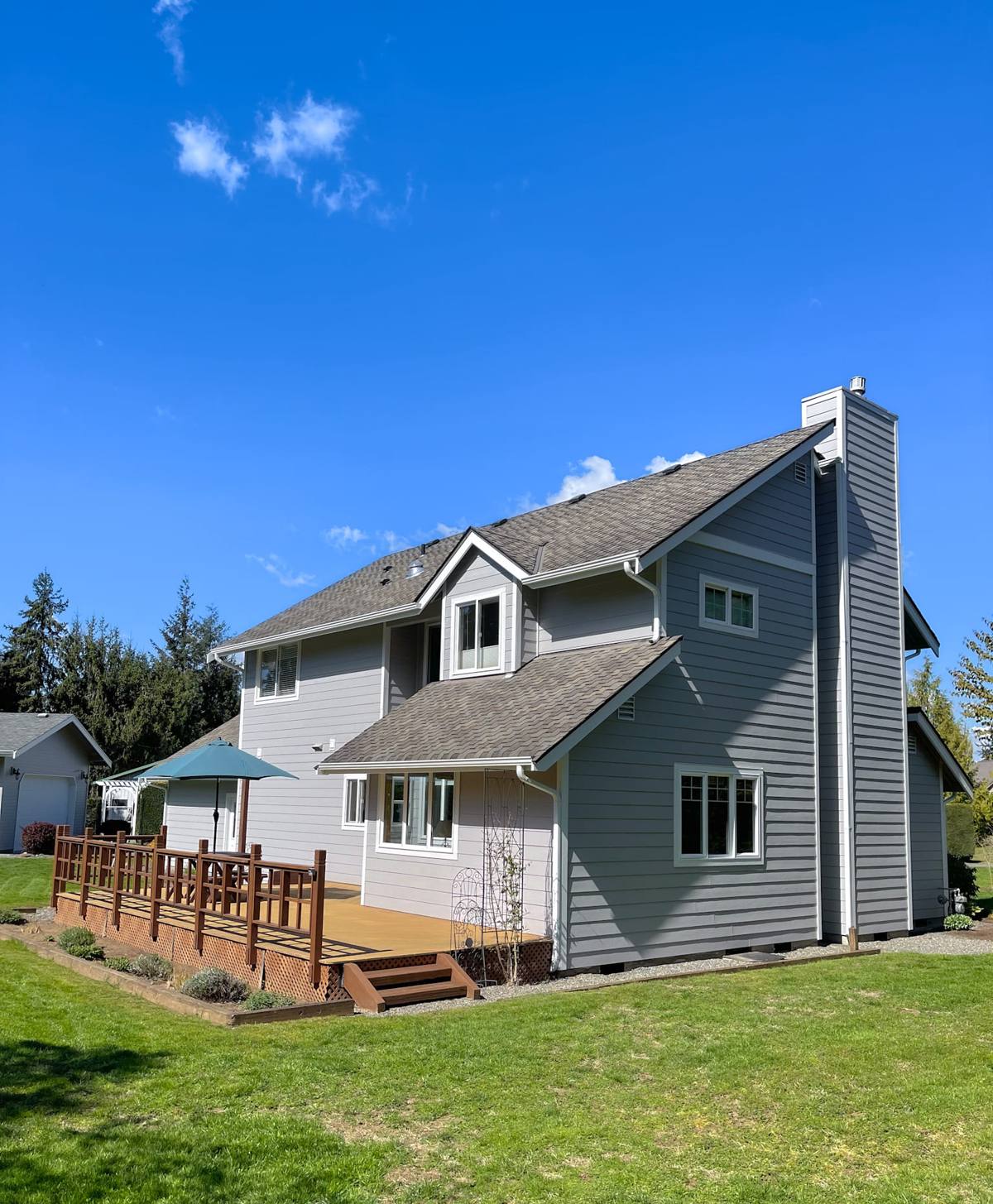
What Ferndale's Climate Actually Does to Siding
Salt Air and Moisture-Driven Corrosion
Airborne salt accelerates corrosion of fasteners, flashing, and any metal trim, and it degrades certain coatings faster than inland weathering would. It also tends to hold moisture against surfaces longer, which matters more than the salt itself in most failures — siding rarely fails from salt directly, it fails from moisture that salt exposure made worse.
Driving Rain and Wind-Driven Water
Whatcom County storms frequently push rain horizontally, which means water gets forced up under laps, into seams, and behind poorly sealed penetrations (hose bibs, light fixtures, vents) far more aggressively than a straight-down rain would. A siding system that only sheds water vertically isn't enough here — the lap geometry, fastening pattern, and flashing details all have to account for wind-driven water specifically.
Moss, Algae, and Prolonged Dampness
Whatcom County's moss season is long because the conditions moss needs — shade, moisture, and mild temperatures — are present most of the year. Moss and algae growth isn't just cosmetic. Sustained organic growth holds moisture against the substrate, and on materials that absorb water, that moisture eventually finds its way into the wall assembly.
What Correct Siding Installation Requires in This Climate
A siding installation done right in Ferndale isn't a different product than what a Whatcom County crew would use anywhere else in the county — it's the same fiber cement system installed with more attention to the details that matter most in wet, salt-exposed conditions.
- A drainage plane behind the siding — a properly lapped weather-resistant barrier and rainscreen gap so any water that gets past the cladding has somewhere to go besides the sheathing.
- Correct fastener spacing and type — hot-dip galvanized or stainless fasteners, driven per the manufacturer's nailing schedule, not gun-set at whatever depth is fast.
- Flashed penetrations — every hose bib, light fixture, vent, and electrical box gets flashed and sealed before siding closes around it, not caulked after the fact.
- Proper clearance at grade — siding held up off decks, patios, and soil so splash-back and standing moisture don't sit against the bottom course.
- Factory-finished panels — a baked-on finish that doesn't depend on a field-applied coat of paint to hold up to salt air and UV.
Skip any one of these and the material underneath doesn't matter much — water finds the gap.
Why We Install James Hardie Fiber Cement — and Nothing Else
We install James Hardie fiber cement siding exclusively. We don't install vinyl, LP SmartSide, Cemplank, Allura, primed spruce, or cedar, and that's a deliberate standard, not a lack of options.
Fiber cement is non-combustible and dimensionally stable — it doesn't expand, contract, warp, or absorb water the way wood-based products can, which matters directly in a climate where moisture exposure is near-constant. James Hardie's ColorPlus factory finish is baked on and warranted against fading and peeling, which removes the recurring maintenance step — repainting — that salt air and UV would otherwise force on a field-painted product every several years. Hardie also engineers specific product lines (HZ5 for cold, wet, moderate climates like ours) rather than selling one formulation nationwide, and backs installations with a transferable limited warranty when installed to their specification.
That doesn't mean every other product is a bad product in the abstract — vinyl is inexpensive and low-maintenance in the right setting, cedar has real aesthetic appeal, engineered wood has its market. But each carries trade-offs — moisture sensitivity, UV degradation, warranty limitations, or maintenance burden — that we don't think hold up well against a Whatcom County winter, year after year. We'd rather install one product well than install several products with an asterisk attached.
How Hardie Compares to Alternatives in This Climate
| Factor | James Hardie Fiber Cement | Vinyl | Wood / Engineered Wood |
|---|---|---|---|
| Moisture absorption | Minimal — cement-based, dimensionally stable | None, but seams and expansion gaps can let water behind panels | Higher — prone to swelling, rot at cut edges and laps |
| Salt air / coastal exposure | Engineered HZ formulations for coastal/wet climates | Can become brittle over time with UV and temperature cycling | Coatings degrade faster; end grain absorbs moisture |
| Finish maintenance | Factory-baked ColorPlus, no repainting needed for warranty term | Color molded in, but fades and chalks over time | Field-applied paint/stain needs recoating every few years |
| Fire resistance | Non-combustible | Combustible | Combustible |
| Typical lifespan installed to spec | Decades, with strong transferable warranty | Long-lived but limited warranty on fading/warping | Shorter without diligent maintenance |
Our Ferndale Installation Process
1. Site and Substrate Assessment
Before any siding comes off, we check the existing wall assembly — sheathing condition, any signs of past moisture intrusion, and how the house is currently detailed at windows, corners, and grade. This tells us what the substrate actually needs, not just what the old siding looked like.
2. Weather Barrier and Rainscreen
We install a lapped weather-resistant barrier and a rainscreen gap behind the new siding. In a climate with this much wind-driven rain and prolonged dampness, giving incidental moisture a drainage path is not optional — it's the difference between siding that lasts and siding that traps water against the wall.
3. Flashing Every Penetration
Windows, doors, hose bibs, vents, and fixtures all get flashed before the siding closes around them. This is the step that's easiest to shortcut and most responsible for water damage when it's skipped.
4. Installing to James Hardie's Specification
Fastener type, spacing, lap dimensions, and clearances all follow Hardie's published installation guide for our climate zone. Installing outside that spec is one of the most common ways a warranty gets voided, so we don't deviate from it.
5. Final Detailing and Walkthrough
Caulking at trim joints, touch-up on any cut edges, and a final walkthrough so you know what was done and why, before we consider the job finished.
Signs Your Ferndale Home Needs Siding Replacement Now
- Soft or spongy spots when you press on the siding, especially near the bottom courses or below windows
- Persistent moss or algae growth that returns within weeks of cleaning
- Visible gaps, warping, or buckling panels, particularly on the sides that catch the most weather
- Peeling or chalking paint that keeps recurring faster than a normal repaint cycle
- Rising heating bills with no other explanation — often a sign the wall assembly behind the siding is compromised
- Visible rot or staining around window and door trim
If you're seeing more than one of these, it's worth having someone look at the wall assembly, not just the siding surface — by the time siding shows damage, moisture has often been working on the sheathing underneath for a while.
What Affects the Cost of a Siding Installation in Ferndale
| Cost Factor | Why It Matters |
|---|---|
| Home size and wall complexity | More corners, gables, and dormers mean more cuts, trim, and labor hours |
| Substrate condition | Rotted sheathing or existing moisture damage adds repair work before siding can go on |
| Siding profile and accessories | Lap width, trim boards, and soffit/fascia work all add to material and labor cost |
| Access and site conditions | Tight lots, multi-story walls, or landscaping near the house can affect staging and labor time |
| Removal and disposal | Tear-off and haul-away of old siding is part of most full replacements |
We don't quote a project without seeing the house — a free estimate is the only way to give you real numbers instead of a range that doesn't mean much.
Why Hire a Crew That Already Works Whatcom County
A crew based near Ferndale already knows what the local weather does to a wall assembly over a few winters, because they've seen it firsthand on other homes in the area. That translates into practical decisions on your job — where to add extra flashing attention, how to detail grade clearance on a lot with poor drainage, which sides of the house take the worst of the wind-driven rain. It also means someone local stands behind the work and the warranty, rather than a crew that installed your siding once and moved on to the next county.
Ready for a Straight Answer on Your Siding?
If your Ferndale home's siding is showing its age, or you're planning ahead before it becomes an emergency, we're happy to take a look and give you a straightforward, no-pressure estimate — no invented urgency, just an honest read on the wall assembly and what it needs. Use the form below to get started.