 Whatcom County
 Why Lynden Decks Wear Out Faster Than the Owner's Manual Says
Every deck comes with a maintenance schedule from the manufacturer or the builder who installed it, and almost none of those schedules were written with Whatcom County in mind. Lynden sits close enough to the water and low enough in the valley that decks here deal with a longer wet season, persistent moisture that never fully dries between rain events, and a moss season that can stretch from fall through spring. Add in salt-laden air moving in off the Strait and Bellingham Bay on a west wind, and you have a combination that speeds up corrosion on fasteners, hardware, and any metal flashing that wasn't rated for it.
None of this means a deck in Lynden is doomed. It means the repair standard has to be higher than "replace the board that's obviously rotten." A deck that looks fine from the top can be hiding failing ledger flashing, corroded joist hangers, or a support post that's been sitting in standing water for years. We repair a lot of decks in this area, and the pattern is consistent: the damage that actually matters is almost never where the homeowner first points.
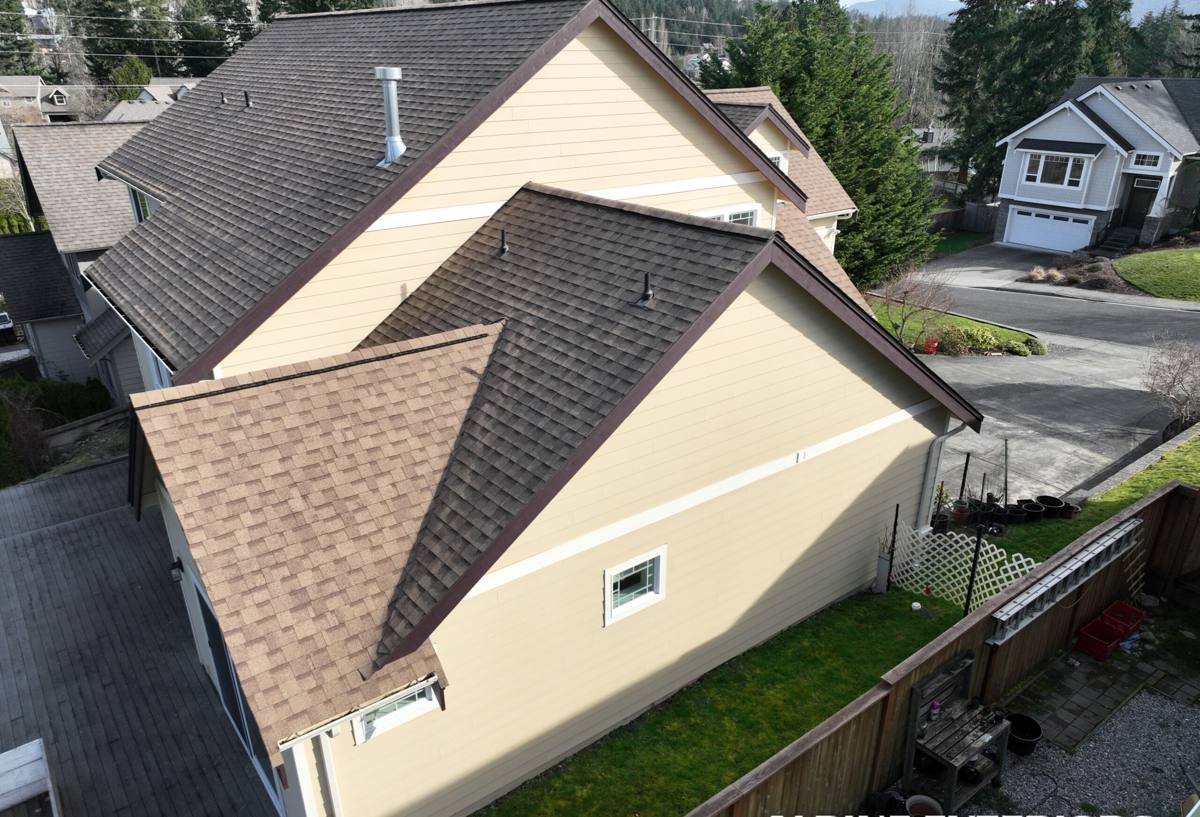
The Three Things Whatcom County Weather Actually Does to a Deck
Driving rain finds every gap
Wind-driven rain doesn't fall straight down — it gets pushed sideways into ledger connections, under railing posts, and into any joint where two pieces of wood meet without proper flashing. Over years, that moisture works its way into end grain and fastener holes, which is where rot almost always starts on an otherwise healthy-looking deck.
Moss season traps moisture against wood and metal
A long, mild moss season means organic growth holds water against the decking surface for months at a time instead of letting it dry between storms. Moss on a deck isn't just a slip hazard — it's a moisture blanket that accelerates surface rot on wood decking and speeds corrosion on fasteners and hardware underneath.
Salt air corrodes metal you can't see
Salt-influenced air is harder on unprotected steel than most homeowners expect. Standard coated screws, joist hangers, and bolts that would last decades further inland can start showing rust and weakening structurally in a fraction of that time here. This is one of the biggest reasons a "quick fix" repair with mismatched hardware often fails again within a year or two.
Cosmetic Damage vs. Structural Damage: Knowing the Difference
Not every repair is an emergency, and not every deck problem is visible on the surface. Part of doing this job right is being honest about which category a given issue falls into.
| Symptom | Usually Means | Urgency |
|---|---|---|
| Gray, weathered board surface | Normal UV and weather wear | Cosmetic — cleaning or refinishing |
| Soft or spongy spots underfoot | Rot in the board or the joist beneath it | Structural — repair soon |
| Rust streaks below fasteners | Corroding hardware, possibly failing | Structural — inspect hardware |
| Railing that flexes or wiggles | Loose or corroded post connection | Safety concern — repair promptly |
| Gap or separation at the house ledger | Ledger flashing or fastening failure | Structural — priority repair |
| Moss or algae film on the surface | Moisture retention, slip hazard | Maintenance — clean and monitor |
The ledger board — where the deck attaches to the house — deserves special attention. It's the single most common source of catastrophic deck failure nationwide, and it's also the connection most exposed to the kind of driving rain Whatcom County sees regularly. If we find rot or corrosion at the ledger, that repair takes priority over everything else on the deck.
What a Correct Deck Repair Actually Involves
A repair that only replaces the board you can see is a temporary fix. A repair that holds up in this climate starts underneath.
- Structural inspection first. We check ledger attachment, joist condition, post bases, and footings before we touch the decking surface.
- Fastener and hardware audit. Corroded screws, bolts, and joist hangers get replaced with hardware rated for exterior and coastal-influenced exposure — not whatever matches the original build if the original build was undersized for this climate.
- Proper flashing at the ledger. If the ledger-to-house connection lacks adequate flashing, we address it as part of the repair, not as a separate future project.
- Moisture pathway correction. Standing water on a deck usually means a slope, drainage, or gap problem, not just a board problem. We identify why water is sitting where it shouldn't.
- Matching materials, not guessing. Replacement boards and hardware are selected to match or improve on what's there, so the repair doesn't create a weak point that fails first next time.
Common Deck Materials in This Area and How They Hold Up
| Material | Typical Issue Locally | Repair Consideration |
|---|---|---|
| Pressure-treated wood | Surface checking, rot at fastener points and ledger | Board-level replacement often viable if framing is sound |
| Cedar | Graying, softening in shaded/damp areas, moss growth | Selective board replacement plus cleaning and sealing |
| Composite decking | Moisture wicking at cut ends, fastener pull-through | End caps and proper fastening matter more than the brand |
| Older or mixed hardware | Rust and corrosion from salt-influenced air | Upgrade to corrosion-resistant fasteners during any repair |
We don't push homeowners toward a full composite replacement when a wood deck's framing is sound — that's a maintenance-versus-replacement decision that should be based on the actual condition underneath, not a sales pitch. Composite decking has real advantages in a wet climate, but it isn't a fix for structural problems, and it comes with its own installation sensitivities, particularly around cut ends and fastener spacing, that matter more here than in a drier region.
How We Approach a Deck Repair in Lynden
- On-site assessment. We walk the full deck, check underneath where accessible, and test suspect boards, railings, and connections by hand.
- Honest scope. We tell you what's cosmetic, what's structural, and what can reasonably wait — in writing, not in vague terms.
- Repair plan. For anything structural, we explain what's failing and why, so you understand the repair rather than just approving a number.
- The work itself. Framing and ledger issues get corrected first, then decking, railings, and stairs.
- Final check. We walk the deck with you when it's done and point out anything worth watching going forward.
What Affects the Cost of a Deck Repair
Deck repair pricing varies a lot based on what's actually wrong, and giving a number without an inspection isn't honest. In general terms, costs run from a few hundred dollars for isolated board or railing repairs up to several thousand for ledger, framing, or multi-post foundation work. The main cost drivers are:
| Factor | Why It Matters |
|---|---|
| Extent of hidden rot | Framing repairs cost more than surface board replacement |
| Ledger condition | Ledger and flashing repair is labor-intensive but non-negotiable for safety |
| Deck height and access | Elevated or hard-to-access decks take more labor to work under |
| Material match | Matching existing decking or upgrading materials affects material cost |
| Number of posts/footings involved | Foundation-level work is the most involved repair category |
Maintenance That Extends the Life of a Repaired Deck
A good repair buys you years, but Whatcom County's climate doesn't stop working on your deck once we leave. A short seasonal routine makes a real difference:
- Sweep debris and standing leaves off the deck surface regularly, especially in fall
- Clean moss and algae before it establishes rather than after, particularly on shaded sections
- Check railings and stair connections for looseness once or twice a year
- Reseal or refinish wood decking on the manufacturer's recommended schedule, not just when it looks faded
- Keep gutters and downspouts clear so roof runoff isn't draining directly onto the deck
- Watch for gaps opening up at the ledger-to-house connection after storms
Why a Crew That Already Works in Lynden Makes a Difference
Deck repair looks straightforward from a distance, and a lot of general handyman work treats it that way — swap the bad board, done. The problem is that a deck is a structural system, and in a climate with this much driving rain, moss, and salt-air corrosion, treating a symptom instead of the cause means you're paying for the same repair again in a few years. A crew that regularly works decks throughout Whatcom County has already seen how local conditions play out on ledgers, hardware, and framing over time, and knows which shortcuts don't hold up here even if they'd be fine somewhere drier.
We're not going to recommend replacing a deck that just needs targeted structural repair, and we're not going to patch over rot that's going to come back. If you're in Lynden and something on your deck feels soft, loose, or just off, we're happy to take a look and give you a straight assessment — no pressure, no inflated scope. Reach out for a free estimate using the form below.