 Whatcom County
 Why Storm Damage Hits Sehome Roofs Differently
Sehome sits close enough to Bellingham Bay to catch salt-laden air off the water, and close enough to mature tree cover to sit under moss season for most of the year. That combination is harder on a roof than either factor alone. Salt air accelerates corrosion on exposed metal — flashing, nail heads, gutter fasteners — while the shade and moisture from surrounding trees keep roof surfaces damp long after a storm has passed, which is exactly the condition moss and algae need to take hold. When wind and driving rain move through, they're not hitting a clean, dry roof. They're hitting one that's already been softened by moisture and weakened at the fastener level by corrosion.
That's the piece a lot of general contractors miss when they come out after a Whatcom County windstorm. They'll patch the obvious damage — a torn shingle, a dented vent cap — without looking at why the roof failed there in the first place. If moss has been lifting shingle edges for two years, a storm didn't cause that damage, it just finished the job. A repair that doesn't address the underlying moss and moisture problem is a repair that fails again in the next storm.
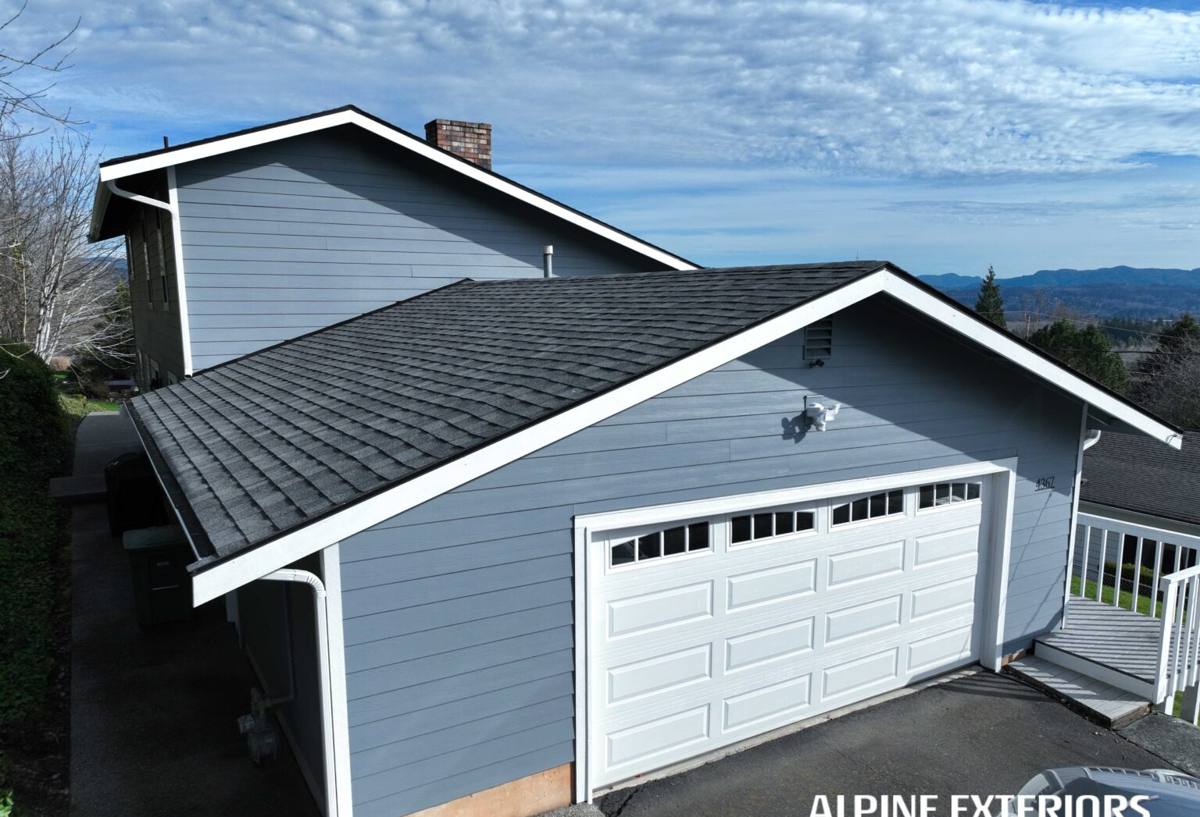
What Storm Damage Actually Looks Like Here
Wind and Rain Damage
Whatcom County storms typically bring sustained wind gusts combined with heavy, sideways rain rather than hail. That pattern tends to produce a specific damage profile: lifted or torn shingle tabs along ridgelines and roof edges, flashing pulled loose around chimneys and vent stacks, and wind-driven water forced up under shingles at valleys and eaves where it wouldn't normally reach. Because the rain comes in at an angle, water can get pushed past points that were never designed to shed it, which shows up later as a ceiling stain in a room nowhere near the actual entry point.
Moss and Moisture Damage
Moss season in this part of Washington runs long — realistically most of the year on shaded or north-facing roof sections. Moss holds water against the shingle surface, works its way under tabs, and over time lifts and cracks the granule coating that protects the shingle from UV and water. A roof section with heavy moss growth is already compromised before a storm ever arrives; the storm just exposes the weak spot.
Salt Air Corrosion
Metal components — flashing, drip edge, nail heads, gutter hangers — corrode faster this close to the bay. Corroded flashing loses its seal at seams and fasteners years before a homeowner would expect to replace it. In a wind event, that's often the first point of failure.
Signs Your Roof Needs a Storm Damage Inspection
- Shingles that look lifted, curled, or missing along ridges, edges, or valleys
- Granules collecting in gutters or at downspout outlets after a storm
- Visible moss or dark streaking on shaded roof sections
- Flashing that looks bent, separated, or rusted around chimneys, skylights, or vent pipes
- A new water stain on a ceiling or in the attic, even a small one
- Gutters pulling away from the fascia or sagging under debris weight
- Daylight visible through the roof deck from inside the attic
Any one of these on its own might be minor. Two or three together, especially right after a windstorm, means it's worth having someone look before the next round of rain finds the gap.
What a Correct Storm Damage Repair Involves
A proper repair isn't just replacing what's visibly torn. It starts with an inspection that covers the whole roof plane, not just the damaged section, because wind damage rarely stays contained to one spot and moss damage is often worse than it looks from the ground.
Assessment
We check the shingle field for lifted or cracked tabs, the flashing at every penetration and transition, the underlayment where it's exposed, and the attic from the inside for water intrusion that hasn't shown up on the ceiling yet. We also look at moss coverage and drainage patterns, since those tell us whether the storm damage is an isolated event or a symptom of an ongoing moisture problem.
Repair
Depending on what we find, that can mean replacing individual shingles, re-securing or replacing flashing, resealing penetrations, or in some cases removing and treating moss growth before any shingle work happens — patching over active moss just traps moisture under the new material. We match materials as closely as possible to the existing roof so a repair doesn't stand out as a patch job, and we use fasteners and flashing rated for coastal exposure rather than standard-grade hardware that will corrode again in a few seasons.
Documentation
If the damage may be covered by insurance, we document it with dated photos and a written scope before and after the repair, which makes the claims process faster and gives you a record for future reference.
Repair vs. Replacement: How We Decide
| Factor | Points Toward Repair | Points Toward Replacement |
|---|---|---|
| Extent of damage | Isolated to one section or slope | Spread across multiple roof planes |
| Roof age | Under 12-15 years, otherwise sound | Nearing or past expected service life |
| Moss/moisture history | Minor, addressed as part of repair | Long-term moss damage under multiple sections |
| Underlying deck condition | Solid, no rot found | Soft spots or rot in the sheathing |
| Flashing and metal condition | Localized corrosion, replaceable | Widespread corrosion across the roof |
Most storm calls we get in Sehome end up being repairs, not full replacements — but we won't recommend a repair on a roof that's already near the end of its life just because it's the cheaper answer today. That usually costs more in the long run once you factor in a second repair call and possible interior damage.
Cost Factors Worth Knowing
Repair cost depends mainly on how much of the roof is affected, whether flashing or just shingles need work, and whether moss removal is part of the job. A small, contained repair is a modest cost. A repair that also involves flashing replacement, moss treatment, and deck inspection runs higher. We give a written estimate before any work starts so there are no surprises.
Our Process
- Inspection. We walk the roof (or use a drone where pitch or access doesn't allow it) and check the attic from inside.
- Written estimate. You get a clear scope of work and price before anything is scheduled.
- Repair. We complete the work with materials suited to the local climate, not just whatever's on the truck.
- Final check and photos. We confirm the repair is sound and give you documentation for your records or an insurance claim.
Long-Term Prevention for Whatcom County Homes
A storm repair fixes the immediate problem. These habits reduce how often you need one:
- Have moss removed and a preventive treatment applied on shaded roof sections before it builds up
- Keep gutters and downspouts clear so wind-driven rain has somewhere to go
- Trim back tree limbs that overhang the roof, which cuts down both moss growth and debris impact
- Have flashing and metal components checked every couple of years given the corrosion pace this close to the bay
- Get a post-storm walk-around after any significant wind event, even if nothing looks obviously wrong from the ground
Why a Crew That Already Works in Sehome Matters
A roofer who works this neighborhood regularly already knows which roof orientations here hold moss longest, which older homes tend to have flashing details that need extra attention, and what kind of storm damage typically shows up after a Whatcom County wind event versus what gets missed. That familiarity means less time spent diagnosing and more time spent fixing the actual problem. It also means we can respond faster after a storm, when a lot of homeowners in the area are calling around at once and timing matters for keeping water out.
We're not going to recommend the most expensive fix when a targeted repair will hold up, and we're not going to patch over a moss or moisture problem just to close out the storm call. We'd rather tell you honestly what we found and what it'll take to fix it properly.
If a recent storm left you with damage — or you're just not sure whether what you're seeing is a problem — we're happy to come take a look. Fill out the form below for a free, no-pressure estimate on storm damage roof repair for your Sehome home.