 Whatcom County
Composite Decking Built for Nooksack's Weather, Not Against It
Nooksack sits in one of the wetter corners of Whatcom County, tucked between the river valley and the foothills, close enough to the Strait of Georgia to catch salt-tinged air on a west wind. Homes here deal with a long wet season, heavy dew, and moss that seems to find a foothold on anything that holds moisture for more than a day. A deck built without that reality in mind starts showing problems within a couple of seasons — not because the material is bad, but because it was installed like it lives somewhere dry.
Composite decking, installed correctly, holds up well against this climate. It doesn't absorb water the way wood does, it doesn't need annual staining, and it resists the kind of rot that eventually takes down even well-maintained cedar or pressure-treated lumber. But "composite" isn't a single product with one set of rules — board quality, substructure, and installation details vary a lot, and in a climate like ours those details matter more than the brand name on the board.
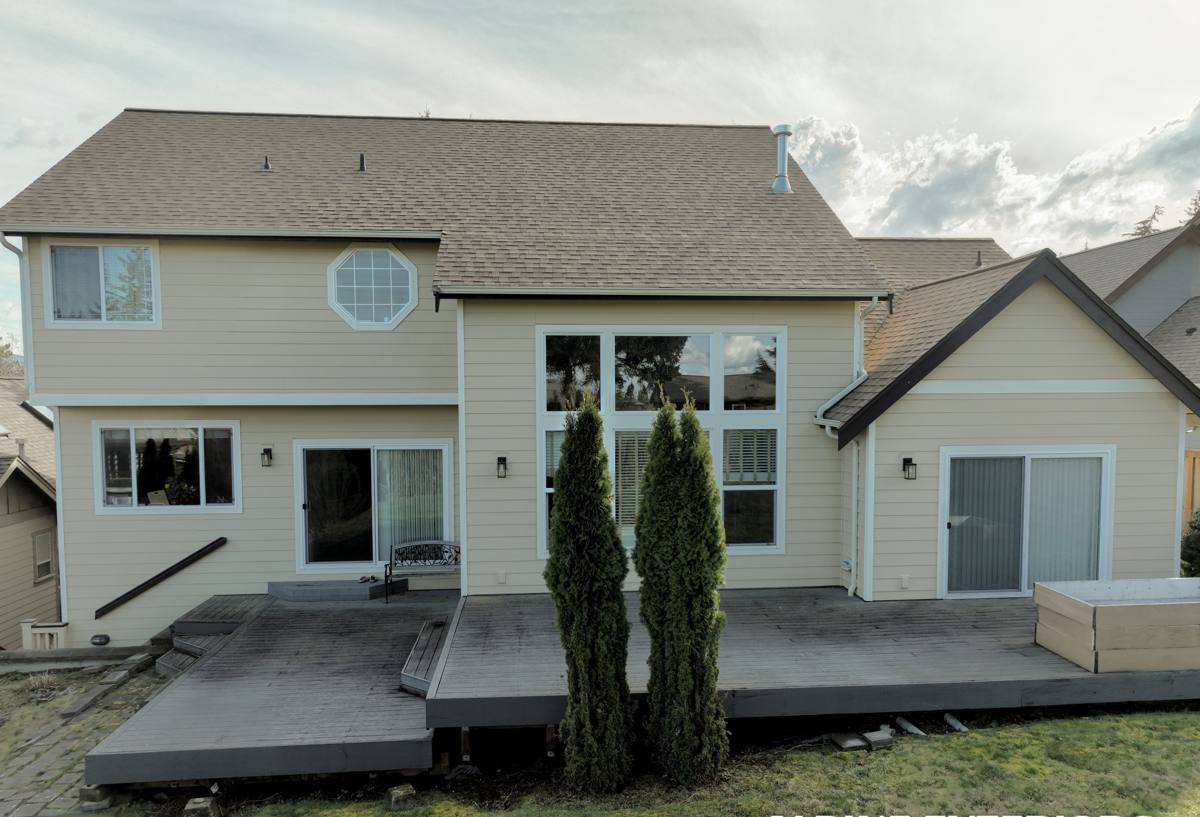
What Whatcom County's Climate Actually Does to a Deck
It helps to be specific about what a deck in Nooksack is up against, because the failures we see are predictable once you understand the conditions.
Driving Rain and Standing Moisture
Rain here doesn't just fall straight down — wind-driven rain gets up under railings, into end grain, and behind fascia boards. If a deck's substructure and drainage aren't planned for that, water sits in places it shouldn't, and that's where rot, mold, and premature fastener corrosion start.
A Long Moss Season
Moss and algae need shade, moisture, and time — Nooksack's fall-through-spring stretch provides all three. On wood decking this shows up as green staining and a slick, slippery surface. On composite decking, moss growth is mostly a surface issue (it doesn't eat into the board the way it can weaken wood fiber), but it still needs to be planned for in board selection and cleaning routine, or it builds up in board grooves and around fasteners.
Salt Air
Even well inland from the coast, homes in this part of Whatcom County get some salt-air exposure, which accelerates corrosion on hardware, screws, and any exposed metal railing or bracket components. This is one of the most overlooked factors in deck longevity — a beautiful deck can fail early because of $40 worth of the wrong fasteners.
Composite vs. Wood vs. PVC: What Actually Makes Sense Here
We install what fits the house, the budget, and the site — but for most Nooksack homeowners weighing options, here's the honest tradeoff picture:
| Material | Performance in Our Climate | Maintenance | Typical Lifespan |
|---|---|---|---|
| Pressure-Treated Wood | Absorbs moisture readily; prone to moss staining and splintering over time | Annual cleaning, periodic staining/sealing | 10-15 years with upkeep |
| Composite (capped) | Resists moisture absorption; surface moss cleans off easily; stable in wet-dry cycles | Periodic washing, no staining or sealing | 25-30+ years |
| PVC/Vinyl Decking | Fully moisture-resistant but can feel and flex differently underfoot; higher cost | Low; occasional washing | 25-30+ years |
For most homes in Nooksack, capped composite hits the right balance of moisture performance, appearance, and cost. We'll tell you honestly if your project or budget points toward a different material instead — the goal is a deck that holds up here, not a specific product sale.
What a Correct Composite Deck Installation Involves
Composite boards are often marketed as low-maintenance, and the surface material is. But a composite deck is only as good as what's underneath it, and this is where a lot of installation shortcuts show up years later.
Substructure and Framing
In a climate this wet, we treat the substructure as the part that actually determines lifespan. That means proper joist spacing for the specific composite product (composite spans differently than wood and manufacturers spec it for a reason), joist tape or flashing to protect framing lumber from moisture wicking up from the boards, and ledger board flashing that actually sheds water away from the house rim joist instead of trapping it.
Drainage and Airflow Underneath
A deck built tight to grade or without ventilation underneath holds moisture against the framing year-round in a climate like ours. We grade and gap for airflow and drainage so water has somewhere to go instead of pooling under the deck surface.
Fasteners and Hardware
Given the salt-air exposure common across Whatcom County, we use corrosion-resistant, code-rated fasteners and hidden fastener systems rated for the specific board profile. Mismatched or budget hardware is one of the most common causes of early deck failure we see when repairing other contractors' work — the boards outlast the screws.
Board Selection for Moss and Moisture
Not all composite boards handle moss and standing moisture the same way. We select capped composite products with textured, moisture-shedding surfaces that resist slip and don't hold moss in fine grooves the way some embossed patterns do.
Our Process for a Nooksack Composite Deck Project
- On-site assessment — We look at drainage, sun/shade exposure, existing structure (for replacements), and how the deck ties into the house.
- Material and layout plan — Board selection, framing layout, and railing/fastener specs matched to the site conditions and your budget.
- Permitting — We handle the permit process where required for the scope of work.
- Demo (if replacing) — Removal of old decking and inspection of ledger and framing condition before anything new goes up.
- Framing and structural work — Built and flashed for drainage and airflow, not just for looks.
- Deck board and railing installation — Installed to manufacturer spec with hidden fasteners and corrosion-resistant hardware.
- Final walkthrough — We go over cleaning and care specific to the board you chose before we consider the job done.
Repairs and Replacements: What We Commonly Find
A good share of our composite deck calls in the Nooksack area aren't new builds — they're fixing problems from an earlier installation that didn't account for our conditions. Common issues include boards installed without proper gapping for expansion, which causes buckling; substructure rot from missing flashing that the composite surface was hiding; corroded fasteners causing loose boards or railings; and moss buildup in board grooves from a textured pattern that wasn't suited to a shaded, damp site. In most cases the composite boards themselves are fine — the problem is what's underneath or holding them down, and that's repairable without a full tear-off.
Maintaining a Composite Deck in a Wet Climate
Composite decking is genuinely lower maintenance than wood, but "low maintenance" doesn't mean "no maintenance" in a climate that grows moss on fence posts. A simple seasonal routine keeps a composite deck looking and performing the way it should:
- Rinse and sweep debris (leaves, needles, dirt) off the surface regularly, especially in fall — trapped organic matter feeds moss growth
- Wash with a soft-bristle brush and mild soap or a composite-safe cleaner a couple of times a year; avoid pressure washing at close range, which can damage the cap surface
- Check and clear drainage gaps between boards so water isn't sitting against edges
- Inspect railing posts and fastener points once a year for corrosion or looseness, particularly after a rough winter
- Trim back overhanging vegetation that keeps sections of the deck shaded and damp longer than the rest
Why Hire a Crew That Already Works in Nooksack
Deck-building advice that works for a dry-climate region doesn't automatically translate to Whatcom County. Framing details, flashing choices, fastener grade, and even board texture selection all shift when you're building for driving rain, salt air, and a moss season that runs most of the year. A crew that works this area regularly has already seen which shortcuts fail here and builds around them from the start, rather than learning it on your deck. That local pattern recognition — knowing how water actually moves across a Nooksack lot, which board finishes hold up against moss, which fastener grades last — is the difference between a deck that needs attention in year three and one that's still solid at year twenty.
Get a Free, No-Pressure Estimate
If you're planning a new composite deck, replacing an aging one, or dealing with a deck that's showing moisture or moss problems, we're happy to take a look and give you an honest read on what it needs. Fill out the form below for a free estimate — no pressure, just a straight assessment of your project.