 Whatcom County
Building Decks for Samish's Marine Climate
A deck in Samish lives a different life than a deck built inland. This part of Whatcom County sits close enough to saltwater that airborne salt settles on every exposed surface, driving rain comes in sideways off the water often enough that vertical surfaces get soaked as hard as horizontal ones, and the gray months bring a long stretch where a deck rarely gets a chance to fully dry out. None of that is a reason to avoid building outdoor living space here — it just means the deck has to be designed and built with those conditions in mind from the start, not treated as an afterthought bolted onto a standard framing plan.
We've built and repaired decks throughout Whatcom County long enough to know which shortcuts show up as callbacks two or three winters later. A deck built the same way you'd build one in a dry inland climate will usually look fine the day it's finished. The difference shows up in year three, when fasteners start weeping rust streaks, when the ledger board connection starts holding water against the house, or when the north-facing stair treads turn into a moss rink every November.
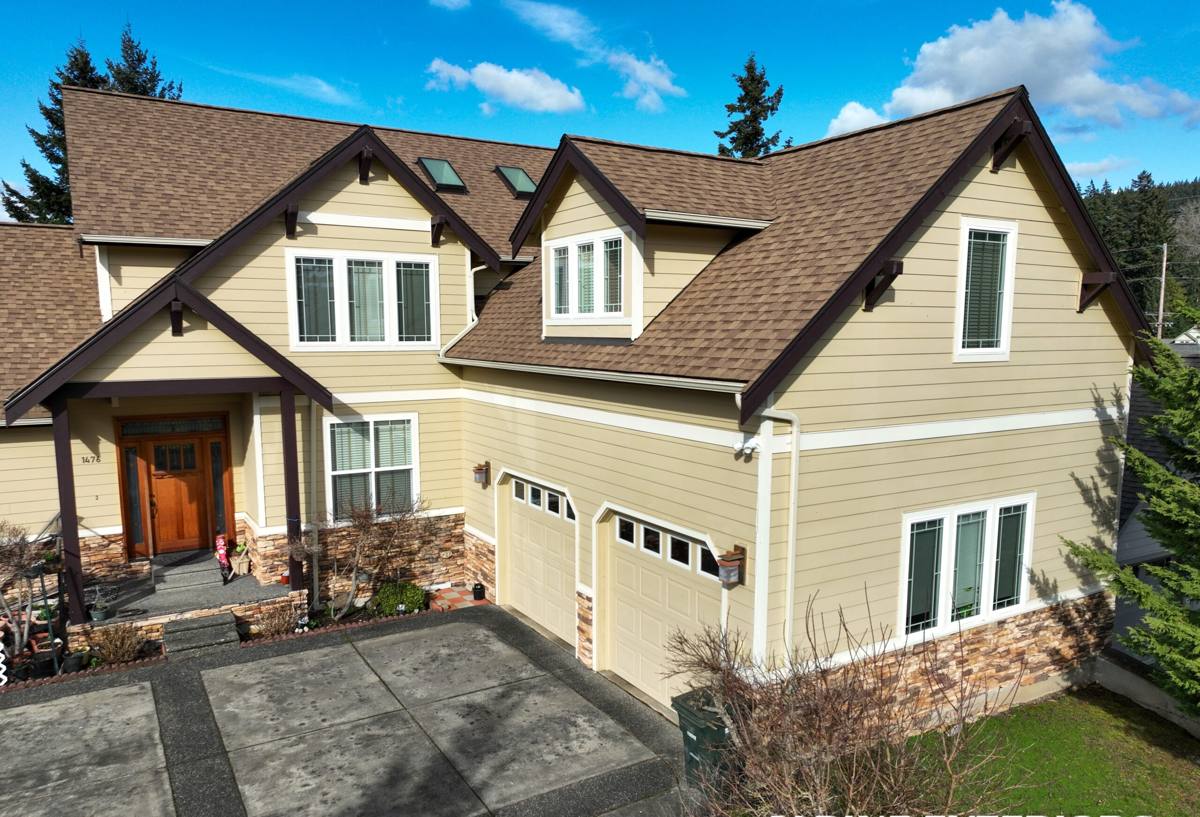
What Samish's Climate Actually Does to a Deck
Salt air and corrosion
Salt-laden air accelerates corrosion on anything metal — fasteners, joist hangers, post bases, railing hardware. Standard hot-dip galvanized hardware holds up reasonably well, but in a marine-influenced area like this one, stainless steel fasteners and connectors are worth the upfront cost, especially anywhere the hardware is exposed or in direct contact with treated lumber.
Driving rain
Rain here doesn't always fall straight down. Wind off the water pushes it sideways, which means ledger boards, rim joists, and any wall-to-deck connection take on more water than a simple flashing detail designed for vertical rainfall can shed. This is the single most common source of hidden rot we find when we're called out to repair or rebuild an older deck.
The long moss season
Low sun angles, shade from mature trees, and stretches of damp weather that can run for months give moss, algae, and lichen plenty of time to establish themselves on decking, especially on north- and east-facing surfaces that don't get much direct sun. Once established, moss holds moisture against the wood or composite surface even after the rain stops, and it turns a deck slick and genuinely dangerous underfoot.
What a Correctly Built Deck Involves Here
A deck that's going to hold up in Samish's conditions needs attention in a few specific places that a generic build often skips:
- A ledger board connection with proper flashing that directs water away from the house rim joist, not just a bead of caulk behind the ledger
- Joist tape or a similar cap over the top of every joist to keep standing water out of end grain and fastener holes
- Post bases set above grade with a gap for drainage, not buried or sitting flush in standing water
- Stainless steel or high-grade coated fasteners and structural connectors, sized correctly for the load
- Decking spaced and oriented to shed water and dry between rain events rather than trapping moisture
- A surface material and finish chosen with this specific site's sun exposure and tree cover in mind
Skip any one of these and the deck can still look good for a while — the framing is hidden, the flashing is hidden, the fastener grade isn't visible from the yard. That's exactly why so many deck problems in this area go unnoticed until there's already rot or a soft spot underfoot.
Choosing a Decking Material for This Site
There's no single right answer for every yard — it depends on budget, how much sun and shade the deck gets, and how much upkeep you actually want to do. Here's how the common options stack up specifically against Samish's salt air, rain, and moss pressure:
| Material | Moisture & moss resistance | Maintenance | Typical lifespan here |
|---|---|---|---|
| Pressure-treated wood | Good if sealed and maintained; moss and algae readily colonize unsealed or shaded boards | Annual cleaning, periodic re-sealing/staining | 15-20 years with upkeep |
| Cedar | Naturally rot-resistant, but surface still needs care in shaded, damp spots | Regular cleaning and refinishing to hold color and resist moss | 15-25 years with upkeep |
| Composite decking | Very good — doesn't absorb water or rot, though moss/algae can still grow on the surface film | Occasional washing; no sealing or staining | 25-30+ years |
| PVC/capped polymer decking | Excellent — fully sealed surface resists moisture and staining | Lowest maintenance; periodic washing | 25-30+ years |
In shaded, north-facing, or tree-covered yards — common around Samish — we generally steer clients toward composite or capped polymer decking, not because wood is a bad product, but because wood in constant shade and dampness needs a maintenance commitment most homeowners underestimate when they're choosing materials in a showroom rather than picturing their actual yard in February.
Hardware and Fasteners: Where Corrosion Actually Starts
Most deck failures we're called to repair don't start with the decking boards — they start with the hardware underneath. Joist hangers, structural screws, and post connectors that aren't rated for a coastal or marine-influenced environment will rust faster here than the same hardware would in a drier inland climate, even when they look adequately coated at installation. We spec stainless steel or marine-grade coated fasteners and connectors on Samish jobs as standard practice, not an upsell — it's a smaller cost difference than most people expect relative to the total project, and it's the difference between hardware that's still sound at year fifteen and hardware that's already staining and weakening at year five.
Moss, Algae, and Keeping a Deck Safe Underfoot
Moss on a deck isn't just cosmetic — it's a slip hazard, and it accelerates surface wear by holding moisture against whatever material is underneath it. A few things make a real difference for decks in Samish's shadier, damper spots:
- Board spacing and orientation that lets water and debris drain through rather than pool
- Keeping overhanging branches trimmed back to let more light and air reach the surface
- Regular clearing of leaves and needles before they compost into a moss-friendly layer
- Periodic cleaning with a deck-safe wash, especially before the wet season sets in
- Choosing a surface texture and material that doesn't hold a film of moisture the way some older wood finishes do
None of this eliminates moss entirely in a persistently shaded spot — that's just the reality of this climate — but the right build and a modest maintenance routine keep it manageable instead of letting it take over.
Our Process, From Design to Finished Deck
We walk every Samish deck project through the same sequence, because skipping steps is exactly how corner-cutting deck builds happen:
- On-site assessment. We look at sun exposure, tree cover, drainage patterns, and the existing structure (if there's a deck to replace) before recommending anything.
- Honest material and design conversation. We'll tell you where a lower-cost option is a reasonable trade-off and where it isn't, based on how your specific yard behaves.
- Permitting. Deck work at height or attached to the house typically requires a permit — we handle that process so it's not left to you.
- Proper structural build. Correct ledger flashing, joist protection, post footings, and fastener grade, done in the order that actually keeps water out.
- Final walkthrough. We go over the finished deck with you, including what maintenance it actually needs and on what schedule.
Why Local Experience Matters for This Job
A deck built by a crew that hasn't worked much in Whatcom County's coastal-influenced neighborhoods tends to default to generic specs — standard galvanized hardware, standard flashing details, standard board spacing — because that's what works in most of the country. Those specs aren't wrong everywhere; they're just under-built for the specific combination of salt air, driving rain, and shade that a lot of Samish properties deal with. Working this area regularly means we've already seen which details hold up through a real Whatcom County winter and which ones come back as a repair call, and we build to the first standard, not the second.
A Quick Pre-Project Checklist
- Confirm whether your project needs a building permit (most attached, elevated decks do)
- Ask any contractor specifically what fastener and hardware grade they use, not just what decking brand
- Walk your yard at different times of day to understand real sun and shade patterns before choosing material
- Ask how ledger flashing will be detailed, since that's the most common source of hidden rot
- Get a clear, written maintenance expectation for whatever material you choose
If you're planning a new deck or need to replace one that's showing its age, we're happy to take a look and put together a straightforward, no-pressure estimate — just fill out the form below.