 Whatcom County
 Why Edgemoor Decks Wear Out Faster Than the Manual Says
Edgemoor sits close enough to Bellingham Bay that salt-laden air is a daily fact of life, not an occasional event. Combine that with the driving rain that rolls in off the water for much of the year, plus a long, shaded moss season under the neighborhood's mature tree canopy, and you have a deck environment that's noticeably harder on materials than what a manufacturer's warranty language assumes. Fasteners corrode faster. Wood fibers stay damp longer between dry spells. Moss and algae get a foothold on shaded boards and never fully let go.
None of that means a deck in Edgemoor is doomed — it means the deck needs to be built and replaced with that reality in mind, not with a generic, one-size-fits-all approach. A deck that would give twenty solid years in a dry inland climate can start showing real trouble in twelve or fifteen years here if the original build didn't account for moisture, drainage, and corrosion resistance from day one.
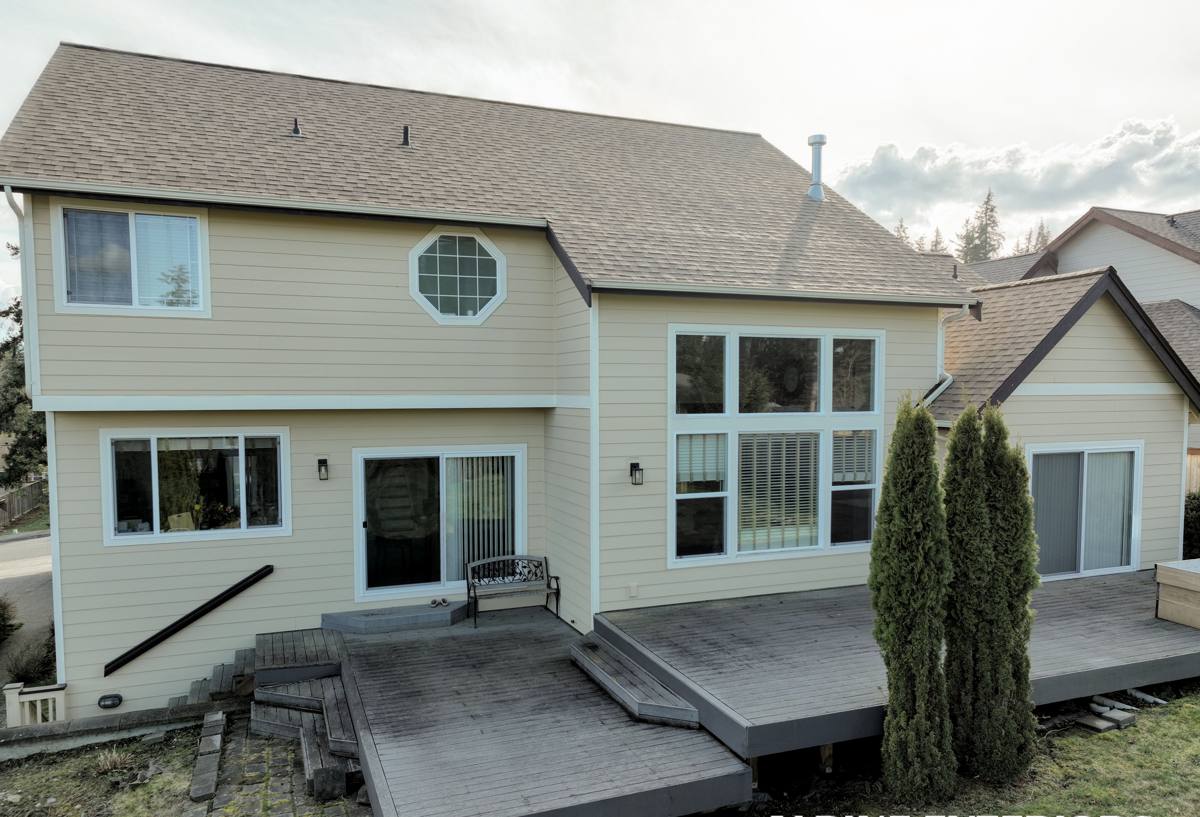
The Warning Signs Worth Taking Seriously
Homeowners often ask whether their deck needs a full replacement or just a repair. In this climate, a few signs tend to mean the structure itself — not just the surface boards — has been compromised:
- Soft or spongy spots underfoot, especially near the house ledger board or stair landings
- Visible rust streaking from fasteners or hardware onto the decking or fascia
- Persistent black or green staining that comes back within weeks of cleaning
- Gaps that have widened unevenly, or boards that cup and crown noticeably
- Any movement or bounce in the railing posts when you lean on them
- Ledger board separation or daylight visible where the deck meets the house
If it's just surface graying or minor moss on a structurally sound deck, cleaning and refinishing may be enough. Once the framing, ledger connection, or footings are in question, replacement is the honest recommendation — patching a compromised structure just delays a more expensive failure.
What a Correct Deck Replacement Actually Involves
Below the Boards: The Part That Determines Longevity
The visible decking gets all the attention, but the framing underneath is what determines whether the next deck lasts fifteen years or thirty-five in this climate. A correct replacement means checking and, where needed, upgrading:
- Footing depth and condition, since shifting or undersized footings show up as deck sag years later
- Joist spacing and sizing appropriate for the decking material chosen, not just whatever spacing was there before
- Proper flashing at the ledger board connection to the house, which is the single most common source of hidden rot on decks in wet climates
- Corrosion-resistant fasteners and structural hardware rated for exposed, coastal-adjacent conditions
- Joist protection (tape or membrane on top of framing) to slow water intrusion into cut lumber
Above the Boards: Surface Choices That Match the Climate
On top of correct framing, the decking surface itself needs to handle sustained dampness and shade without becoming a moss farm. That's a materials conversation as much as an installation one, covered below.
Choosing a Decking Material for Salt Air, Rain, and Shade
There's no single "best" decking material for every home — it depends on how much sun the deck gets, how much upkeep the owner wants to do, and budget. Here's how the common options actually compare in this specific climate:
| Material | Moisture & Moss Behavior | Maintenance | Typical Lifespan Here |
|---|---|---|---|
| Pressure-treated wood | Absorbs moisture readily; needs sealing to resist moss and rot in shaded areas | Annual cleaning, periodic re-staining or sealing | 10–20 years with upkeep |
| Cedar | Naturally rot-resistant but still needs sealing near salt air and shade | Regular sealing to maintain resistance and color | 15–20 years with upkeep |
| Capped composite | Resists moisture absorption well; still needs occasional cleaning where moss can gather on the surface film | Low — periodic washing, no sealing or staining | 25–30+ years |
| PVC decking | Doesn't absorb moisture; best resistance to staining and moss buildup | Lowest — occasional washing | 25–30+ years |
Our professional standard is to steer homeowners away from materials that trap moisture against the framing or that require maintenance schedules most people won't actually keep up with — not because a given product is bad, but because in a climate with this much sustained dampness, the maintenance burden and moisture behavior of the material matters more than it would somewhere drier. We'll walk through the honest trade-offs for your specific deck's sun exposure and budget rather than push one product line.
Drainage and Moss Prevention Built Into the Design
A deck that sheds water and dries out between rain events will always outlast one that holds moisture, regardless of the decking material chosen. In Edgemoor's tree-shaded, marine-influenced setting, that means paying deliberate attention to:
- Proper board spacing so water drains through rather than pooling
- Slight slope away from the house at the ledger connection
- Adequate under-deck ventilation so the space beneath the boards can actually dry out
- Keeping decking clear of overhanging branches where practical, since leaf litter holds moisture and feeds moss
- Gutter and downspout placement that doesn't dump roof runoff directly onto or under the deck
These details cost little to get right during a replacement and are expensive to retrofit later, which is why we address them as part of the build, not as an afterthought.
Fasteners and Hardware: The Detail That Fails First
In a lot of decks we've torn out around the county, the boards were still usable but the fasteners and connector hardware had failed — rust staining, corroded screw heads, weakened joist hangers. Salt-influenced air accelerates that process. A correct deck replacement uses stainless steel or heavy hot-dip galvanized fasteners and hardware rated for exposed, coastal-adjacent use, not standard interior-grade hardware that happens to be cheaper up front. It's a small line item on an estimate that has an outsized effect on how long the whole structure lasts.
Our Deck Replacement Process
- On-site assessment — we inspect the existing deck's framing, footings, ledger connection, and hardware condition, not just the surface boards, so you know exactly what's driving the recommendation.
- Honest scope and estimate — a written breakdown of what's being replaced, what materials are recommended for your specific sun and shade exposure, and why.
- Permit handling — where the project's size or height requires a permit, we handle that process rather than leaving it to the homeowner.
- Careful tear-out — removing the old structure without unnecessary damage to landscaping, siding, or adjacent hardscape.
- Structural rebuild — footings, framing, flashing, and hardware brought up to a standard built for this climate, not just code minimums.
- Decking and railing installation — installed to the material manufacturer's specifications, with attention to spacing and drainage.
- Final walkthrough and cleanup — site cleared of debris, and we walk the finished deck with you before calling the job done.
Permits and Local Requirements
Depending on the deck's height, size, and attachment to the home, a permit may be required through the local jurisdiction covering Edgemoor and the rest of Whatcom County. Requirements around guardrail height, stair geometry, and structural connections are there for real safety reasons, particularly on the sloped, tree-covered lots common in this area. We factor permit needs into the estimate up front so there are no surprise delays once work has started.
What Drives the Cost of a Deck Replacement
Every deck is different, so we don't quote a number without seeing the site, but these are the main factors that move the price up or down:
| Factor | Why It Matters |
|---|---|
| Deck size and shape | More square footage and complex angles mean more material and labor |
| Decking material chosen | Composite and PVC cost more up front than wood but less over the deck's life |
| Height and stair requirements | Taller decks and multi-flight stairs add framing, railing, and code complexity |
| Condition of existing footings | Reusable footings save cost; footings needing replacement add time and material |
| Site access | Tight, wooded, or sloped lots can slow tear-out and material staging |
| Railing style | Cable, glass, and custom railing systems cost more than standard baluster railing |
Why a Crew That Already Works Edgemoor Makes a Difference
Wooded, bay-influenced neighborhoods like Edgemoor have their own quirks — sloped and shaded lots, mature trees close to the house, and homes built decades apart with very different original construction standards. A crew that already works this specific pocket of Whatcom County has seen how those lots drain, where moss tends to establish first, and what the local permitting process actually expects, which means fewer surprises mid-project and a build that's suited to the property rather than a generic template.
If your deck is showing its age, or you'd simply like an honest opinion on repair versus replacement, we're happy to take a look. Fill out the form below for a free, no-pressure estimate.