 Whatcom County
Why Edgemoor Homes Need a Different Approach to Siding
Edgemoor sits close enough to Bellingham Bay that salt-laden air, wind-driven rain, and heavy shade from mature trees are simply part of owning a home here. That combination is harder on exterior siding than almost anywhere else in Whatcom County. Salt air accelerates corrosion on fasteners and trim. Driving rain off the water finds every gap in a wall assembly. And the tree canopy that makes Edgemoor so desirable also means less sun exposure, longer drying times, and a moss and algae season that can run eight or nine months out of the year.
None of that makes siding impossible here — it makes the choice of material and the quality of installation more important than in a drier inland neighborhood. We install James Hardie fiber cement siding exclusively, and Edgemoor is exactly the kind of environment that shows the difference between a product built for this climate and one that's merely tolerating it.
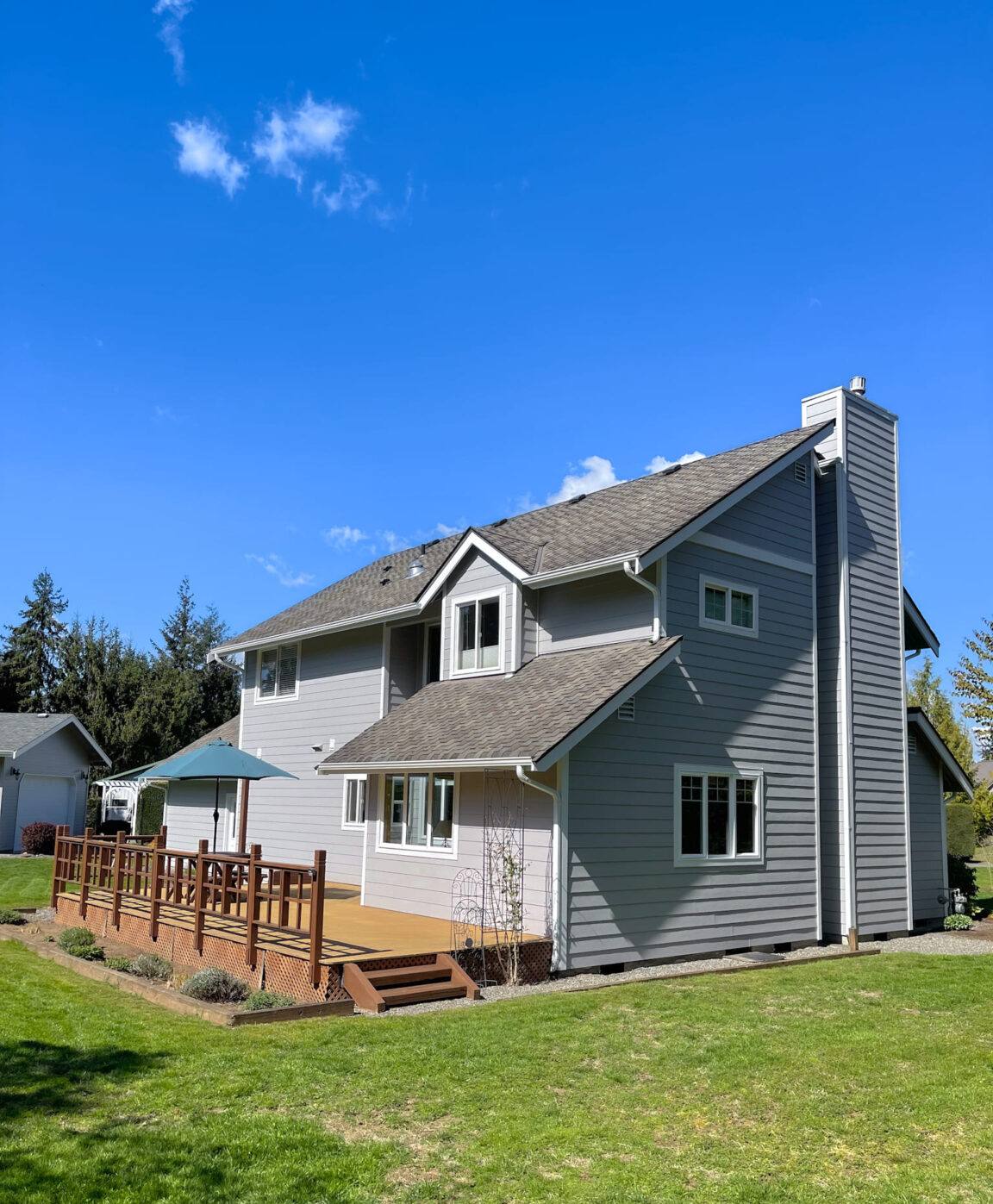
What Salt Air, Rain, and Moss Actually Do to a House
Salt Air
Airborne salt from Bellingham Bay settles on every exterior surface. On untreated or lightly coated materials, it accelerates rust on fasteners, staples, and metal trim, and it can degrade certain paint films faster than an inland home would experience. Over years, that shows up as streaking, corrosion bleed-through, and premature finish failure on south- and west-facing walls that catch the prevailing weather.
Driving Rain
Storms moving in off the water don't just fall straight down — wind pushes rain sideways into wall assemblies, seams, and butt joints. A siding system with weak joints, poor flashing details, or a material that swells when wet is going to lose that fight eventually. Water intrusion at siding seams is one of the most common causes of hidden rot in coastal Whatcom County homes.
Moss and Algae
Shade, moisture, and mild temperatures are a perfect recipe for moss and algae growth on north-facing walls and anywhere tree cover blocks direct sun. Porous or wood-based siding materials absorb moisture and give organic growth something to root into. Once moss establishes itself, it holds water against the siding surface, which compounds every other problem on this list.
Why We Only Install James Hardie in Edgemoor
We've made a deliberate decision as a company to install James Hardie fiber cement exclusively — not vinyl, not LP SmartSide, not Cemplank or Allura, not primed spruce or cedar. In a neighborhood like Edgemoor, that decision matters more than in most places:
- Non-combustible core: Fiber cement doesn't feed a fire the way wood-based products can, which matters for insurance and long-term peace of mind.
- Engineered for wet climates: Hardie's HZ5 product line is specifically formulated for regions with high moisture exposure like ours, rather than a one-size-fits-all national spec.
- Factory-applied ColorPlus finish: The finish is baked on at the factory under controlled conditions, giving it better adhesion and fade resistance than field-applied paint, which matters when salt air is working against the finish year-round.
- Dimensionally stable: Fiber cement doesn't swell, cup, or warp with repeated wet-dry cycles the way wood-based composite products can over time.
- Strong transferable warranty: A meaningful warranty backing the product matters when you're planning to own the home, or sell it, in a climate that stress-tests siding harder than average.
We're honest that other products have real advantages in other contexts — cost, weight, or ease of installation, for example. But for a home absorbing salt air, driving rain, and near-constant shade, we don't think those trade-offs make sense, and we'd rather turn down a job than install something we don't believe will hold up on your wall.
What a Correct Fiber Cement Job Actually Involves
Fiber cement siding is only as good as the assembly behind it. A rushed or under-specified installation can fail in this climate even with the right material. Here's what we treat as non-negotiable on every Edgemoor project:
Water Management Behind the Siding
A weather-resistive barrier and correctly lapped flashing at every window, door, and horizontal transition come first — before a single piece of siding goes up. In a driving-rain environment, the barrier behind the siding is doing as much work as the siding itself.
Proper Clearances and Gaps
Hardie siding needs the manufacturer-specified clearance from grade, roofing, decks, and other flat surfaces so water has somewhere to go instead of wicking up into the bottom edge of the boards. We also maintain expansion gaps at butt joints and trim per spec, sealed with the correct sealant rather than caulked over and hoped for.
Fastening for a Coastal Environment
Fastener corrosion is one of the quiet failure points on salt-exposed homes. We use fasteners rated for the exposure and follow Hardie's fastening pattern exactly — over-driven or under-driven nails are a common cause of premature siding problems that have nothing to do with the material itself.
Field Cutting and Touch-Up
Every cut edge needs to be sealed or primed per Hardie's installation guidelines, or that edge becomes the weak point in an otherwise well-built wall. This is a step that's easy to skip and impossible to verify once the wall is closed up — which is exactly why we don't skip it.
Product Lines That Make Sense for This Neighborhood
| Hardie Product | Best Fit For | Why It Works in Edgemoor |
|---|---|---|
| HardiePlank Lap Siding | Most home styles, straightforward re-sides | Widely proven, engineered HZ5 formulation for wet climates |
| HardieShingle | Craftsman or cottage-style homes wanting a cedar-shake look | Delivers the shingle look without the moisture absorption of real wood shakes |
| HardiePanel Vertical Siding | Accent walls, gables, modern or mixed-material exteriors | Clean lines that pair well with board-and-batten detailing |
| HardieTrim | Corners, window and door surrounds, fascia | Matches the siding's moisture resistance so trim doesn't become the failure point |
Color and Finish Considerations for a Shaded, Salt-Exposed Home
Because so much of Edgemoor sits under tree cover, color choice affects more than curb appeal. Darker colors on shaded walls can stay damp longer after rain, which can make moss and algae growth more visible sooner. ColorPlus finishes are formulated to resist fading and mildew better than field-applied paint, but we'll still talk through which colors and sheens tend to perform best on north-facing or heavily shaded elevations versus walls that get more direct sun and salt exposure.
Our Process for an Edgemoor Fiber Cement Project
- On-site assessment: We walk the exterior, check for existing moisture damage, moss buildup, and problem areas specific to your lot's exposure and shade pattern.
- Tear-off and inspection: Old siding comes off and we inspect the sheathing underneath for rot or water damage before anything new goes up — this is often where hidden problems from a previous installation surface.
- Water barrier and flashing: A correctly lapped weather-resistive barrier and flashing package goes in at every penetration and horizontal transition.
- Hardie installation to spec: Siding, trim, and fastening follow James Hardie's published installation guidelines for our climate zone, not a generic national default.
- Final detailing: Cut edges sealed, caulking joints finished, and a full walkaround before we call the job done.
Signs Your Edgemoor Home's Siding Needs Attention
- Persistent moss or algae staining that returns shortly after cleaning
- Soft or spongy spots when you press on the siding, especially near the bottom edge
- Paint that's peeling, bubbling, or chalking faster than it should
- Visible gaps or separation at butt joints and corner trim
- Rust streaking below fasteners or metal trim pieces
- Warping, cupping, or bowed boards on wood-based or composite siding
If you're seeing more than one of these on a home in Edgemoor, it's worth having someone look at it before winter storm season adds to the problem.
Maintenance That Actually Matters in This Climate
Even the right material benefits from basic upkeep in a salt-air, high-moisture environment. A yearly rinse-down to clear salt residue and organic buildup, a walk-around to catch caulking that's started to separate, and prompt attention to any gutter or drainage issue near the siding go a long way. Fiber cement holds up far better than wood-based alternatives with minimal maintenance, but "minimal" isn't "none" — especially on the shaded, moisture-prone walls common throughout the neighborhood.
Why Local Experience in Edgemoor Matters
A crew that's worked in Edgemoor and similar Bellingham Bay-adjacent neighborhoods already knows how to read a lot's exposure — which walls take the worst of the driving rain, which stay shaded and damp longest, and how salt air tends to show up first on a given elevation. That's the kind of judgment that doesn't come from a spec sheet; it comes from having done the work on homes dealing with the same weather yours does. It affects decisions on flashing details, fastener choice, and even which color and product line will perform best on a specific wall — decisions that are hard to get right without local context.
Get a Free, No-Pressure Estimate
If you're weighing a re-side or replacing storm-damaged or aging siding on an Edgemoor home, we're happy to walk the exterior with you, point out what we see, and give you an honest read on what the job actually needs. There's no obligation and no pressure — just a straight assessment from a crew that installs James Hardie fiber cement and only James Hardie fiber cement. Fill out the form below to get started.