 Whatcom County
Why Edgemoor Roofs Wear Differently Than Inland Homes
Edgemoor sits close to Bellingham Bay, and that proximity to open water changes how a roof ages. Salt-laden air drifts in off the water and settles on every exposed surface, including shingles, flashing, and fasteners. Combine that with Whatcom County's long stretch of wet weather each year and a moss season that can run from late fall through spring, and you get a roofing environment that's noticeably tougher on materials than what you'd see twenty miles inland. A roof that might last its full rated lifespan in a drier part of the state can show granule loss, fastener corrosion, and moss colonization years earlier here if it wasn't built or maintained with that climate in mind.
This page is about one job: full roof replacement for Edgemoor homes. Not a patch, not a repair — a real tear-off and rebuild done in a way that accounts for the salt air, the driving rain off the bay, and the moss that finds a foothold on anything north-facing or shaded by mature trees.
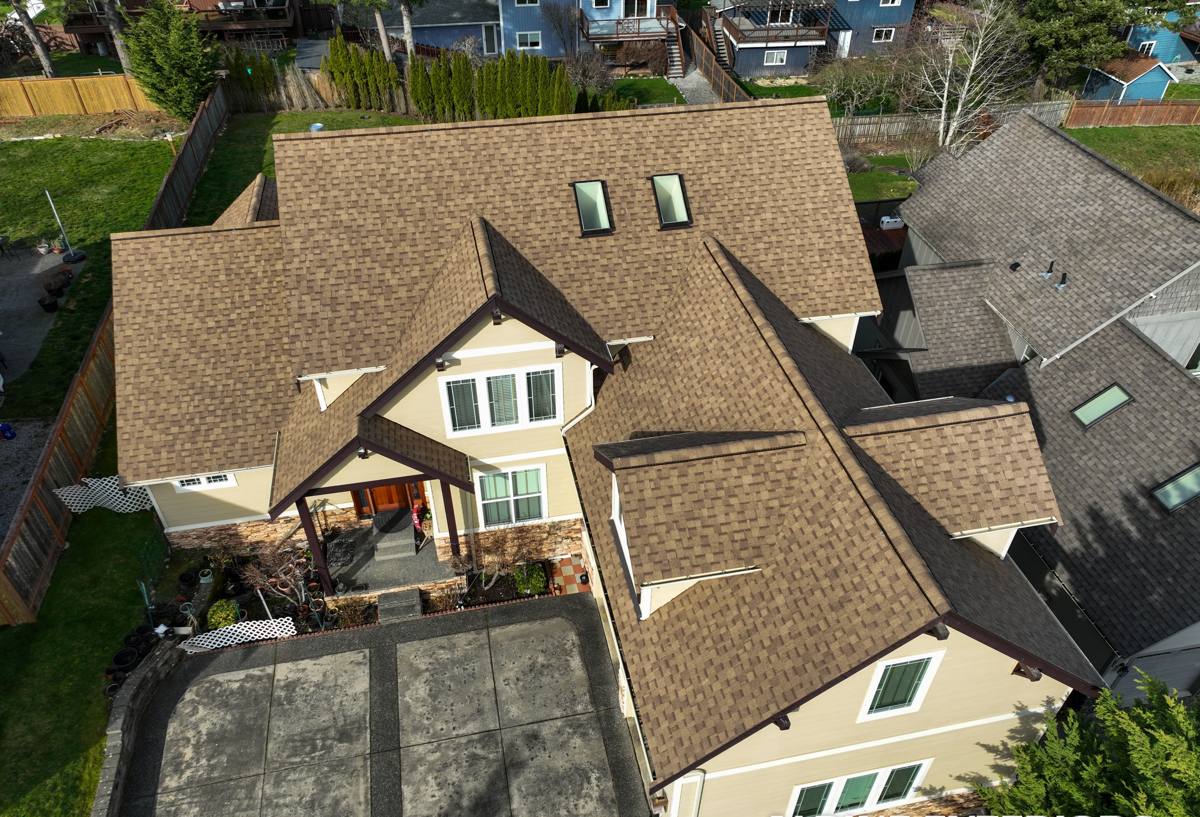
How Salt Air, Rain, and Moss Actually Damage a Roof
Salt Air and Metal Fatigue
Salt is corrosive to unprotected or under-protected metal. On a roof, that means flashing, nail heads, gutter hardware, and any exposed fasteners are the first things to show pitting and rust if they weren't specified for a marine-influenced environment. Once flashing starts to corrode, its seal weakens, and that's usually where water finds its way into a roof system long before the shingles themselves look worn out.
Driving Rain and Wind-Driven Water
Storms coming off the water don't just drop rain straight down — wind pushes it sideways, up under shingle edges, and into any gap in the flashing or underlayment. A roof designed for calmer conditions can underperform here because standard installation tolerances assume less lateral water pressure. Proper underlayment coverage and flashing detail matter more in Edgemoor than they would in a sheltered inland lot.
Moss Season and What It Does Beneath the Surface
Moss doesn't just look bad — it holds moisture against the roofing material for extended periods, and on shaded or north-facing slopes it can establish itself within a couple of seasons. As moss mats grow, they lift shingle edges slightly, which lets wind-driven rain work its way underneath. Over years, that trapped moisture accelerates granule loss on asphalt shingles and can lead to rot in the decking below if it's never addressed.
Signs an Edgemoor Roof Needs Replacement, Not Just Repair
- Granule loss heavy enough that you can see bare asphalt on multiple shingles, not just one or two spots
- Shingles that are cupping, curling at the edges, or cracking when you look at them from the ground
- Flashing around chimneys, vents, or valleys showing rust streaks or visible gaps
- Moss or algae that returns within a season or two of cleaning, even after treatment
- Daylight visible through the roof deck from inside the attic, or damp insulation after a storm
- A roof that's approaching or past the upper end of its rated service life, especially if it was never re-flashed or had ventilation upgraded
- Multiple past repairs in different spots — a sign the underlying system is failing broadly, not in one isolated area
Any one of these on its own might point to a repair. Several of them together, especially on a roof that's a decade or more old, usually means it's time to talk replacement instead of continuing to chase leaks one at a time.
Choosing a Roofing System for a Coastal Whatcom County Home
There's no single "best" roofing material for every Edgemoor home — it depends on the roof's exposure, the home's style, and how much long-term maintenance the owner wants to take on. Here's how the common options stack up specifically against salt air, wind-driven rain, and moss.
| Material | Salt Air Resistance | Moss Resistance | Typical Maintenance |
|---|---|---|---|
| Architectural asphalt shingle | Good, with corrosion-resistant flashing and fasteners | Moderate — benefits from zinc/copper strips on shaded slopes | Periodic moss treatment, gutter checks |
| Standing-seam metal | Very good with a marine-grade coating and stainless fasteners | Good — moss struggles to grip a smooth metal surface | Low; occasional coating inspection |
| Cedar shake | Fair — needs treated fasteners and careful detailing | Poor without regular treatment; retains moisture | High — regular cleaning and treatment required |
| Composite/synthetic shingle | Good; engineered to resist salt corrosion | Moderate to good depending on product line | Low to moderate |
We don't push one material on every job. A steep, shaded, north-facing roof that's fought moss for years is a very different conversation than a sun-exposed south slope with a clean sightline to the water. We'll walk the roof, look at the exposure, and give you a straight recommendation rather than defaulting to whatever's easiest to install.
A Note on Cedar Shake
Cedar has a real place in the Pacific Northwest aesthetic, and we're happy to install it when a homeowner wants that look. But we're upfront about the trade-off: in a moss-prone, salt-air environment like Edgemoor, cedar needs more consistent upkeep than asphalt or metal to perform well over the long run. If you go that route, budget for annual or biennial cleaning and treatment as part of the ownership cost, not an optional extra.
What a Correct Roof Replacement Actually Involves
A roof replacement is more than swapping old shingles for new ones. Done right, in this climate, it includes several layers most homeowners never see once the job is finished.
Full Tear-Off and Deck Inspection
We remove the existing roofing down to the deck rather than layering over it. That's the only way to actually see the plywood or plank sheathing underneath — which is exactly where moss-related moisture damage and rot tend to hide. Any soft, delaminated, or rotted decking gets replaced before anything new goes down; covering over compromised decking just guarantees an early failure.
Underlayment Built for Wind-Driven Rain
Given how much lateral water pressure this area sees during a bay storm, underlayment coverage matters more here than in sheltered locations. We pay particular attention to ice-and-water shield in valleys, around penetrations, and along eaves — the spots where wind-driven rain is most likely to find a way in.
Corrosion-Resistant Flashing and Fasteners
Given the salt exposure, we specify flashing and fastener hardware rated for coastal/marine conditions rather than standard-grade materials. It costs a bit more up front and it's the difference between flashing that's still sound in fifteen years and flashing that's rusting through in five.
Ventilation That Matches the Roof
Poor attic ventilation traps moisture, which speeds up decking rot and can even encourage moss growth from underneath. We check and, where needed, correct intake and exhaust ventilation as part of a full replacement — not as an afterthought.
Moss-Resistant Details on Shaded Slopes
On roof sections we know will stay shaded and damp through the moss season, we can install zinc or copper strips near the ridge, which release trace metal ions with the rain that inhibit moss regrowth over time. It's a small detail that meaningfully cuts down on how often a homeowner needs to treat the roof afterward.
Our Roof Replacement Process
- Walk-through and assessment. We inspect the current roof, the attic, and the decking where accessible, and talk through what we're seeing with you directly.
- Written estimate. You get a clear scope of work and price — what's included, what materials, and why we're recommending them for your specific roof.
- Scheduling around the weather. We plan tear-off days around forecasts, since an open roof deck and an unpredicted squall off the bay don't mix.
- Tear-off and deck repair. Old roofing comes off, the deck gets inspected, and any damaged sheathing is replaced before we move forward.
- Underlayment, flashing, and ventilation work. The layers that actually keep water out go in with attention to the details covered above.
- New roofing installation. Shingles, metal panels, or shakes go on per manufacturer specification, with fastener patterns and exposure set correctly for wind and rain exposure.
- Final walk-through and cleanup. We review the finished roof with you, clean the property of debris and nails, and go over any maintenance recommendations specific to your roof's exposure.
Cost Factors to Understand Before You Get Quotes
| Factor | Why It Moves the Price |
|---|---|
| Roof size and pitch | Steeper roofs take longer and require more safety setup; more square footage means more material |
| Layers to remove | Multiple existing layers add labor and disposal cost beyond a single tear-off |
| Decking condition | Rot from years of trapped moisture means replacing sheathing, not just the roofing on top |
| Material choice | Asphalt, metal, and cedar carry different material and labor costs, as shown in the comparison above |
| Flashing and ventilation upgrades | Marine-grade hardware and ventilation corrections add cost but reduce failures down the road |
| Access and site conditions | Steep lots, mature landscaping, or limited driveway access can affect setup and staging time |
We'd rather walk you through these factors honestly during the estimate than quote a number that doesn't hold up once we're on the roof and can see the actual condition of the decking and flashing.
Why a Crew That Already Works Edgemoor Makes a Difference
A roofer who works across Whatcom County regularly, including the neighborhoods closest to the water, has already seen how salt exposure, driving rain, and moss season play out over years on real roofs in this area. That's not something you can substitute with generic manufacturer specs written for a national average climate. It shows up in small decisions — which fastener grade to spec, where to add extra underlayment coverage, whether a given slope needs moss-resistant detailing — that matter more here than they would twenty miles inland.
It also shows up in scheduling and logistics. A crew familiar with the area knows how weather moves in off the bay and plans tear-off timing accordingly, rather than getting caught with an open deck when a storm arrives sooner than forecast.
Before You Sign a Roofing Contract
- Ask what happens if the decking inspection reveals rot — is replacement sheathing priced separately or built into the estimate?
- Confirm the flashing and fastener grade being used, especially given the salt air exposure this close to the water
- Ask whether moss-resistant detailing (like zinc or copper strips) is available for shaded slopes
- Get the warranty terms in writing — both the manufacturer's material warranty and the contractor's workmanship warranty
- Ask how ventilation will be assessed and whether corrections are included if needed
- Make sure the estimate specifies full tear-off, not an overlay, unless you've discussed and agreed to that trade-off
A roof replacement is a significant investment, and the difference between a roof that performs well for decades in this climate and one that needs early repairs usually comes down to these details, not just the shingle brand on the label.
If your Edgemoor roof is showing its age or you're just not sure whether it needs repair or full replacement, we're happy to take a look and give you an honest read — no pressure, no sales script. Fill out the form below for a free estimate.