 Whatcom County
Siding Replacement in Edgemoor: Built for the Bay, Not Just the House
Edgemoor sits close enough to the water that its homes deal with a different set of siding stresses than houses a few miles inland. Salt-laden air off Bellingham Bay, wind-driven rain that gets pushed sideways into wall assemblies, and a moss season that can run most of the year all combine to work siding harder here than in drier parts of Whatcom County. When we replace siding in Edgemoor, we're not just swapping old material for new — we're re-thinking how the wall handles water, salt, and organic growth for the next several decades.
This page is specifically about full siding replacement for Edgemoor homes. If you're comparing products or trying to understand what's actually failing on your house right now, this is where we lay out what local conditions demand, what a correct replacement job includes, and how our process works from first visit to final walk-through.
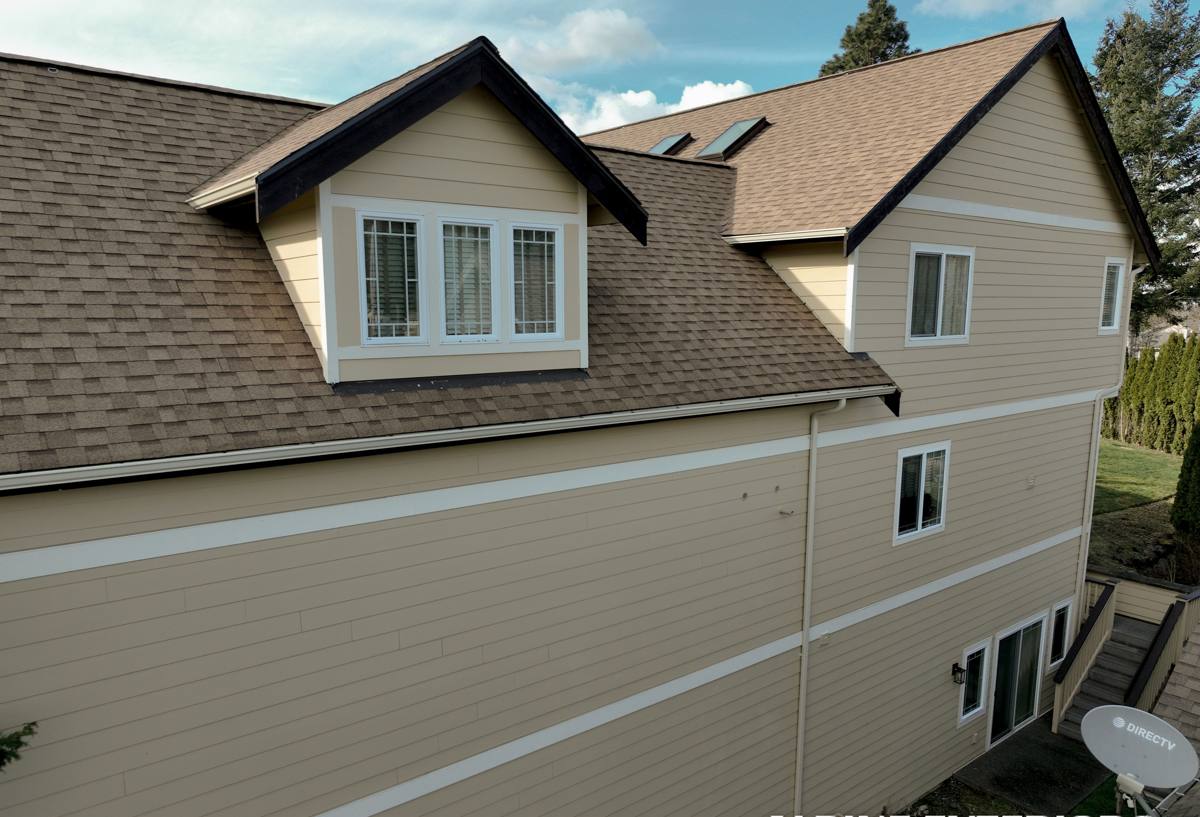
Why Edgemoor's Climate Is Tougher on Siding Than It Looks
Whatcom County as a whole sees a lot of moisture, but proximity to the water changes the equation for Edgemoor specifically. Three factors show up again and again when we inspect siding in this neighborhood:
Salt Air and Corrosion
Airborne salt doesn't just affect metal fasteners and flashing — it accelerates the breakdown of paint films, softens caulk joints faster than manufacturers' published lifespans suggest, and speeds up the fading and chalking of lower-grade finishes. Siding and trim close to the water need finishes and fastener systems that are genuinely rated for coastal exposure, not just "exterior grade" in a generic sense.
Driving Rain
Wind off the bay doesn't just fall on a house — it pushes water horizontally into lap joints, butt seams, and anything less than a fully sealed penetration. A siding system that performs fine on a sheltered inland lot can leak on an exposed Edgemoor elevation simply because the water is arriving at an angle the original installation never accounted for.
Moss and Organic Growth
Shade from mature trees, persistent dampness, and mild temperatures give moss and algae a long growing season here. On the wrong siding material, sustained moss growth holds moisture against the surface and can accelerate rot or delamination. On the right material, properly installed, it's a cosmetic issue you wash off — not a structural one.
None of this means Edgemoor homes need exotic materials or oversized budgets. It means the details — flashing, fastener choice, finish quality, and installation sequence — matter more here than they would somewhere drier and more sheltered.
Signs Your Edgemoor Home Needs Siding Replacement, Not Just Repair
Not every siding problem calls for full replacement. Here's how we tell the difference during an inspection:
- Soft or spongy spots when you press on the siding, especially near the bottom courses or around windows — usually a sign of moisture intrusion into the substrate
- Paint that's failing across large areas rather than in isolated spots, particularly on wind-exposed sides of the house
- Persistent moss or algae staining that returns quickly after cleaning
- Visible gaps, warping, or cupping in lap siding, especially on wood or composite products nearing the end of their service life
- Rust streaking from fasteners, a common issue on older coastal installations with the wrong fastener spec
- Multiple past repairs in different spots — a pattern that usually means the underlying material or original installation, not isolated damage, is the real problem
When damage is localized and the rest of the siding is sound, a targeted repair can make sense. When we see multiple items from that list, or when the water-resistive barrier behind the siding shows signs of long-term saturation, replacement is the honest recommendation — patching over compromised material just delays a bigger repair.
What We Install: James Hardie Fiber Cement, and Why That's the Only Product We Put on a House
We install James Hardie fiber cement siding exclusively. We don't install vinyl, LP SmartSide, Cemplank, Allura, primed spruce, or cedar, and that's a deliberate standard rather than a limitation in what we're capable of installing. Each of those alternatives has real strengths, but in a coastal, high-moisture, long-moss-season environment like Edgemoor, they come with trade-offs we're not willing to put our name behind:
- Vinyl can warp or deform under sustained heat and doesn't hold up as well against physical impact; its seams and expansion joints are also a natural place for wind-driven rain to find its way behind the cladding
- Wood-based composite and engineered wood products depend heavily on an intact factory coating and perfect field sealing at every cut edge — a single missed edge in a wet climate becomes the failure point
- Primed spruce and untreated cedar require an ongoing maintenance commitment (repainting, caulking, moisture monitoring) that most homeowners don't want to sign up for indefinitely, and any lapse accelerates rot
- Cedar in particular is a beautiful, genuinely good material — but it's also a food source for the organic growth this neighborhood already fights, and it asks for more upkeep than most owners realistically deliver year after year
James Hardie fiber cement is non-combustible, dimensionally stable across our wet-to-dry seasonal swings, and comes with a factory-applied ColorPlus finish that's engineered to resist fading and chalking far longer than field-applied paint. Hardie's HZ5 product line is specifically engineered for climates with sustained moisture exposure — which describes Edgemoor about as well as any neighborhood in the county. It also carries a strong transferable warranty, which matters if you sell the house before the siding's service life is up.
James Hardie Product Lines We Use
| Product Line | Best For | Notes |
|---|---|---|
| HardiePlank Lap Siding | Most Edgemoor homes, traditional and modern styles | Available in smooth and cedar-textured finishes; the workhorse product for full replacements |
| HardiePanel Vertical Siding | Modern facades, accent walls, gable ends | Often paired with lap siding for a layered look |
| HardieTrim | Window and door surrounds, corners, fascia | Matches the durability of the field siding instead of mixing in a weaker trim material |
| HardieShingle | Accent gables, Craftsman-style details | Used selectively rather than whole-house in most of our Edgemoor jobs |
What a Correct Siding Replacement Actually Involves
Siding replacement is often sold as a cosmetic upgrade, but the material you see is the last layer of a system. In a wind-and-rain-exposed neighborhood like Edgemoor, the layers underneath the siding matter as much as the siding itself.
1. Tear-Off and Substrate Inspection
We remove the existing siding down to the sheathing and inspect for rot, delamination, or hidden moisture damage. This is the point where problems that have been hiding behind the old siding for years finally become visible — and it's also the point where the cost of a job can shift if we find damage that needs to be addressed before new siding goes on.
2. Water-Resistive Barrier and Flashing
We install or replace the weather-resistive barrier and integrate flashing at every window, door, and penetration. This is the single most important step for a house exposed to driving rain — siding sheds most water, but flashing and the barrier behind it are what stop the water that gets past the surface.
3. Rainscreen Considerations
On exposed elevations, we evaluate whether a rainscreen gap (a small air space between the barrier and the siding) makes sense for the specific wall. It allows incidental moisture to drain and the wall to dry, which matters more on a bay-facing wall than on a sheltered one.
4. Fastener and Hardware Selection
Coastal exposure calls for corrosion-resistant fasteners and hardware rated for the environment, not just whatever is fastest to install. This is a small line-item cost that prevents rust streaking and premature fastener failure down the road.
5. Installation to Manufacturer Spec
James Hardie's warranty depends on installation matching their published specifications — proper nailing patterns, correct clearances from grade and roof lines, and correct joint treatment. Installers who don't follow spec can void the manufacturer warranty even though the product itself is sound, which is why installation quality is as important as the product choice.
6. Finish Details and Cleanup
Caulking at trim joints, touch-up painting at cut edges, and a full site cleanup close out the job. We also walk the property with you to review the finished work before we consider it complete.
Our Process, Start to Finish
- Free on-site estimate — we walk the exterior, check for moisture and substrate issues, and give you an honest read on repair vs. replacement
- Written proposal — product selection, scope of work, and pricing laid out clearly, with no pressure to decide on the spot
- Scheduling — we give you a realistic timeline that accounts for Whatcom County's wet-season weather windows
- Tear-off and substrate repair — old siding removed, damage addressed before anything new goes up
- Barrier, flashing, and rainscreen installation — the part of the job that determines how the house performs in ten years, not just how it looks this year
- Siding installation to spec — installed to James Hardie's requirements so the manufacturer warranty stays intact
- Final walk-through — we review the finished work with you and address anything before we call it done
Why a Crew That Already Works Edgemoor Matters
Siding installation isn't one-size-fits-all across Whatcom County. A crew that mostly works drier, inland, tree-sheltered lots can do fine work there and still make avoidable mistakes on a bay-exposed Edgemoor property — underestimating flashing needs at a wind-exposed corner, or not accounting for how much faster salt air degrades a lower-grade caulk. A crew that has already worked this specific stretch of coastline knows which elevations take the worst of the weather, which fastener and finish choices actually hold up here, and how the moss season affects material selection and maintenance expectations.
That local pattern-recognition doesn't replace following manufacturer specs — it supplements it. The spec sheet tells you the minimum; local experience tells you where this particular neighborhood needs more attention than the minimum.
Cost Factors for Edgemoor Siding Replacement
Every house is different, and we don't publish blanket per-square-foot pricing because it misleads more than it informs. What we can tell you is what actually moves the price on a job like this:
| Factor | Why It Matters |
|---|---|
| Substrate condition | Hidden rot or water damage found during tear-off adds repair scope before new siding can go on |
| House size and complexity | More corners, gables, and window/door penetrations mean more flashing and trim work |
| Product mix | Combining lap siding with panel accents or trim details changes material and labor costs |
| Rainscreen inclusion | Adding a drainage gap on exposed elevations is an added step with a real performance payoff |
| Access and site conditions | Tight lots, mature landscaping, or difficult staging areas affect labor time |
| Existing siding removal | Multiple layers of old material or hazardous materials (like old paint) can add disposal costs |
We walk through all of this during the estimate so you understand what you're paying for and why, not just a bottom-line number.
Maintaining Hardie Siding in a Salt-Air Environment
One of the advantages of switching to James Hardie in a neighborhood like Edgemoor is how little ongoing maintenance it asks for compared to wood-based alternatives. That said, "low maintenance" isn't "no maintenance," especially this close to the water:
- Rinse the siding periodically to clear salt residue and prevent moss or algae buildup, especially on shaded or north-facing walls
- Check caulking at trim joints and penetrations every year or two, since even quality caulk works harder in salt air
- Keep vegetation trimmed back from the siding to reduce shade, trapped moisture, and physical contact
- Address any impact damage or chipped finish promptly so the underlying material stays protected
This is a fraction of the upkeep that primed wood or cedar siding demands, but it's still worth doing — it's what lets the ColorPlus finish and the fiber cement substrate actually reach their designed lifespan in this environment.
If your Edgemoor home's siding is showing its age, or you're just not sure whether you're looking at a repair or a replacement, we're happy to come take a look. The estimate is free, there's no pressure to commit on the spot, and you'll walk away with a straight answer about what your house actually needs.