 Whatcom County
 Why Decks in Happy Valley Need to Be Built for the Weather, Not Just the Yard
A deck in Happy Valley lives a different life than a deck built in a dry climate. Between the salt-tinged air that drifts in off the water, the driving rain that comes sideways in a fall storm, and the long stretch of the year when shaded, damp surfaces grow moss instead of drying out, this part of Whatcom County asks more of a deck's materials and connections than most builders give credit for. A deck that looks fine on installation day can still be quietly failing at the ledger board, the fasteners, or under the decking itself within a few seasons if it wasn't built with this climate in mind.
None of this means building here is harder in some mysterious way. It means being deliberate about a handful of details that matter more here than they would somewhere drier or less coastal.
Salt Air and Corrosion
Homes closer to the water pick up airborne salt that accelerates corrosion on unprotected metal. Fasteners, joist hangers, and structural screws that would last for decades inland can start rusting and staining lumber years earlier when they're the wrong grade for a marine-influenced climate.
Driving Rain and Wind-Driven Moisture
Storms coming off the water don't just fall straight down — they push rain sideways and up under overhangs and ledger boards. That means flashing details that would be adequate in a calmer climate can still let water track behind them here.
Long Moss Season and Shaded Lots
Mature tree cover is part of what makes Happy Valley pleasant to live in, but shade plus regional rainfall equals a long window every year when deck surfaces stay damp long enough for moss and algae to take hold, especially on the north side of a house or under tree canopy.
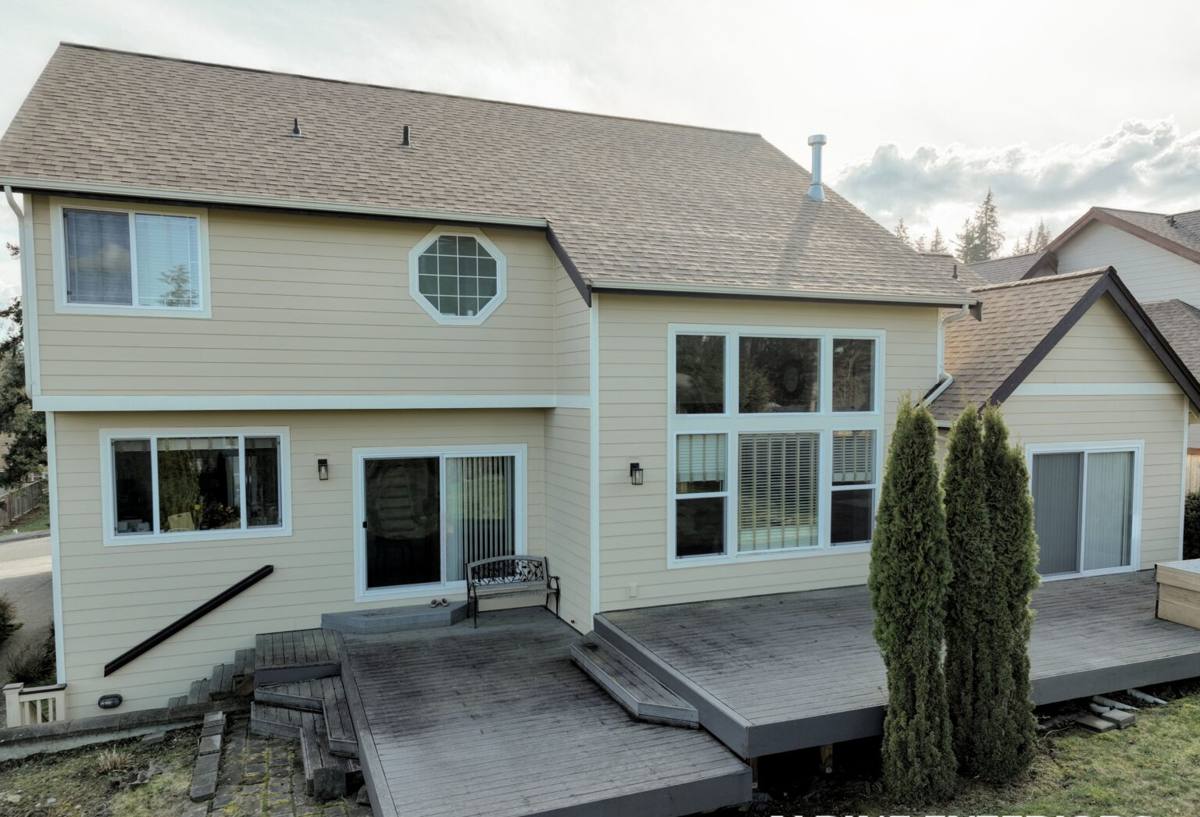
Framing and Structure: Getting the Bones Right
Everything visible on a deck sits on top of a structure that either sheds water and stays dry, or holds moisture and slowly rots from the inside. This is where a correctly built deck and a deck that looks fine but fails early actually diverge.
Footings need to reach solid, undisturbed soil at the depth required for this area, not just a depth that seemed deep enough. The ledger board — where the deck attaches to the house — is the single most common point of failure on decks in wet climates, because it's the one structural connection that's hardest to inspect once it's covered. Proper ledger flashing that integrates with the house's existing water barrier, rather than just being caulked and hoped for, is not optional in a climate that sees this much rain.
Joist spacing, beam sizing, and hardware all need to be sized for the actual loads the deck will see, including snow load in a harder winter, not just the minimum that gets a permit approved. Cutting joist spacing wider to save a few boards is one of the more common shortcuts we see on decks we're asked to repair.
Choosing a Decking Surface That Can Handle Shade and Moss
There's no single right decking material for every home — it depends on budget, how much shade the deck sits in, and how much upkeep you actually want to do. What changes in a climate like this is how each material performs specifically against moisture and moss, not just general wear.
| Material | Upfront Cost | Moisture & Rot Resistance | Moss/Algae Resistance | Typical Upkeep |
|---|---|---|---|---|
| Pressure-treated lumber | Lowest | Good if sealed and maintained | Needs regular cleaning | Annual cleaning, periodic resealing |
| Cedar | Mid | Naturally decay-resistant, but surface needs care | Needs regular cleaning | Cleaning plus oil or stain every 1-2 years |
| Capped composite | Higher | Excellent — won't rot | Better, but still needs occasional washing in heavy shade | Occasional wash, no sealing or staining |
| PVC decking | Highest | Excellent — fully synthetic | Best of the group, but not immune in deep shade | Occasional wash only |
Our standard on shaded, damp lots is to steer clients away from bare pressure-treated boards left unsealed, not because the wood itself is bad, but because it demands a maintenance schedule most homeowners underestimate. Capped composite and PVC cost more up front but remove the resealing cycle entirely, which matters more here than in a drier climate where that cycle is easier to stay ahead of.
Fasteners, Flashing, and Hardware Where Salt Air Wins If You Let It
This is the part of a deck build that's invisible once it's finished, and it's exactly where corners get cut because nobody checks it after the fact. Pressure-treated lumber today is manufactured with chemical preservatives that are more corrosive to standard fasteners than older treatments were, which is why hot-dip galvanized or stainless steel fasteners and connectors are the standard we build to, not an upgrade option. In a salt-air environment, that standard matters even more.
Ledger flashing, joist tape over the top of joists, and self-adhering flashing membrane at every point where wood meets wood or wood meets the house are what keep water from sitting in the one place a deck can't dry out. Skipping joist tape to save a step is common on lower-cost builds, and it's usually the reason we see joists rotting from the top down on decks that are otherwise still structurally sound.
Drainage, Slope, and Keeping Water Moving
A deck that sheds water well will always outlast one that doesn't, regardless of what it's built from. Decking boards need consistent gapping so water passes through instead of pooling, and the substructure underneath needs enough airflow to actually dry out between storms rather than staying damp for weeks at a time under heavy tree cover.
Low decks close to the ground are particularly prone to trapped moisture and moss growth underneath if there's no ventilation path, and downspouts or grading that dump water toward the deck's footings instead of away from them will undermine even a well-built structure over time. These are details that get missed when a deck is designed without walking the actual site first.
Our Deck Building Process
- Site visit and assessment. We look at drainage, shade patterns, existing structure (for replacement decks), and how the deck will tie into the house before recommending anything.
- Design and material selection. We walk through the real trade-offs between materials for your specific spot — shade, budget, and how much upkeep you want — rather than defaulting to one product.
- Permitting. We handle the permit application and coordinate required inspections so you're not the one chasing paperwork.
- Framing and structural build. Footings, ledger flashing, framing, and hardware are all built to hold up specifically in this climate, not just to pass a minimum inspection.
- Decking and finish work. Surface material goes down with proper spacing and fastening, followed by railings, stairs, and any trim details.
- Final walkthrough. We go over the finished deck with you, including what maintenance it actually needs and on what schedule.
Keeping a Happy Valley Deck Looking Good Through Every Season
A well-built deck still needs some seasonal attention in this climate — the goal is to make that upkeep manageable instead of a surprise.
- Clear leaves and needles off the deck surface before fall rains start, especially in gaps between boards where debris traps moisture
- Wash off moss and algae buildup with a deck-safe cleaner rather than a high-pressure wash that can gouge softer woods
- Check for popped or corroding fasteners once a year, particularly on older builds that may not have coastal-rated hardware
- Reseal or oil wood decking on the schedule it actually needs, not just when it starts looking gray
- Confirm gaps between boards haven't closed up from swelling, which blocks proper drainage
- Inspect ledger flashing and caulking annually for any gaps that have opened up
- Trim back branches that keep a section of the deck in deep shade longer than the rest
Permits and Working Within Local Requirements
Deck permitting requirements depend on the size, height, and attachment method of the deck, and on whether your specific property falls under Whatcom County's jurisdiction or a city's. Most decks above a certain size or height off the ground require a permit and at least one inspection during framing, and setback requirements from property lines apply just as they do for any other structure. We handle this as part of the build rather than leaving it for the homeowner to sort out, and we'll tell you upfront what applies to your specific property before work starts.
Why Hiring a Crew That Already Works in Happy Valley Matters
A deck designed for a dry inland climate and a deck designed for a shaded, rain-heavy property near the water are not the same build, even if they look identical from the street. A crew that already works regularly in Happy Valley and the surrounding parts of Whatcom County has already seen which ledger details fail here, which hardware holds up against the salt air, and which decking choices actually stay usable through a long moss season instead of becoming a slip hazard every winter. That local pattern recognition is hard to substitute for, no matter how good a builder's general craftsmanship is.
If you're planning a new deck or replacing one that's showing its age, we're happy to take a look and talk through what actually makes sense for your property. Use the form below to request a free, no-pressure estimate.