 Whatcom County
What Happy Valley's Climate Does to an Old Deck
Happy Valley is one of the older, more established residential neighborhoods on Bellingham's south side, with mature tree cover and housing stock that spans several decades. A lot of the decks we get called out to replace here were built years ago to a standard that simply doesn't hold up to what Whatcom County's climate does to exterior wood structures over time. Driving rain off the Salish Sea, salt-tinged air carried inland from Bellingham Bay, and a moss season that runs from fall through spring don't just make a deck look tired — they attack the parts of the structure a homeowner can't see from the top down.
A deck is one of the few parts of a house with no roof protecting it. Every board, fastener, and framing member is exposed to whatever the weather does, year-round, and in this part of Whatcom County that means long stretches of standing moisture, shaded areas that never fully dry out, and metal hardware that corrodes faster than it would in a drier inland climate. Replacement, done correctly, means building for those specific conditions rather than just swapping out old boards for new ones on top of a structure that has the same underlying problems.
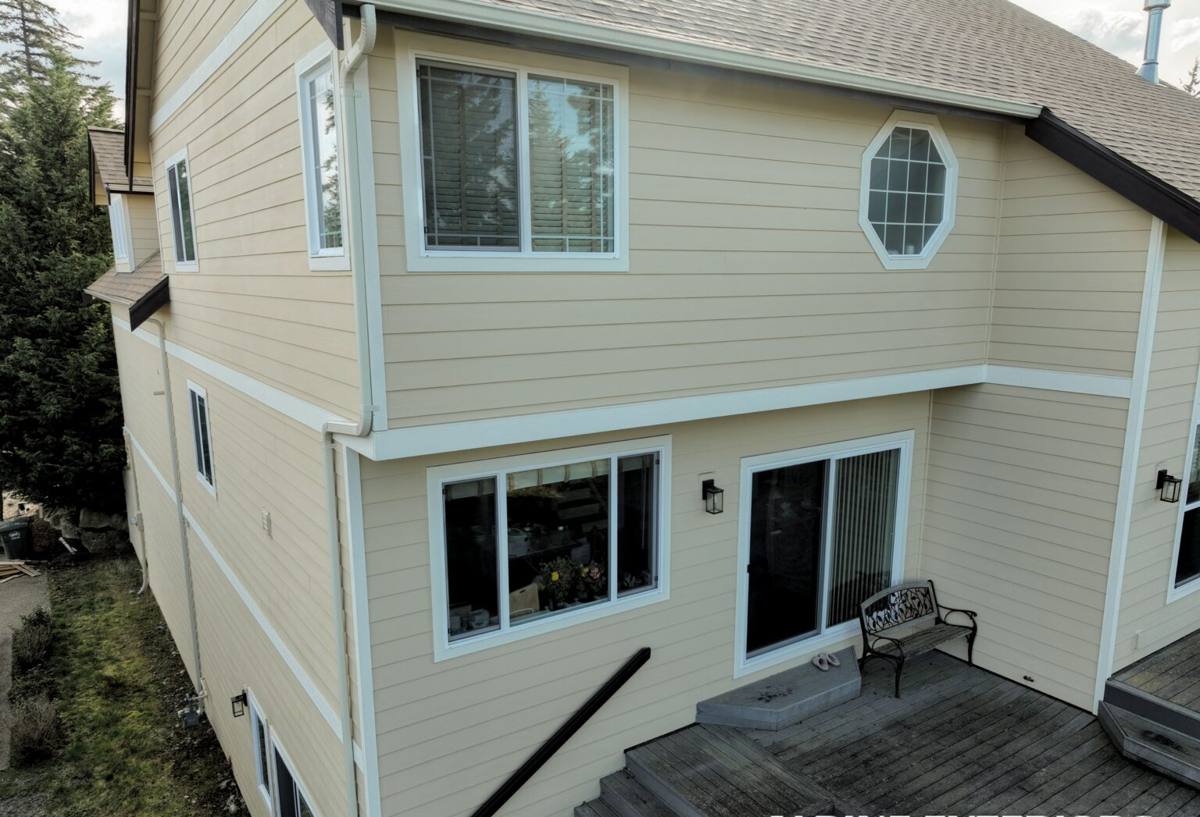
Signs a Deck Needs Replacing, Not Patching
Not every tired-looking deck needs a full replacement, but a lot of the decks we evaluate in Happy Valley have gone past the point where repair makes sense. A few boards can usually be swapped. A structure with rot working through the framing generally can't be patched back to safe.
- Boards that feel soft, spongy, or spring back slowly when you step on them
- Visible gaps or separation where the deck's ledger board meets the house
- Rust streaks bleeding out from screw heads or joist hangers
- Posts that feel loose at the base, or noticeable sway when several people are on the deck
- Moss or dark staining that keeps coming back within weeks of cleaning
- Stair stringers with visible cracks or soft spots near the ground contact points
- Any framing member you can push a screwdriver into without resistance
That last one is the clearest sign. If a screwdriver sinks into a joist or ledger board with light pressure, the wood fiber has already broken down, and no amount of surface repair changes what's happening structurally underneath.
What a Correct Deck Replacement Involves
Ledger Board and Flashing
The ledger board — where the deck attaches to the house — is the single most common point of failure on decks in this climate, and it's also the detail most likely to get rushed on a lower-quality rebuild. Water has to be directed away from the house at that connection with proper flashing, not just caulk or a wrap of housewrap tape. When that detail is done wrong, water works its way behind the siding and into the rim joist, which turns a deck problem into a siding and framing problem. We treat this connection as the part of the job that determines whether the whole structure lasts, not a step to move through quickly.
Footings and Framing
Whatcom County's frost depth and soil conditions matter for how deep and how footings are set, and posts need to sit on proper post bases that keep the wood off concrete and out of standing water — not buried in the ground or resting flush on a slab where moisture collects. Joist hangers and structural connectors need to be rated for the treated lumber used in modern framing, since the chemicals in current pressure-treated wood corrode standard fasteners faster than the older lumber formulations most homeowners remember.
Fasteners and Hardware
In a neighborhood close enough to Bellingham Bay to get salt-tinged air on a regular basis, fastener grade isn't a detail to skip past. Stainless steel or heavy hot-dip galvanized hardware costs more up front than standard coated fasteners, but it's the difference between hardware that's still sound in fifteen years and hardware that's already bleeding rust streaks down the decking within a few seasons.
Choosing Decking Material for This Climate
There's no single right material for every homeowner — budget, maintenance tolerance, and how the deck gets used all factor in. What matters is picking with an honest understanding of how each option behaves in a wet, shaded, moss-prone environment rather than going by appearance alone.
| Material | Moisture Behavior | Maintenance | Typical Lifespan |
|---|---|---|---|
| Pressure-treated wood | Resists rot with proper sealing, but absorbs and releases moisture with the seasons, which drives swelling, cupping, and checking | Needs cleaning and re-sealing every 1–2 years to perform as intended | 10–15 years before replacement-level wear |
| Cedar | Naturally moisture- and insect-resistant, but softer and more prone to surface wear and graying without upkeep | Periodic cleaning and oiling to hold color and shed water | 15–20 years with consistent maintenance |
| Capped composite | Doesn't absorb moisture the way wood does, so no swelling or splintering; some early composite generations struggled with mold on the surface, which capped products largely solved | Occasional washing; no sealing or staining | 25+ years, backed by manufacturer warranty |
| Cellular PVC | Fully moisture-resistant since there's no wood fiber to absorb water at all | Lowest maintenance of the group; occasional cleaning | 25+ years, backed by manufacturer warranty |
Wood costs less up front and has a natural look plenty of homeowners still want. Composite and PVC cost more initially but largely remove moisture absorption from the equation, which matters more in a climate where boards rarely get a full day to dry out between wet spells. We'll walk through the honest trade-offs for your specific deck rather than pushing whichever material carries the best margin.
Railings, Stairs, and Code Basics
Deck replacement in Whatcom County generally requires a permit once you're rebuilding structure rather than just resurfacing, and current building code sets baseline requirements for guardrail height, baluster spacing, and stair rise and run that a correct rebuild needs to meet regardless of what the old deck had. Specifics can vary by jurisdiction and project scope, so we confirm exact requirements with the local building department as part of the job rather than assuming the old deck's dimensions were compliant to begin with — plenty of older decks in this neighborhood were built before current code existed.
We handle the permit application and inspections as part of the project. That's not an upsell — it's part of doing the job correctly, and it protects you if the deck ever comes up during a home sale or insurance review.
How Our Replacement Process Works
- Site visit to assess the existing deck's condition, including probing framing members and checking the ledger connection
- Honest scope discussion — what's failing structurally, what materials fit your budget, and what the realistic options are
- Permit handling with the local building department where required
- Full tear-out and disposal of the old structure
- Structural rebuild — footings, framing, ledger flashing, and fasteners sized and rated for this climate
- Decking, railing, and stair installation with the material you chose
- Final walkthrough covering what your new deck needs going forward
Tear-out often reveals more than what was visible during the initial estimate — a soft rim joist hidden behind old flashing, or post bases buried below grade. When that happens, we tell you before we proceed, not after the invoice.
Why It Matters to Hire a Crew That Already Works Happy Valley
A contractor who occasionally works this side of Bellingham can still do competent work, but a crew that regularly builds and replaces decks in Happy Valley has already seen the patterns specific to this neighborhood — the age and construction style of the housing stock, how shade from mature trees affects which walls and deck areas stay damp longest, and how far salt-tinged air from the bay actually reaches into these inland blocks. That familiarity shows up in smaller judgment calls too: how much extra corrosion resistance a given lot actually needs, or being straightforward about which parts of an old deck are worth flagging to a homeowner who might not know to ask.
Working the same part of Whatcom County job after job also means faster scheduling and fewer surprises with local permitting, since we're not learning the process for the first time on your project.
What Affects the Cost of a Deck Replacement
We don't quote a number without seeing the site, but a few factors consistently drive cost up or down on projects like this:
- Overall size and footprint of the deck
- Single-level versus multi-level or elevated structures requiring more substantial framing
- Decking material chosen — wood costs less upfront, composite and PVC cost more but need less long-term upkeep
- How much structural rot or damage tear-out reveals beyond what's visible at the estimate stage
- Stair and railing complexity, including custom railing styles
- Permit fees and any structural engineering review required for larger or elevated decks
- Site access — a deck reachable only through a narrow side yard takes longer to demo and rebuild than one with open access
Caring for a New Deck Through the Wet Season
Even a correctly built deck needs some routine attention to get its full lifespan in this climate. Clear leaves and debris out of the gaps between boards regularly, since trapped organic material holds moisture against the surface and feeds moss growth. Make sure gutters and downspouts direct roof runoff away from the deck area rather than onto it. Plan on an annual soft wash or moss treatment rather than waiting until growth is heavy and established. And check railing posts and any exposed hardware once a year, especially heading into the fall rains, so a small corrosion issue gets caught before it becomes a structural one.
If you're dealing with a deck in Happy Valley that's past the point of patching, we're happy to take a look and give you a straight read on what's actually going on with it. Reach out below for a free, no-pressure estimate.