 Whatcom County
Why Silver Beach Homes Need Siding Built for This Exact Climate
Silver Beach sits in one of the more exposed pockets of Whatcom County when it comes to what the weather actually does to a house. Homes here take a steady combination of moisture-laden air, wind-driven rain that gets pushed sideways into wall assemblies, and long stretches of gray, damp months where surfaces rarely get a chance to fully dry out. Add in the salt air common to this part of the county, and you've got a set of conditions that will find every weakness in a siding system — usually within the first five to ten years, not the first thirty.
This isn't a scare tactic. It's just what siding contractors who've worked Silver Beach and the surrounding Whatcom County neighborhoods see over and over: houses sided with the wrong material, or sided correctly with a material that wasn't built for this, start showing problems while the rest of the house is still solid. Moss creeps into laps and seams. Paint that looked fine at installation starts failing in patches by year six or seven. Panels that swelled during a wet winter never quite look right again.
James Hardie fiber cement siding was engineered specifically for climates like this. It doesn't solve every problem on its own — installation quality matters as much as the product — but it gives Silver Beach homes a fighting chance against salt air, driving rain, and moss in a way that most alternative siding materials simply can't match.
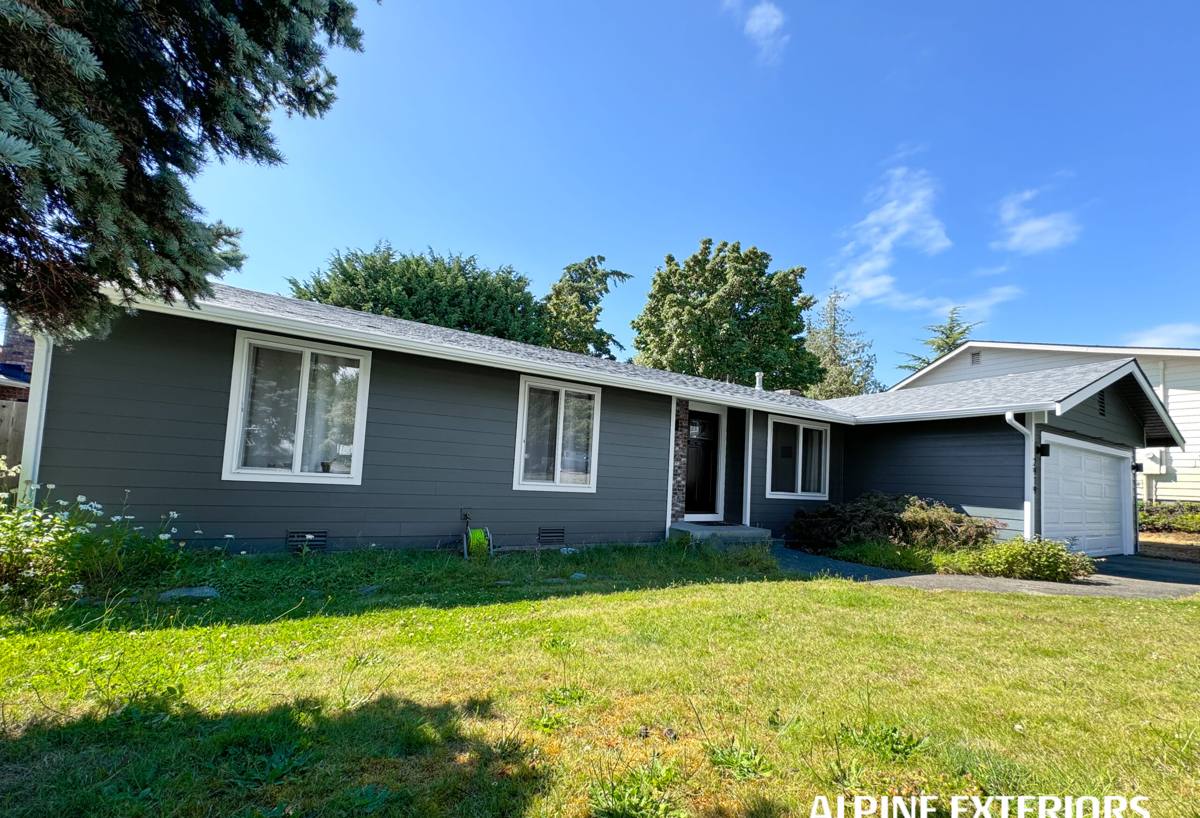
What Salt Air, Rain, and Moss Actually Do to a House
Salt Air
Salt-laden air accelerates corrosion on fasteners, flashing, and any exposed metal trim. It also speeds up the breakdown of certain paint and coating chemistries, which is why some siding products lose their finish faster near the water than they do further inland. Fiber cement itself doesn't corrode, but the fasteners and trim details around it still need to be chosen and installed with that exposure in mind.
Driving Rain
Wind-driven rain doesn't just fall — it gets pushed horizontally into wall assemblies, working its way behind poorly lapped siding, undersized flashing, and gaps around windows and doors. Over time, this is what causes rot in the sheathing and framing behind the siding, not just cosmetic damage to the siding itself. The siding material matters, but the water management system behind it — house wrap, flashing, proper laps — matters just as much.
Moss and Persistent Moisture
Whatcom County's long wet season means north-facing walls, shaded areas, and anywhere airflow is restricted can stay damp for weeks at a time. That's exactly the environment moss and mildew need to take hold. Porous or wood-based siding materials absorb that moisture and give organic growth something to root into. Materials that don't absorb water the same way are far more resistant to sustained moss and mildew problems, though nothing is entirely immune if it's installed tight against foliage or without adequate clearance.
| Climate Stress | What It Does to Siding | What Hardie Offers |
|---|---|---|
| Salt air | Corrodes exposed metal, degrades some coatings faster | Non-corroding fiber cement body; factory ColorPlus finish resists fading and wear |
| Driving rain | Pushes moisture behind poorly lapped or flashed siding | Engineered lap profiles and HardieZone HZ5 formulation for wet Pacific Northwest exposure |
| Moss / prolonged damp | Wood-based and porous materials absorb moisture, feed growth | Fiber cement doesn't swell or rot; resistant to moisture-driven decay |
| Freeze-thaw swings | Cracks materials that absorb and hold water | Dimensionally stable in Whatcom County's temperature range |
Why We Only Install James Hardie in Silver Beach
We don't install LP SmartSide, vinyl, Cemplank, Allura, primed spruce, or cedar. That's a deliberate standard, not a lack of options. Each of those products has legitimate strengths, but none of them holds up to close scrutiny for a house sitting in Silver Beach's specific combination of salt exposure, driving rain, and extended damp seasons the way Hardie's fiber cement does.
- Wood-based engineered siding (LP SmartSide) resists moisture better than raw wood but still relies on a wax and resin treatment plus an intact paint film to keep water out. Once an edge or cut is compromised, moisture can work in, and this region gives it plenty of opportunity to try.
- Vinyl siding is affordable and low-maintenance, but it can warp or distort in temperature swings, and its seams and laps are a common entry point for wind-driven rain if not installed with real precision. It also doesn't offer the fire resistance fiber cement does.
- Cedar and primed spruce are beautiful materials, but they're wood — they need consistent maintenance, refinishing, and vigilance against the exact moss and rot conditions Whatcom County produces every winter.
- Other fiber cement brands (Cemplank, Allura) are closer competitors to Hardie on paper, but we've standardized on Hardie specifically for its factory-applied ColorPlus finish, its climate-specific HZ engineering, and the strength of its transferable warranty.
Standardizing on one product means our crews install it constantly, know its quirks cold, and don't have to relearn install details every time we switch materials between jobs. That consistency is part of what keeps a Silver Beach installation performing the way it's supposed to.
What a Correct James Hardie Installation Involves
The siding material is only part of the equation. A large share of the failures we get called out to inspect — on any brand of siding — trace back to installation shortcuts, not the product itself. For a Silver Beach home, a correct install includes:
- Water-resistive barrier installed continuously and lapped correctly, shingle-style, so water is shed downward and outward rather than trapped.
- Proper flashing at every window, door, and roofline intersection — the details that matter most when rain is being driven sideways by wind off the water.
- Correct fastening using corrosion-resistant fasteners driven to Hardie's specified depth and location, not just close enough.
- Minimum clearances from grade, roofing, and decking, so the bottom edge of the siding isn't sitting in a moisture trap.
- HardieZone HZ5 product selection, engineered for the wetter, cooler climate zones the Pacific Northwest falls into, rather than a formulation meant for drier regions.
- Correct joint and lap treatment at every butt joint and corner, sealed and backed per manufacturer spec rather than caulked over and hoped for.
Any one of these done wrong can undermine an otherwise good product. This is also why we don't treat installation as a generic skill that transfers evenly across siding brands — a crew that installs Hardie constantly in this climate catches details a crew installing five different products across the year might miss.
Our Process for Silver Beach Projects
1. On-Site Assessment
We look at the existing siding, sheathing condition, moisture exposure on each elevation, and any specific problem areas — north-facing walls, spots near mature trees, areas that catch wind off the water. This tells us if there's hidden rot or moisture damage that needs to be addressed before new siding goes up, not covered over.
2. Product and Color Selection
We walk through Hardie's plank profiles, panel systems, and ColorPlus finish options so you're choosing based on how each performs here, not just how it looks in a sample.
3. Tear-Off and Substrate Repair
Old siding comes off, and we inspect sheathing and framing for damage before anything new goes up. Any compromised wood gets repaired or replaced — sealing new siding over rot just hides the problem.
4. Water Management Installation
House wrap, flashing, and drainage details go in first, and this stage gets as much attention as the visible siding — it's the layer that actually keeps water out long-term.
5. Hardie Installation to Spec
Siding, trim, and joint treatment installed to manufacturer specification, with fastening and clearances checked as we go, not just at final inspection.
6. Final Walkthrough
We walk the finished job with you, elevation by elevation, before calling it done.
Maintenance: What Silver Beach Homeowners Should Actually Expect
Hardie siding with a ColorPlus finish is low-maintenance, not no-maintenance. In this climate, a realistic care routine looks like:
- Rinse siding annually to clear salt residue, pollen, and organic buildup before it has a chance to set into moss.
- Keep gutters clear so overflow isn't running down the face of the siding during heavy rain events.
- Trim back vegetation and tree cover that keeps any wall shaded and damp longer than necessary.
- Inspect caulking at joints, trim, and penetrations every year or two and address any cracking before it becomes a water entry point.
- Watch for any fastener staining or trim issues near the harshest wind- and salt-exposed elevations first — they'll show wear before the rest of the house does.
Why Hiring Local Experience Matters
A siding contractor who already works Silver Beach and greater Whatcom County isn't guessing at how to handle this climate — they've seen which elevations take the worst of the driving rain, how fast moss can establish itself on a shaded wall here, and what salt exposure does to hardware over a few seasons. That local pattern recognition shows up in small decisions during installation: where extra flashing attention goes, which clearances get treated as non-negotiable, and which details get double-checked rather than assumed.
It also matters for warranty support. James Hardie's product warranty and any workmanship warranty from the installing contractor are only as good as the contractor's ability to stand behind the work locally, years down the road — not a crew that did one job in the area and moved on.
If you're weighing a siding replacement for a Silver Beach home, we're happy to walk the property, look at your specific exposure, and give you a straightforward assessment — no pressure, no upsell into a product we don't stand behind. Reach out for a free estimate using the form below.