 Whatcom County
Windows Built for Lynden's Corner of Whatcom County
Lynden sits in a part of Whatcom County that gets more weather than most homeowners realize until they start paying attention to their heating bills or notice fog building up between panes of glass. Between the Nooksack lowlands and the marine air that moves in off the Sound and up the valleys, homes here deal with a long wet season, damp ground-level air that never fully dries out, and enough wind-driven rain to expose every weak point in an old window installation. Windows are one of the biggest thermal weak spots in a house, and in this climate a poorly performing or poorly installed window doesn't just waste energy — it invites moisture into wall cavities where it can sit for months.
We work on homes throughout Whatcom County, and Lynden has its own particular mix of housing stock: older farmhouses with original single-pane wood windows, 1980s-90s aluminum-frame builds, and newer construction with vinyl units that are now old enough to be failing at the seals. Each of those starting points needs a different approach. This page is about what energy-efficient window replacement actually looks like for a Lynden home — not a generic pitch, but the specifics of what the job should involve given the climate this county actually has.
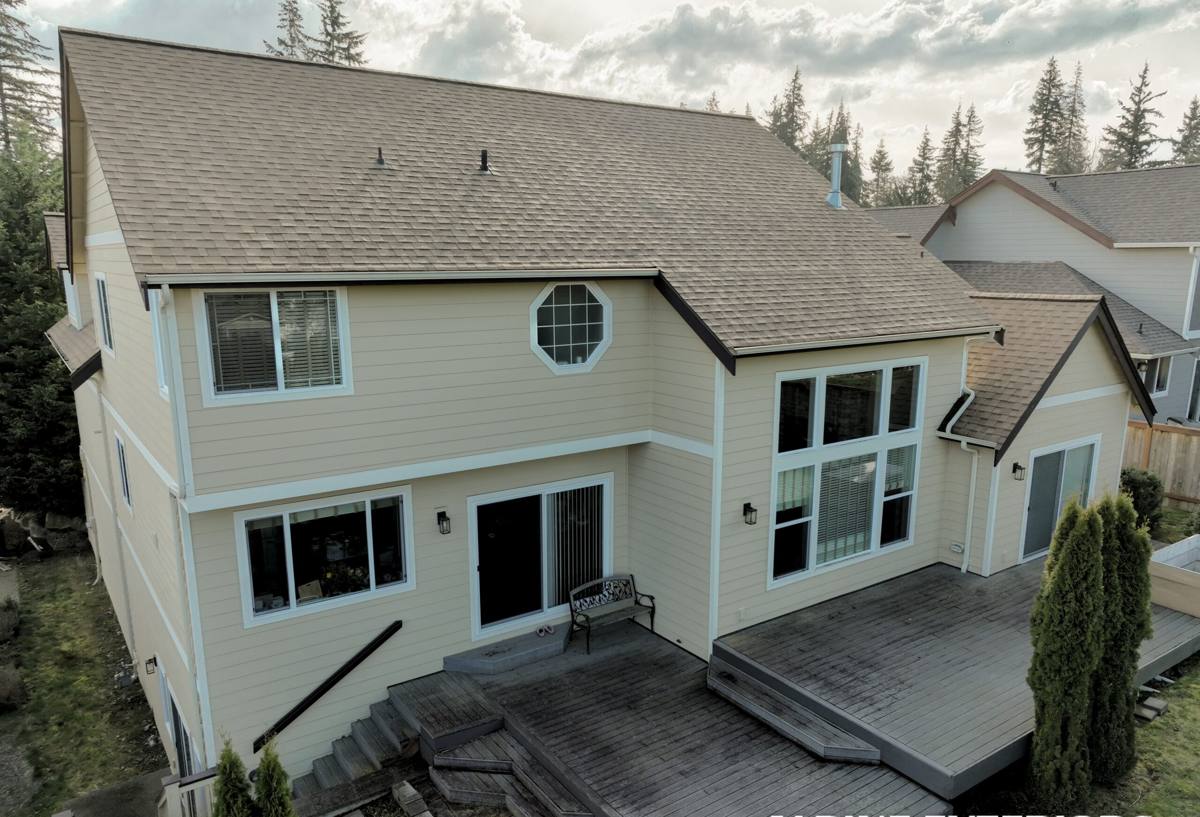
What This Climate Does to Windows Over Time
Three things drive window failure in Whatcom County faster than in drier parts of the state: sustained damp, driving rain, and a long moss and algae season that keeps exterior surfaces wet longer than they'd otherwise be.
Driving rain and wind-loaded moisture
Storms coming through the county are frequently wind-driven, which means rain doesn't just fall on a window — it gets pushed sideways into the gap between the frame and the rough opening. If the original flashing and sealant weren't done correctly (or have simply aged out, which happens to sealants long before people expect), that water finds its way behind the trim and into the wall. You often don't see it until there's staining, soft trim, or a musty smell in the room.
The long moss and algae season
Whatcom County's damp stretch runs long, and anywhere moisture sits — roof edges, north-facing walls, the sills and tracks of older windows — moss and algae get a foothold. On windows specifically, this shows up as green or black buildup in the corners of sills and tracks, which holds moisture against the frame and finish far longer than a dry climate would allow. On wood-framed windows this accelerates rot; on vinyl and aluminum it's mostly cosmetic but signals a spot that needs better drainage.
Salt-influenced marine air
Even away from the immediate waterfront, the marine air that moves through the county carries enough salt content to matter over the life of a window. It accelerates corrosion on lower-grade hardware, hinges, and fasteners, and it's part of why we pay attention to the hardware grade and finish on any unit we recommend, not just the glass package.
What "Energy-Efficient" Actually Means Here
"Energy-efficient" gets used as a marketing word more than a technical one. For a Lynden home, it should mean a specific combination of glass performance, frame material, and — just as important — installation quality, since even a high-performance window unit will underperform if it's not sealed and flashed correctly.
Glass and glazing
Double-pane windows with a low-E coating and an inert gas fill (typically argon) are the standard for this climate. The low-E coating reflects radiant heat back into the room in winter, and the gas fill slows heat transfer through the airspace. For west- and south-facing rooms that get more direct sun, a slightly different low-E coating balances heat gain against glare and fading of interior furnishings.
Frame material and thermal break
The frame matters as much as the glass. A frame with a poor thermal break will feel cold to the touch near the edges of the glass even with good glazing, and in a humid climate that cold spot is exactly where condensation forms on the interior in winter. We look at U-factor (how well the whole unit resists heat flow) and not just the glass spec in isolation.
Air and water sealing at the frame
This is the part that's easy to skip and expensive to fix later. A correctly installed window needs a continuous water-resistive barrier tie-in, properly lapped flashing at the head, jambs, and sill, and a sill pan that directs any water that does get past the exterior seal back out rather than into the wall framing. In a county with this much driving rain, we treat this step as non-negotiable, not an upsell.
Signs Your Current Windows Are Costing You Money
Homeowners often call us after noticing one or two of these, not realizing how many boxes they'd actually check if they looked closely:
- Visible fog or moisture trapped between panes (a failed seal on a double-pane unit)
- Cold drafts near the frame edges even with the window fully latched
- Condensation forming on the interior glass or sill in cold weather
- Wood trim that's soft, discolored, or has visible rot near the sill
- Moss, algae, or black staining building up in the track or lower corners
- Windows that are difficult to open, close, or lock — often a sign the frame has shifted
- Noticeably higher heating bills compared to similarly sized homes nearby
- Paint or caulk around the exterior trim that's cracked, peeling, or gapped
Any one of these on its own might just mean a repair. Several together, especially on original single-pane or early aluminum-frame windows, usually mean replacement will pay for itself faster than continuing to patch them.
Comparing Window Frame Options for This Climate
There's no single "best" window material — the right choice depends on the home's age, style, and how much upkeep the homeowner wants to take on. Here's how the common options actually perform in Whatcom County's damp, moss-prone conditions:
| Frame Material | Moisture Behavior | Maintenance | Typical Fit |
|---|---|---|---|
| Vinyl | Won't rot or corrode; seams and welds need to be well-made to stay watertight long-term | Low — occasional cleaning, no painting | Most homes; best value for straightforward replacements |
| Fiberglass | Very stable in wet/dry cycling, resists warping in sustained damp better than vinyl | Low — durable finish, minimal upkeep | Homes wanting a slimmer sightline or higher-end finish |
| Wood-clad | Exterior cladding protects the wood, but any breach in the cladding lets moisture reach bare wood | Higher — cladding seams and interior wood need periodic attention | Older or historic-style homes where wood interior trim matters aesthetically |
| Aluminum | Prone to condensation and cold-transfer without a good thermal break; can corrode with prolonged salt-air exposure | Moderate — hardware and seals need more frequent checks | Generally not our first recommendation for this climate |
For most Lynden homes we install vinyl or fiberglass, largely because both hold up to sustained damp without the ongoing maintenance wood-clad requires. We still install wood-clad windows where a homeowner wants that look and understands the upkeep — it's a legitimate choice, just not a low-maintenance one here.
How Our Installation Process Works
The window unit itself is maybe half of what determines how it performs over the next twenty years. The other half is installation. Here's what a correct job involves:
- On-site assessment. We check the rough opening, look for existing water damage or rot around the current frame, and measure for an exact fit rather than assuming a standard size.
- Remove and inspect. Once the old window is out, we inspect the framing and sheathing underneath. This is often the first time hidden moisture damage from years of minor leaks becomes visible, and it needs to be addressed before a new window goes in — installing a new window over compromised framing just hides the problem.
- Sill pan and flashing. We install a sill pan to direct any water that gets past the exterior seal back outside, then flash the head and jambs so water sheds correctly, lapped in the right order — this detail is where most water intrusion problems trace back to when a job's done wrong.
- Set and shim the unit. The window is leveled, plumbed, and shimmed so it operates smoothly and the reveal is even, which also affects how well the seal performs over time.
- Insulate and seal. The gap between the frame and rough opening is insulated (not over-packed, which can bow the frame) and sealed with appropriate materials at the interior and exterior.
- Exterior trim and finish. Trim is reinstalled or replaced, caulked, and finished to shed water away from the window rather than trapping it against the frame.
What Affects the Cost
We're not going to quote numbers here — every home is different, and giving a number without seeing the opening does homeowners a disservice. What we can tell you is what actually moves the price up or down:
| Factor | Why It Matters |
|---|---|
| Frame material chosen | Vinyl is generally the most budget-friendly; fiberglass and wood-clad cost more |
| Number of openings | Whole-house replacements typically bring a better per-window rate than one-off jobs |
| Existing damage found during removal | Rotted framing or sheathing found behind an old window has to be repaired before the new one goes in |
| Window size and configuration | Large picture windows, custom shapes, or multi-panel assemblies cost more than standard double-hungs or sliders |
| Glass upgrades | Specialty low-E coatings, tempered glass where code requires it, or sound-dampening glass add cost |
| Access and site conditions | Second-story or hard-to-reach openings take more time and equipment |
Why Hiring a Crew That Already Works in Lynden Matters
A crew that regularly works this part of Whatcom County has already seen what happens when window installations skip steps in this climate — where water tends to intrude, which frame materials hold up and which don't, and how the moss and algae season affects a house that isn't cleaned or ventilated well. That's not something you get from a crew that mostly works drier inland climates and treats every job the same way.
Local also means practical things: knowing the permitting expectations for the jurisdiction, being reachable for a follow-up check after the first real storm season, and having a reputation in the community worth protecting. We'd rather do the flashing and sealing right the first time than get a callback in January because water found a gap we should have caught.
Keeping New Windows Performing Through the Seasons
Even a correctly installed, high-quality window benefits from a little seasonal attention in this climate:
- Clear tracks and weep holes of debris, moss, and algae buildup a few times a year
- Check exterior caulking annually for cracking or gaps, especially after the first year as materials settle
- Wipe down interior sills after heavy condensation events, particularly in unheated or poorly ventilated rooms
- Keep gutters and downspouts clear so roof runoff isn't sheeting down over window heads
- Have hardware (locks, hinges, rollers) checked periodically, since marine air can accelerate wear on lower-grade components
None of this is heavy maintenance — it's the kind of five-minute check that keeps a good installation performing the way it should for its full lifespan instead of quietly failing at year eight.
If your Lynden home has windows that are drafty, fogged, hard to operate, or original to a house that's due for an upgrade, we're happy to come take a look. Estimates are free, there's no pressure, and we'll tell you honestly whether replacement makes sense now or whether a repair will hold you over — use the form below to get in touch.