 Whatcom County
Why Edgemoor Roofs Wear Differently
Edgemoor sits close enough to Bellingham Bay that the weather reaching your roof isn't quite the same as weather three miles inland. Salt-laden air drifts up off the water, wind-driven rain comes in sideways during winter storms, and the tree cover that gives the neighborhood its character also means a lot of shaded, damp roof area that never fully dries out. Put those three things together and you get a roof environment that's tougher on fasteners, tougher on seams, and tougher on anything organic that can grow on a slope facing the wrong direction.
None of that makes metal roofing a bad choice for Edgemoor — it's often the right one. But it does mean the material, the coating, the fastening system, and the flashing details all matter more here than they would on a dry, open lot elsewhere in Whatcom County. A metal roof installed to a generic spec, without those local conditions in mind, will underperform. One installed correctly for this exact setting can outlast two or three asphalt roofs.
What Salt Air Actually Does to a Roof
Salt air near Bellingham Bay isn't as aggressive as true oceanfront exposure, but it's still enough to matter over a 30-40 year roof life. Airborne salt is corrosive to bare or poorly coated metal, and it accelerates rust wherever a coating is scratched, thin, or missing — most commonly at cut edges, fastener heads, and places where two metal panels meet.
This is why we're particular about what goes on an Edgemoor roof:
- Galvalume or properly painted steel with a full factory finish, not bare or mill-finish metal
- Stainless or coated fasteners rated for coastal exposure, not standard zinc-plated screws
- Factory-cut panel edges wherever possible, with field cuts sealed and touched up the same day
- Flashing and trim in materials that match the panel's corrosion resistance — mismatched metals at a seam can accelerate corrosion through galvanic reaction
None of this is exotic. It's standard practice for coastal and near-coastal installs, but it's the kind of detail that gets skipped when a crew is used to inland jobs and doesn't adjust their material list for a bay-facing property.
Galvanic Corrosion: The Detail Most Crews Skip
One of the more common mistakes we see on older Edgemoor roofs is dissimilar metals touching each other — copper flashing against a steel panel, for example, or the wrong screw type driven into aluminum trim. Near salt air, that contact point corrodes faster than either metal would on its own. It's a small thing to get right at installation and an expensive thing to fix once it's failed and water has gotten behind the panel.
Driving Rain and Wind-Driven Water
Edgemoor's exposure to weather coming off the bay means rain doesn't always fall straight down — it comes in at an angle, sometimes hard enough to push water uphill under a lap or around a poorly sealed penetration. This is a bigger factor in metal roof performance than most homeowners realize, because a metal roof's water resistance depends almost entirely on lap direction, fastener placement, and flashing detail rather than on the panel itself being watertight.
A correctly installed metal roof handles this without issue. The panels overlap in the direction that sheds water with the prevailing wind and rain, underlayment is installed as a genuine second line of defense rather than an afterthought, and every penetration — plumbing vents, chimney flashing, skylight curbs — gets sealed with materials built for the specific panel profile in use. A roof that looks identical from the ground can perform very differently depending on whether these details were done right, and the difference only shows up during a real storm, not on a calm inspection day.
Where Wind-Driven Rain Finds Weak Points
The failure points we see most often on wind-exposed metal roofs in this area aren't in the open field of the roof — they're at the edges and transitions:
- Valleys where two roof planes meet and water volume concentrates
- Eave edges where wind can push rain back up under the drip edge
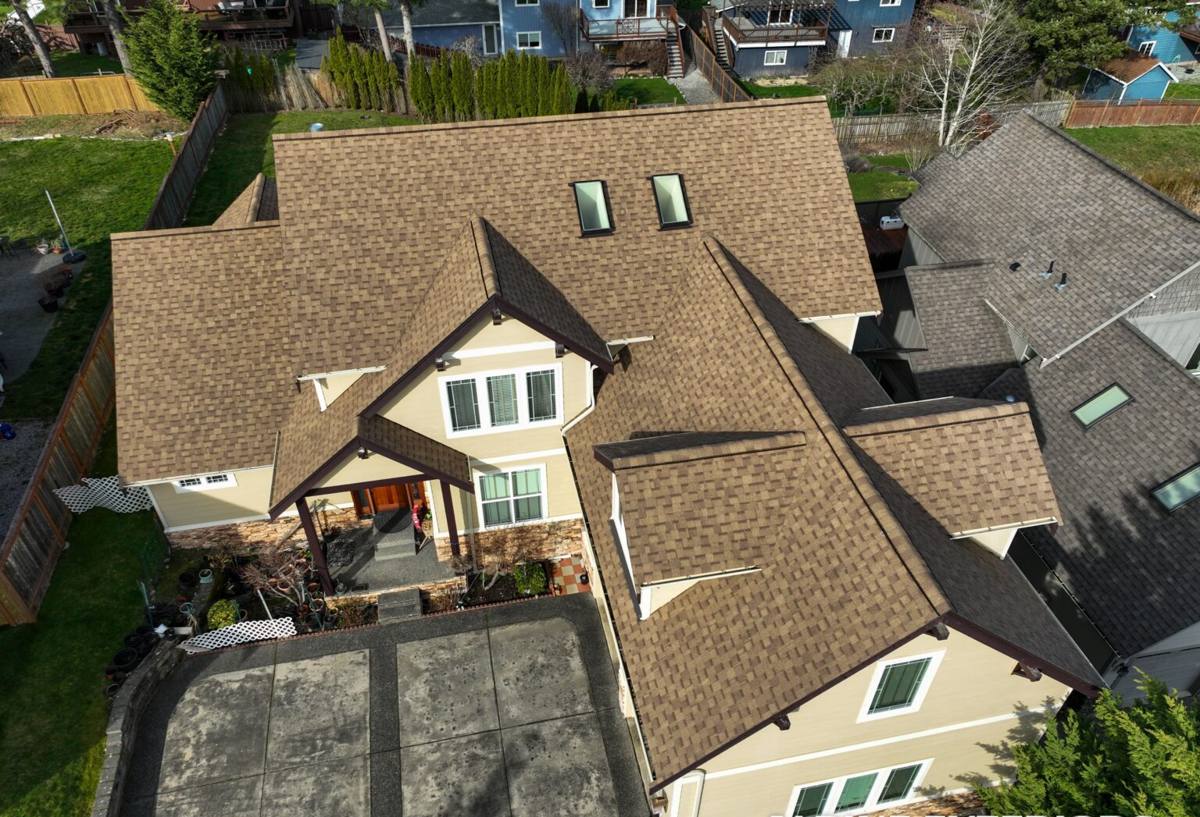
- Wall-to-roof transitions, especially at dormers or additions
- Ridge caps that weren't vented or sealed for the prevailing wind direction
These are also the areas that take the longest to do properly and the easiest to shortcut. It's worth asking any contractor bidding an Edgemoor roof how they handle valleys and wall transitions specifically, not just what panel brand they're quoting.
Moss, Algae, and Edgemoor's Tree Cover
Whatcom County's long wet season is hard enough on roofs on its own. Add the mature tree canopy common in Edgemoor — which keeps parts of many roofs shaded and slow to dry — and you get conditions where moss and algae can take hold even on a well-built roof. This is one of the genuine advantages of metal over asphalt shingles in this specific setting: metal doesn't give moss the porous, granulated surface it needs to root into, so growth stays on the surface and washes or brushes off far more easily than it would out of a shingle mat.
That said, metal isn't immune. Debris that collects in valleys, behind chimneys, or against a shaded slope can hold moisture against the panel long enough for algae staining to develop, and in the Pacific Northwest's moss season that buildup happens faster than most homeowners expect. A metal roof still needs periodic debris clearing, especially on the shaded, tree-covered sides of a property — it just needs far less intervention than shingles do.
Choosing the Right Metal Roofing System
Not every metal roofing product is a good match for every Edgemoor home, and part of doing this job right is matching the system to the house — its roof pitch, its exposure, and its budget.
| System | Best Fit For | Coastal/Moisture Notes |
|---|---|---|
| Standing seam (concealed fastener) | Most Edgemoor homes, especially bay-facing or shaded roofs | Best water resistance; no exposed fasteners to corrode or work loose over time |
| Exposed-fastener panel | Budget-conscious projects, outbuildings, secondary structures | Lower upfront cost, but fastener gaskets need monitoring near salt air and will need replacement over the roof's life |
| Stone-coated steel | Homes wanting a shingle or shake appearance with metal durability | Coating protects the substrate well, but valley and edge detailing still needs the same coastal-grade attention |
| Metal shingles/shakes | Historic-style homes wanting a traditional look | More seams than standing seam, so flashing quality matters even more in wind-driven rain |
For most of the homes we work on near the bay, we lean toward standing seam because the concealed fastener system removes one of the more common long-term failure points — exposed screws that loosen or corrode over 20-plus years of coastal exposure. It costs more upfront than an exposed-fastener panel, but for a waterfront-adjacent property it usually pays for itself in avoided maintenance.
What a Correct Installation Actually Involves
A metal roof is only as good as the details underneath it. On every Edgemoor job, our process includes:
- Deck inspection and repair — any soft, rotted, or water-damaged sheathing gets replaced before a single panel goes down. Metal panels amplify problems in a bad deck; they don't hide them.
- High-quality underlayment — a synthetic or self-adhering underlayment rated for the exposure, installed as a true water barrier rather than a formality.
- Ice and water shield at vulnerable areas — valleys, eaves, and penetrations get additional protection where wind-driven rain and moisture concentrate.
- Correct panel layout and lap direction — set to shed water with the prevailing wind pattern off the bay, not just laid out for convenience.
- Coastal-appropriate fasteners and flashing — matched metals, corrosion-rated hardware, and properly formed trim at every edge.
- Ventilation review — proper intake and exhaust ventilation to keep moisture from condensing under the deck, which matters even more under a shaded, slow-drying roof.
- Final detailing and cleanup — sealants cured, fastener heads checked, and the site cleared of debris and metal shavings that can stain a roof or a lawn if left behind.
Cost Factors Specific to This Area
Metal roofing costs vary by panel type, roof complexity, and access, but a few Edgemoor-specific factors tend to move the number more than homeowners expect:
| Factor | Why It Affects Cost Here |
|---|---|
| Tree cover and access | Mature trees common in the neighborhood can mean more careful staging, tarping, and sometimes limb clearance to protect the new roof during install |
| Roof complexity and valleys | Homes with multiple roof planes need more flashing labor to get wind-driven rain protection right |
| Fastener and flashing upgrades | Coastal-grade hardware costs more than standard inland-spec materials but avoids early corrosion callbacks |
| Existing roof removal vs. overlay | Some metal systems can go over existing shingles in limited cases; deck condition on older Edgemoor homes often makes tear-off the safer route |
We give straight numbers during an on-site estimate rather than a phone quote, because roof pitch, valley count, and deck condition all shift the price more than the panel choice does.
Maintenance in a Coastal, Wet Climate
Compared to asphalt shingles, a well-installed metal roof needs relatively little upkeep — but "little" isn't "none." For Edgemoor homes specifically, we recommend:
- Clearing valleys and gutters of needles and leaf debris at least twice a year, more often under heavy tree cover
- A visual check after major windstorms for lifted trim, loose fasteners, or displaced flashing
- Rinsing off algae or salt residue on shaded or bay-facing slopes if it starts to build up visibly
- Having fastener gaskets and sealant joints inspected every few years if the system uses exposed fasteners
These are quick tasks compared to what a shingle roof demands, but skipping them in this particular climate shortens the gap between "long-lasting roof" and "roof with an avoidable problem."
Why Hiring Local Experience Matters Here
A metal roof installed by a crew unfamiliar with Whatcom County's coastal conditions can look fine on installation day and still develop problems within a few years — corroding fasteners, moss buildup in valleys, or leaks at wall transitions that were flashed for a drier climate. We work on homes throughout Whatcom County, including Edgemoor and the surrounding Bellingham Bay-adjacent neighborhoods, so the material choices and flashing details above aren't theoretical for us — they're what we spec by default because we've seen what does and doesn't hold up here.
If you're weighing a metal roof for an Edgemoor home, we're happy to walk your roof, talk through what your specific exposure and tree cover call for, and give you a straightforward estimate — no pressure, no upsell on materials you don't need. Reach out through the form below to schedule a free, no-obligation estimate.