 Whatcom County
 Why Everson Roofs Age Differently Than Roofs Inland or Down South
Everson sits in the Nooksack River valley, surrounded by farmland, mature trees, and enough tree cover and low-lying moisture to keep roofs wet longer than a shingle warranty ever accounts for. Whatcom County doesn't get harsh freeze-thaw cycling the way inland states do, but it makes up for that with months of steady, low-intensity rain, valley fog that sits on rooftops overnight, and a moss season that can run nearly year-round on north-facing slopes and shaded sections. Homes closer to Bellingham Bay pick up salt-laden air that speeds up corrosion on nails, flashing, and metal components; homes further inland along the river bottoms deal more with sustained dampness and organic growth. Either way, a roof built to a national average spec, without local adjustments, tends to underperform here.
That's the case for treating a new roof installation in Everson as a climate-specific job, not a generic one. The materials, the ventilation balance, and the detailing at valleys and eaves all need to account for how much water this roof will actually see over a year, not how much water the manufacturer assumed in a lab test somewhere drier.
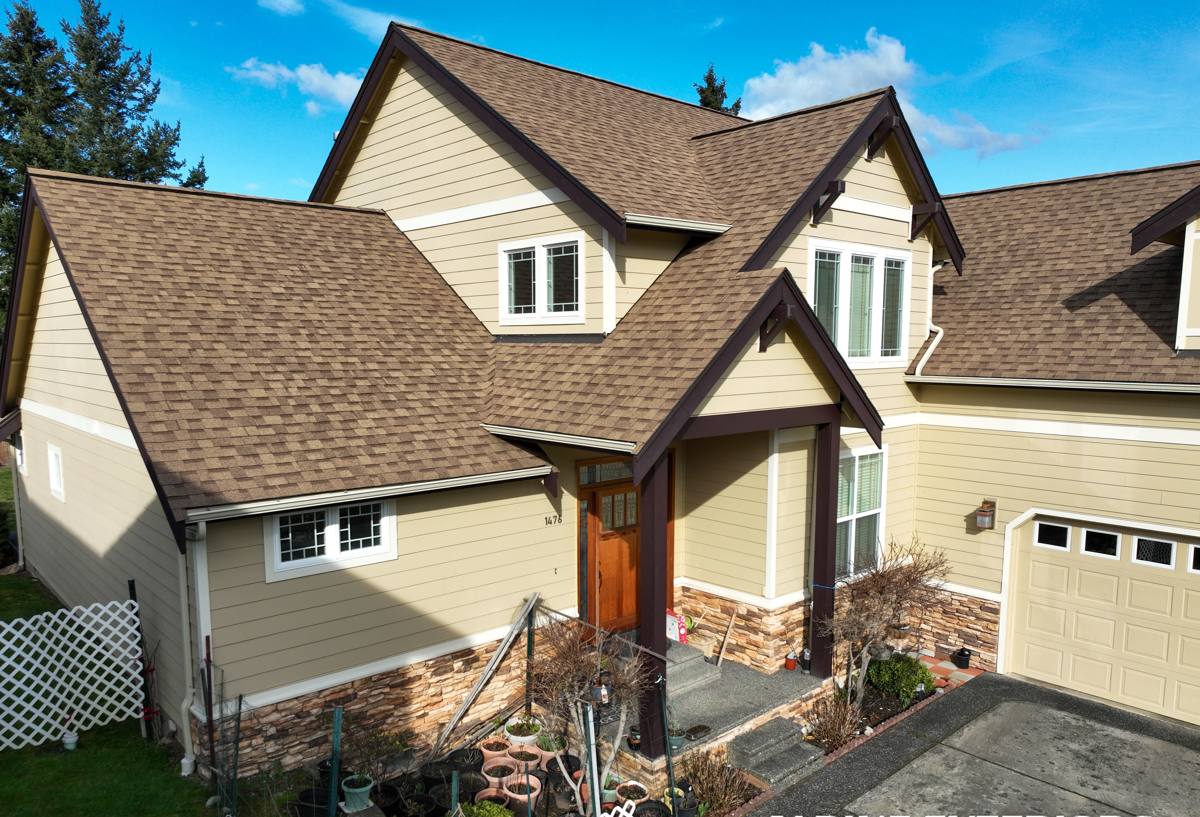
Signs an Everson Home Needs a New Roof, Not Another Repair
Repairs make sense when the problem is isolated — a cracked pipe boot, a few lifted shingles after a windstorm. A full replacement makes sense when the damage is spread across the roof or built into its age. Common signs we see on Everson homes:
- Granule loss heavy enough that you can see bare, shiny patches on south- and west-facing slopes
- Moss mats thick enough to lift shingle edges, which lets wind-driven rain track underneath
- Soft or spongy decking felt underfoot during inspection, usually near valleys or eaves
- Daylight or damp insulation visible from inside the attic
- A pattern of repeat leak calls in the same general area each winter
- A roof at or past 20-25 years old — shorter than the rated lifespan, because sustained moisture shortens real-world service life in this climate
If two or three of these show up at once, patching one spot usually just delays the same conversation by a season or two.
What a Correct New Roof Installation Actually Involves
Full tear-off and deck inspection
We don't recommend overlaying new shingles on old ones. A full tear-off is the only way to see the actual deck condition, catch soft or rotted sheathing before it's covered up again, and let the new system sit flat instead of telegraphing the outline of the old layer.
Underlayment and ice-and-water barrier at vulnerable points
Valleys, eaves, and areas around penetrations get a self-adhering waterproof membrane underneath the field underlayment. In a valley climate with this much sustained rain, this is the detail that keeps a slow seep from becoming a stained ceiling three winters later.
Balanced ventilation, intake and exhaust
A roof deck that can't breathe traps moisture from below, which speeds up rot and feeds moss growth from underneath. We size intake at the eaves and exhaust at the ridge or through vents so they work as a system, not just whatever vent happened to already be there.
Flashing at chimneys, sidewalls, and skylights
Most leaks that show up years after a "new roof" trace back to flashing that was reused, undersized, or installed without proper step-and-counter detailing. New flashing, sized and installed correctly, is non-negotiable on every job.
Choosing a Material for Whatcom County's Climate
There's no single right answer for every house — pitch, budget, and how much shade and moss exposure the roof gets all factor in. Here's how the common options compare for a moisture-heavy, moss-prone climate like Everson's:
| Material | Realistic Lifespan Here | Moss/Moisture Behavior | Typical Cost Position |
|---|---|---|---|
| Standard 3-tab asphalt shingle | 15-20 years | Lowest moss resistance; granule loss accelerates in shaded, damp areas | Lowest upfront cost |
| Architectural (laminate) asphalt shingle | 20-28 years | Better shedding profile, holds up noticeably better than 3-tab under moss pressure | Mid-range |
| Metal panel roofing | 40+ years | Sheds water fast, very poor surface for moss to root into; needs quality fasteners near salt-air exposure | Higher upfront, lower lifetime cost |
| Cedar shake | 20-30 years with upkeep | Attractive but needs regular maintenance to resist moisture and moss in this climate | Higher upfront and ongoing maintenance |
For most Everson homes we recommend architectural asphalt as the practical middle ground, with metal as the long-term option for homeowners planning to stay put and wanting the lowest maintenance burden. We're not tied to pushing one product line — the right call depends on your roof's pitch, sun exposure, and how long you plan to own the home.
Our Installation Process, Start to Finish
- On-site inspection and honest assessment — we walk the roof and attic, not just glance from the ground, and tell you plainly whether repair or replacement makes sense.
- Written estimate with material options — clear scope, clear pricing, no vague allowances.
- Permitting — handled through the appropriate local jurisdiction before work starts.
- Tear-off and disposal — old material removed and hauled off, deck exposed for inspection.
- Deck repair — any soft or damaged sheathing replaced before anything new goes down.
- Underlayment, flashing, and ventilation installed — the parts that don't show but determine how long the roof actually lasts.
- New roofing material installed to manufacturer spec, not shortcut spec.
- Cleanup and magnetic sweep for stray nails, plus a final walkthrough with you before we call it done.
Ventilation and Moss Prevention Built Into the Job, Not Sold as an Add-On
A lot of moss and moisture problems on Whatcom County roofs aren't a shingle problem — they're a ventilation and airflow problem that shows up as moss and granule loss. When a deck stays damp from the underside because intake and exhaust venting aren't balanced, the topside conditions get right for moss spores to take hold, especially in shaded, north-facing sections that don't get enough sun to dry out between rain events. We treat ventilation sizing as part of every new roof install, not a separate upsell, because doing it right the first time is the actual moss-prevention strategy — not a chemical treatment applied after the fact.
Cost Factors for a New Roof in Everson
Every roof is different, but the main variables that move the number are consistent. Broadly, a straightforward single-story asphalt shingle replacement on an average-size Everson home tends to fall somewhere in the low-to-mid five figures; steep pitch, multiple layers to remove, deck repair, or a switch to metal will move that range upward. Rather than quote a number that won't match your house, we walk the roof first and give you a written estimate built on what's actually there.
- Roof size and number of stories
- Pitch — steeper roofs take longer and cost more to work safely
- Number of existing layers to tear off
- Deck condition and how much sheathing needs replacing
- Material selection (asphalt vs. metal vs. cedar)
- Complexity — valleys, dormers, chimneys, skylights
- Ventilation upgrades needed to correct an existing imbalance
Why Hiring a Crew That Already Works Whatcom County Matters
A roofing crew that mostly works drier inland climates will size ventilation, underlayment, and flashing details for conditions that don't match what Everson roofs actually face. A crew that works Whatcom County regularly already knows where the driving rain hits hardest, which slopes hold moss longest, and how much intake venting a valley-climate attic actually needs versus what a generic spec sheet says. That local pattern recognition is the difference between a roof that looks right on installation day and one that's still performing correctly in year fifteen.
Questions to Ask Before You Hire Anyone for a Roof Replacement
- Are you licensed and insured to work in Washington, and can you provide proof?
- Will you do a full tear-off, or are you proposing an overlay?
- How will you handle ventilation — intake and exhaust, or just adding a vent where one already exists?
- What underlayment and ice-and-water barrier are included at valleys and eaves?
- Is the estimate written with a clear scope, or is it a vague lump-sum number?
- Who handles permitting, and is that included in the quote?
- What does the workmanship warranty actually cover, separate from the manufacturer's material warranty?
If you're weighing a repair against a full replacement, or just want a straight answer on what your roof actually needs, we're happy to take a look. Fill out the form below for a free, no-pressure estimate on your Everson home.