 Whatcom County
Why Decks in Nooksack Wear Out Faster Than the Spec Sheet Promises
Most decking products are rated and marketed based on average national conditions. Nooksack doesn't have average conditions. Sitting in the Nooksack River valley, homes here deal with long stretches of damp, low-light weather, heavy fall and winter rain, and the kind of humidity that lingers in low-lying ground long after the rest of Whatcom County has dried out. Add in the broader region's driving rain and a moss season that can run six months or more, and you have an environment that finds every weak point in a deck build within a few years, not a few decades.
A deck that would hold up fine in a dry climate can fail here in ways homeowners don't expect: soft spots around ledger boards, rot hiding under decking that looks fine on top, slick moss buildup on shaded boards, and fasteners that corrode and stain the wood around them. None of this is inevitable. It's the result of decks built to a generic standard instead of a Whatcom County one.
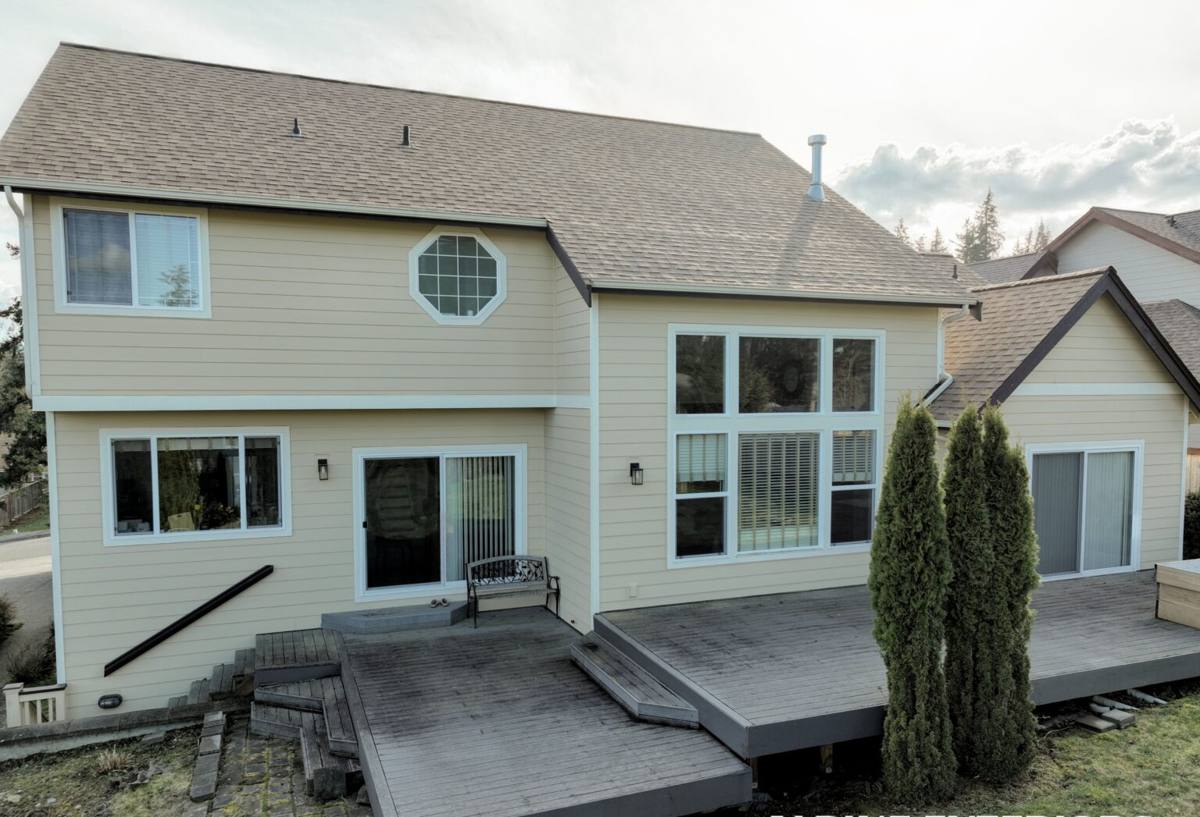
What a Correctly Built Deck Actually Needs Here
The Ledger Connection
The ledger board — where the deck attaches to the house — is the single most common failure point we see on older decks in this area. Water works its way behind the ledger over time, and once moisture gets trapped against the house's rim joist, rot spreads quietly. A correct install uses proper flashing, a water-resistant barrier between the ledger and the house, and structural lag bolts or through-bolts rated for the load — not just deck screws. This is not optional detail work; it's the difference between a deck lasting 10 years or 30.
Framing and Wood Treatment
Joists and beams should be pressure-treated for ground contact exposure wherever moisture can collect, even if the deck itself is elevated. Cut ends need to be re-treated with sealant, since factory treatment doesn't penetrate a fresh cut. In a climate that stays wet for months at a stretch, skipping this step is how framing rots from the inside while the surface decking still looks new.
Fasteners and Hardware
Standard steel fasteners corrode fast in persistently damp wood, and corroding fasteners weaken joints and streak the wood with rust stains. We use hot-dip galvanized or stainless hardware rated for treated lumber, along with joist hangers and structural connectors sized to the actual load — not just whatever came in the framing package.
Choosing the Right Decking Material for This Climate
There's no single "best" decking material — there's a best material for a given budget, maintenance appetite, and how much sun or shade the deck gets. Shaded decks under trees or on the north side of a house need extra consideration here, since that's exactly where moss and algae take hold first.
| Material | How It Handles Our Climate | Maintenance | Typical Lifespan |
|---|---|---|---|
| Pressure-treated wood | Good if properly sealed; absorbs moisture if neglected | Annual cleaning and re-sealing recommended | 10–15 years with upkeep |
| Cedar | Naturally rot-resistant, but still needs sealing in constant damp | Periodic cleaning and oil/sealant | 15–20 years with upkeep |
| Composite decking | Resists rot and moisture absorption well; can still grow surface moss in deep shade | Periodic washing, no staining or sealing | 25+ years |
| PVC/capped polymer | Best moisture resistance of the common options | Occasional washing | 25–30+ years |
Composite and capped polymer decking cost more up front, but in a climate where wood is fighting moisture nearly year-round, the reduced maintenance burden is a real, ongoing savings — not just a marketing line. That said, plenty of homeowners in Nooksack still prefer the look and feel of real wood and are willing to keep up with sealing. Both are legitimate choices when built correctly; the mistake is choosing wood and then never maintaining it, or choosing composite and assuming it needs zero attention.
Footings, Drainage, and What Happens Under the Deck
A deck is only as good as what's underneath it. Footings need to be set below frost depth and sized for the soil conditions on your lot — river-valley soil can hold more moisture than soil elsewhere in the county, which affects how footings settle over time. We also grade and, where needed, add drainage beneath the deck so water isn't pooling against posts or footings after every heavy rain.
Post bases should sit on top of the concrete footing, not buried in it, so the wood post itself never sits in standing water. This is a small detail that gets skipped on rushed jobs and is one of the first things we check when we're asked to inspect or repair an existing deck.
Railings, Stairs, and Code Requirements
Railing height, baluster spacing, and stair rise/run requirements aren't just bureaucratic boxes to check — they're based on real fall-prevention data and they get enforced during permitting and inspection in Whatcom County. Beyond code minimums, hardware for railing posts needs the same corrosion resistance as the rest of the structure, since a railing post that loosens over time is a safety issue, not just a cosmetic one. We build railings and stairs to hold their rigidity for the life of the deck, not just pass inspection on day one.
Our Process for a Nooksack Deck Build
- On-site assessment — We look at sun/shade exposure, drainage on your specific lot, soil conditions, and how the deck will attach to your home.
- Material and layout discussion — We walk through decking options honestly, including trade-offs in cost, maintenance, and lifespan, so you're choosing based on real information.
- Permitting — Deck projects of meaningful size typically require a permit; we handle the paperwork and coordinate inspections so nothing gets built that has to be torn out later.
- Footings and framing — Footings set to proper depth, ledger flashed and fastened correctly, framing treated and fastened with corrosion-resistant hardware.
- Decking, railings, and stairs — Installed to the spacing and fastening pattern the material manufacturer specifies, since improper spacing is a common cause of premature warping or squeaking.
- Final walkthrough — We go over basic care for whatever material you chose, so you know what upkeep actually looks like going forward.
Broad Cost Factors
Every deck is different, but as a general range, most pressure-treated-to-composite deck projects in this area land somewhere between $35 and $75 per square foot installed, depending on decking material, deck height, railing style, and stair count. Multi-level decks, built-in benches, or higher-end capped polymer materials push toward the upper end. We'll give you a firm number for your specific project after a site visit — we don't quote sight unseen.
Maintenance Checklist for Whatcom County Decks
- Sweep debris and standing leaves off the deck surface regularly, especially in fall — trapped organic matter holds moisture against the boards and feeds moss growth.
- Rinse or wash the deck surface at least once or twice a year to remove algae and moss before it gets established, particularly in shaded areas.
- Check and re-seal wood decking on the manufacturer's recommended schedule — don't wait until it looks dry and gray.
- Inspect the ledger board area and any spots where the deck meets the house for soft wood, staining, or gaps in flashing.
- Check railing posts and stair stringers annually for looseness — a wobble that seems minor now is easier to fix before it becomes a structural issue.
- Keep gutters and downspouts near the deck clear so roof runoff isn't dumping directly onto or under the structure.
Common Mistakes We See on Older Nooksack-Area Decks
When we're called out to inspect or repair an existing deck in this area, the same handful of issues show up again and again: ledger boards attached without proper flashing, standard steel screws used throughout instead of corrosion-resistant fasteners, post bases set flush with or below grade so they sit in water, and decking boards installed with little to no gap for drainage and airflow. Individually, each of these might not cause an immediate problem. Combined with a climate that stays wet for months at a time, they compound into rot, mold, and structural softening well before the deck's expected lifespan is up.
None of these are exotic fixes — they're standard best practices that simply require someone who builds decks in this specific climate to actually apply them, rather than following a generic build sheet.
Why Hiring a Crew That Already Works in Nooksack Matters
A contractor who mostly builds in drier parts of the state may do competent framing and still miss the details that matter here — the flashing detail that keeps a ledger dry through a wet Whatcom County winter, the fastener choice that resists a long moss season, the drainage plan that accounts for river-valley soil. Local experience isn't about knowing landmarks; it's about having already seen what fails in this specific climate and building to avoid it from the start, rather than learning the lesson on your deck.
If you're planning a new deck, replacing an aging one, or just want an honest opinion on whether an existing deck is sound, we're happy to take a look. Reach out for a free, no-pressure estimate using the form below — we'll walk your property, talk through real options, and give you a straight answer either way.