 Whatcom County
Siding Repair Built for Nooksack's Climate
Nooksack sits in a part of Whatcom County where weather does real, cumulative damage to a home's exterior. Marine-influenced air moving in off the Salish Sea, long stretches of driving rain through fall and winter, and a moss season that can run eight months or more all put steady pressure on siding. None of that damage happens overnight. It shows up as a soft spot behind a downspout, a bowed panel near grade, or a patch of siding that never quite dries out between storms. Repairing it correctly means understanding not just what's broken, but why it broke in this specific climate.
We work on homes throughout Nooksack and the surrounding Whatcom County area, and the failure patterns repeat: moisture intrusion at poorly flashed penetrations, moss and algae holding water against siding surfaces, and repairs from other contractors that patched the symptom without addressing the water path behind it. A siding repair that doesn't account for those realities is a repair that fails again.
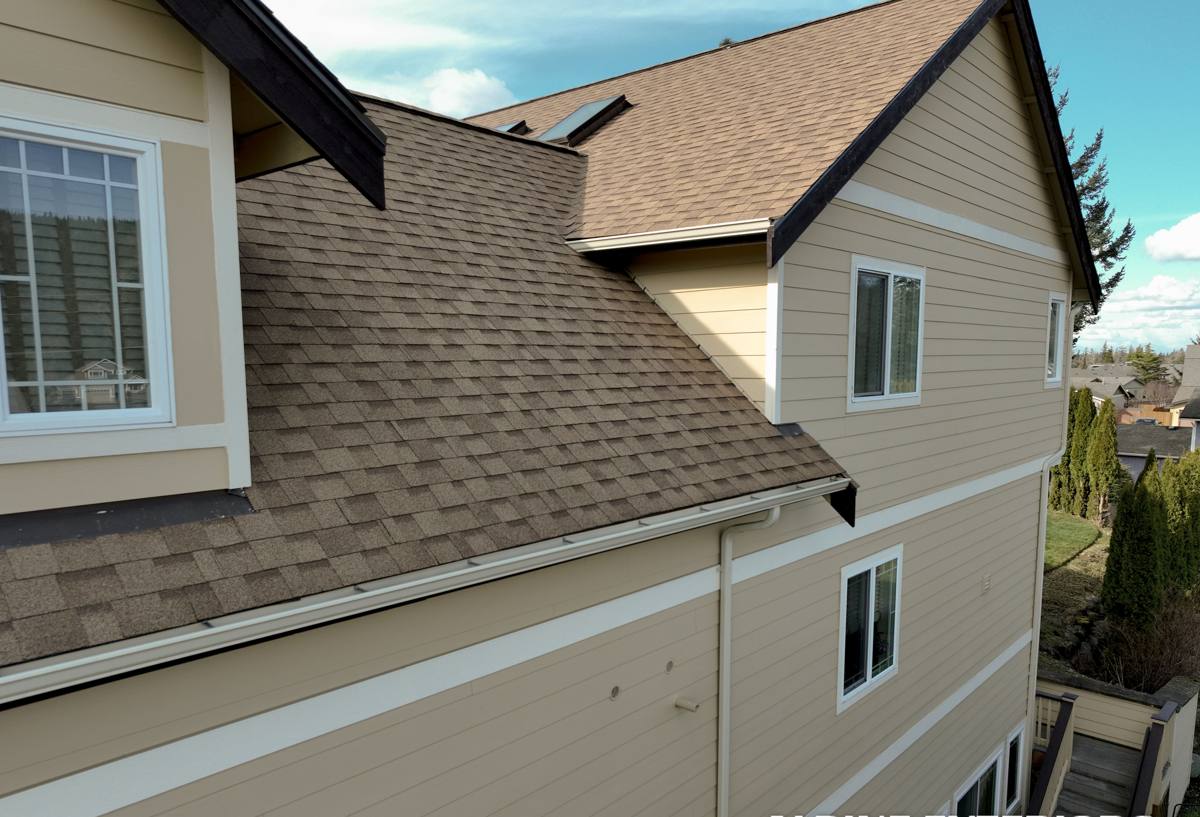
What Local Homes Are Up Against
Persistent Moisture
Whatcom County doesn't get dramatic downpours as much as it gets prolonged, low-intensity rain over many months. That kind of weather is harder on siding than a few heavy storms because it gives water time to find every gap in flashing, caulk, or panel overlap. Wood-based siding products absorb that moisture and swell; even well-installed siding can suffer if flashing details were rushed.
Moss and Organic Growth
Shaded, north-facing walls and areas near mature trees stay damp far longer than sun-exposed elevations. Moss and algae don't just look bad — they hold moisture directly against the siding surface, extending the time wood-based products stay wet and accelerating rot at seams, laps, and fastener points.
Salt-Tinged Air
Air moving inland off Puget Sound carries a mild salt content that, combined with constant dampness, speeds up corrosion on fasteners, flashing, and any exposed metal trim. Over years, corroded fasteners loosen, siding shifts, and small gaps open up that let water behind the cladding.
Signs Your Siding Needs Repair, Not Just Paint
- Soft, spongy, or crumbling sections when pressed — usually a sign of rot underneath
- Panels that have visibly bowed, cupped, or pulled away from the wall
- Persistent dark staining or moss growth that returns shortly after cleaning
- Peeling or bubbling paint in a localized area, which often points to trapped moisture rather than just an old paint job
- Visible gaps at seams, corners, or around windows and doors
- Interior signs — a musty smell, discoloration, or soft drywall on an exterior wall
- Rust streaking below fasteners or trim
A homeowner can spot most of these from the ground. The harder part is knowing whether the damage is isolated or a symptom of a larger moisture problem working its way through the wall assembly — that's where an experienced eye matters.
What a Correct Repair Actually Involves
A lot of "siding repair" in this region amounts to cutting out a bad board, nailing in a new one, and caulking the edges. That approach ignores the reason the original section failed, and in a climate like Whatcom County's, the same failure usually comes back within a season or two.
Our repair process starts with diagnosis, not demolition
- Identify the water path. We trace how moisture got behind the siding in the first place — often a flashing gap, a caulk failure, or a grade issue directing water at the wall.
- Check for hidden damage. Visible rot is rarely the whole story. We check sheathing, house wrap, and framing near the affected area before closing anything back up.
- Correct the underlying issue. This might mean re-flashing a window head, adjusting a kickout flashing at a roofline, or improving drainage behind the cladding — not just replacing the visible board.
- Match materials correctly. Repairs get tied into the existing siding with proper overlap, fastening, and joint treatment so the repaired section performs the same as the surrounding wall, not as a patch.
- Finish to last. Paint, caulk, and trim work get done to hold up through another wet season, not just to look finished on handoff day.
Repair vs. Replacement: How We Help You Decide
Not every siding problem calls for full replacement, and not every repair is worth doing if the underlying material is compromised broadly. We look at the extent and cause of the damage before recommending either path.
| Factor | Repair Usually Makes Sense | Replacement Should Be Considered |
|---|---|---|
| Extent of damage | Isolated to one or two areas | Recurring rot in multiple locations |
| Cause | A specific, fixable flashing or caulk failure | Systemic moisture issues across the wall |
| Material condition | Surrounding siding is sound | Surrounding siding is aging out or was a failure-prone product |
| Age of existing siding | Relatively young, still under warranty | Near or past expected service life |
| Cost over time | Lower upfront cost, addresses the immediate problem | Higher upfront cost, resets the clock on the whole exterior |
We'll give you a straight answer on which category your home falls into. If a repair is the honest recommendation, we won't push a full replacement.
What Happens Next in Whatcom County's Wet Season
Any repair work here has a timing consideration: once fall rains set in, exposed sheathing or open wall sections need to be closed up quickly. We plan repair work around the weather window when possible, and when a job has to happen during the wet months, we take extra care to protect the opened area until the repair is fully sealed.
Why We Only Install James Hardie Siding — Even for Repairs
When a repair calls for new material, whether it's a few boards or a full section of a wall, we use James Hardie fiber cement. That's a deliberate standard, not a default. Fiber cement doesn't absorb water the way wood-based siding does, so it holds up better against the exact conditions that cause repeat failures in this climate: prolonged dampness, moss retention, and swelling at seams. It's also non-combustible, which matters for long-term durability regardless of the immediate repair.
Hardie's ColorPlus factory finish means a repaired section can be color-matched without relying on field-applied paint holding up as well as the original finish — a common weak point when other materials are patched. And Hardie's HZ5 product line is engineered specifically for climates like the Pacific Northwest's, with moisture and freeze-thaw performance suited to exactly the kind of weather Whatcom County sees.
We don't install LP SmartSide, vinyl, Cemplank, Allura, primed spruce, or cedar. Some of those products have real strengths, but each comes with trade-offs in moisture behavior, maintenance burden, or installation sensitivity that we've decided aren't worth carrying forward on the homes we work on. Hardie's combination of durability, warranty backing, and finish quality is why it's the only material we stand behind for both full installs and repairs.
Why Hire a Crew That Already Works in Nooksack
A siding repair is only as good as the person diagnosing it. Crews unfamiliar with Whatcom County's specific conditions — the extended damp season, the moss patterns on shaded elevations, the way salt-tinged air accelerates fastener corrosion — tend to treat every repair the same way regardless of region. That leads to patches that look fine at handoff and fail again within a year or two.
Working regularly in this area means we've seen how these failures actually develop here, not in a generic climate model. We know which elevations tend to hold moisture longest, which original installation shortcuts show up most often, and what a repair needs to actually withstand another Whatcom County winter.
Questions Worth Asking Any Siding Repair Contractor
- Will you check for hidden moisture damage before closing up the repair, or just replace what's visibly damaged?
- What's causing this failure, and will the repair address that cause?
- What material will be used, and how will it be color-matched to the existing siding?
- Is the flashing or water-management detail being corrected, or just the siding itself?
- What's the warranty on the repair, and does it cover labor as well as material?
Our Process, Start to Finish
We start with an on-site inspection to assess the visible damage and check for signs of deeper moisture intrusion. From there, we give you a clear explanation of what caused the problem, whether repair or replacement makes more sense, and a straightforward estimate — no pressure, no upsell to a full re-side unless that's genuinely the right call. If you move forward, we schedule the work around the weather, protect the opened wall section throughout, and finish with materials and detailing built to hold up through Whatcom County's wet, mossy winters, not just to pass a walk-through.
If you're noticing soft spots, staining, or shifting siding on your Nooksack home, we're happy to take a look and give you an honest read on what's going on and what it'll take to fix it right. Reach out for a free, no-pressure estimate using the form below.