 Whatcom County
A deck in Sehome earns its keep the same way any outdoor structure does in this corner of Washington: by standing up to months of driving rain, a steady dose of salt-laden air off Bellingham Bay, and a moss season that seems to stretch longer every year. Sehome's mix of wooded, sloped lots and older housing stock means a lot of decks in this neighborhood were built decades ago under different code, different materials, and different expectations. When we build or rebuild a deck here, we're building for the climate that actually exists in Whatcom County, not the one on the lumber yard's sample board.
What Whatcom County's Climate Does to a Deck
Three things wear a deck down here, and they work together, not separately.
Driving Rain and Standing Moisture
Rain in this part of Washington doesn't just fall straight down — wind off the water pushes it sideways into ledger connections, stair stringers, and any horizontal surface that isn't sloped to shed water. Framing that isn't detailed for that reality holds moisture against wood and fasteners far longer than it should, which is where rot and rust actually start.
Salt Air
Proximity to Bellingham Bay means airborne salt reaches inland further than most homeowners assume, especially on elevated or west-facing decks. Salt accelerates corrosion in fasteners, brackets, and railing hardware that would otherwise last for decades. It's a slow process, so the damage is usually invisible until a connection has already weakened.
A Long Moss Season
Shaded, wooded lots — common in Sehome — stay damp longer after every storm, and that dampness is exactly what moss and algae need to take hold on decking boards, stair treads, and railings. Beyond looking bad, moss holds moisture against the wood surface and turns smooth boards into a slip hazard, particularly on stairs.
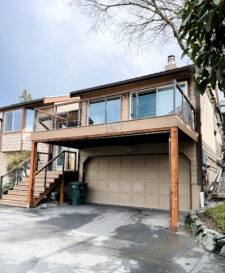
Choosing the Right Decking Material for Sehome's Conditions
There's no single "best" decking material — there's a best material for a given budget, sun exposure, and how much upkeep a homeowner actually wants to do. Here's how the common options compare in this climate specifically.
| Material | Moisture & Moss Behavior | Maintenance | Typical Lifespan |
|---|---|---|---|
| Pressure-treated wood | Absorbs water readily; needs a sealed surface to resist moss and staining | Annual cleaning and re-sealing or staining | 15-20 years with upkeep |
| Cedar | Naturally rot-resistant but still needs finish to control moss and graying | Cleaning and finish renewal every 1-3 years | 20-25 years with upkeep |
| Traditional composite | Won't rot, but early-generation composites can hold surface moisture and grow moss if not capped | Periodic washing; no staining or sealing | 25+ years |
| Capped composite / PVC | Sealed outer shell resists moisture absorption and moss much better than uncapped wood-composite blends | Occasional washing | 25-30+ years |
For a shaded, damp lot like a lot of what we see in Sehome, we lean toward capped composite or a well-finished cedar when budget allows — both give you a fighting chance against moss without a demanding maintenance schedule. Pressure-treated wood is still a reasonable, honest choice if the budget calls for it, as long as the homeowner understands the upkeep that comes with it.
Framing and Ledger Details That Actually Matter Here
The decking surface is what everyone sees, but the framing underneath is what fails first in this climate if it's cut corners.
- Ledger flashing: Where the deck attaches to the house, proper metal flashing and a water-resistant barrier behind it are what keep rain from working its way into the rim joist and wall framing — this is the single most common failure point we find on older decks.
- Joist protection tape: A self-adhering membrane over the top of each joist keeps standing water from soaking into end grain and fastener holes, which is where rot typically starts even on treated lumber.
- Proper slope: Decking should shed water away from the house, not pool against it — a subtle detail that's easy to get wrong and expensive to fix later.
- Ventilation underneath: Low-clearance or skirted decks trap humid air against the framing; airflow underneath is what keeps that framing dry between storms.
Footings, Height, and Building on Sehome's Terrain
A lot of Sehome sits on sloped or hillside lots, which changes how a deck gets engineered compared to a flat backyard. Footings need to reach proper frost depth and bear on undisturbed, stable soil, and on a slope that often means deeper or more numerous footings than a flat-lot deck of the same size. Elevated decks on hillside lots also carry stricter railing and guard requirements simply because the fall distance is greater. None of this is a reason to avoid building on a sloped lot — it's a reason to work with a crew that engineers for the actual grade instead of treating every lot like it's level.
Whatcom County and the City of Bellingham both require permits for most new deck construction and many significant rebuilds, with inspections tied to footing depth, structural connections, and guard/railing height. We handle that permitting as part of the build rather than leaving it to the homeowner to sort out.
Railings, Fasteners, and Hardware for a Salt-Air Environment
Hardware is where a lot of decks quietly fail years before the decking itself gives out. In a salt-air environment, we default to stainless steel or high-grade coated fasteners and structural connectors rather than standard galvanized hardware, which corrodes faster than most homeowners expect this close to the water. The cost difference over the life of the deck is small; the difference in how long the structure stays sound is not.
| Hardware Choice | Salt-Air Performance | Where It Matters Most |
|---|---|---|
| Standard galvanized fasteners | Adequate short-term, corrodes faster near the coast | Lower-cost builds, less exposed areas |
| Coated deck screws (polymer/ceramic) | Good resistance, cost-effective upgrade | General decking and railing assembly |
| Stainless steel fasteners & connectors | Best long-term resistance to salt corrosion | Structural connections, ledger bolts, visible hardware |
Our Deck-Building Process
- On-site walkthrough: We look at slope, sun exposure, existing structure (if it's a rebuild), and how water currently moves across the lot.
- Design and material selection: We talk through decking material, railing style, and layout based on budget and how the deck will actually be used.
- Permitting: We prepare and submit the plans required by Whatcom County or the City of Bellingham and schedule the required inspections.
- Demolition (if applicable): Old decking, framing, or footings that don't meet current standards get removed rather than built over.
- Framing and flashing: Ledger, joists, and footings go in with the moisture-management details this climate requires.
- Decking, railings, and finish work: Surface material and railings are installed to spec, with fasteners chosen for the site's exposure.
- Final walkthrough: We go over the finished deck with the homeowner and cover basic care for the material chosen.
Maintenance Through a Long Moss Season
Even a well-built deck needs some seasonal attention in Whatcom County. A short, honest checklist:
- Sweep leaves and debris off the deck surface regularly through fall — trapped organic matter is what moss and algae feed on.
- Rinse or lightly scrub decking and stair treads at the start and end of the wet season to keep moss from establishing.
- Check fastener heads and railing connections annually for any sign of rust bleed or loosening.
- Keep gutters and downspouts clear so roof runoff isn't dumping extra water directly onto or under the deck.
- Re-seal or re-stain wood decking on the schedule the finish manufacturer recommends — don't wait until it's visibly gray or worn.
- Clear vegetation that's shading the deck and keeping it damp longer than the rest of the yard.
Why a Crew That Already Works Sehome Matters
A deck built to a generic national standard isn't necessarily built for a Sehome lot. A crew that already works this neighborhood knows which streets sit on sloped, tree-covered ground that demands different footing work, understands the permitting process with Whatcom County and the City of Bellingham, and has seen firsthand how fast an under-flashed ledger or ungalvanized bracket fails this close to the bay. That's not a marketing point — it's the difference between a deck that needs real repair in eight years and one that's still solid in twenty-five.
If you're planning a new deck or need an honest look at an aging one, we're happy to walk the property with you and talk through what it actually needs. There's no cost and no pressure for an estimate — just a straight assessment based on what your lot and your budget call for.