 Whatcom County
Siding Repair in Sehome: A Different Climate Problem Than Most of the Country
Sehome sits close enough to Bellingham Bay that homes here deal with a combination most siding never has to survive in drier parts of the country: salt-laden air, wind-driven rain that hits walls sideways instead of falling straight down, and a moss season that can stretch from October through May. None of these factors alone would be a big deal. Together, over years, they find every weak point in a siding system — a nail hole that was never sealed, a seam that was caulked instead of flashed, a bottom edge that sits too close to the ground. Siding repair in this part of Whatcom County isn't just about patching what's visible; it's about figuring out why that spot failed when the rest of the wall didn't.
Homes in Sehome range from older single-family houses to newer construction near the university area, and we see repair needs across all of them. The common thread isn't age — it's exposure. A wall that faces prevailing weather off the bay will show problems years before a sheltered wall on the same house.
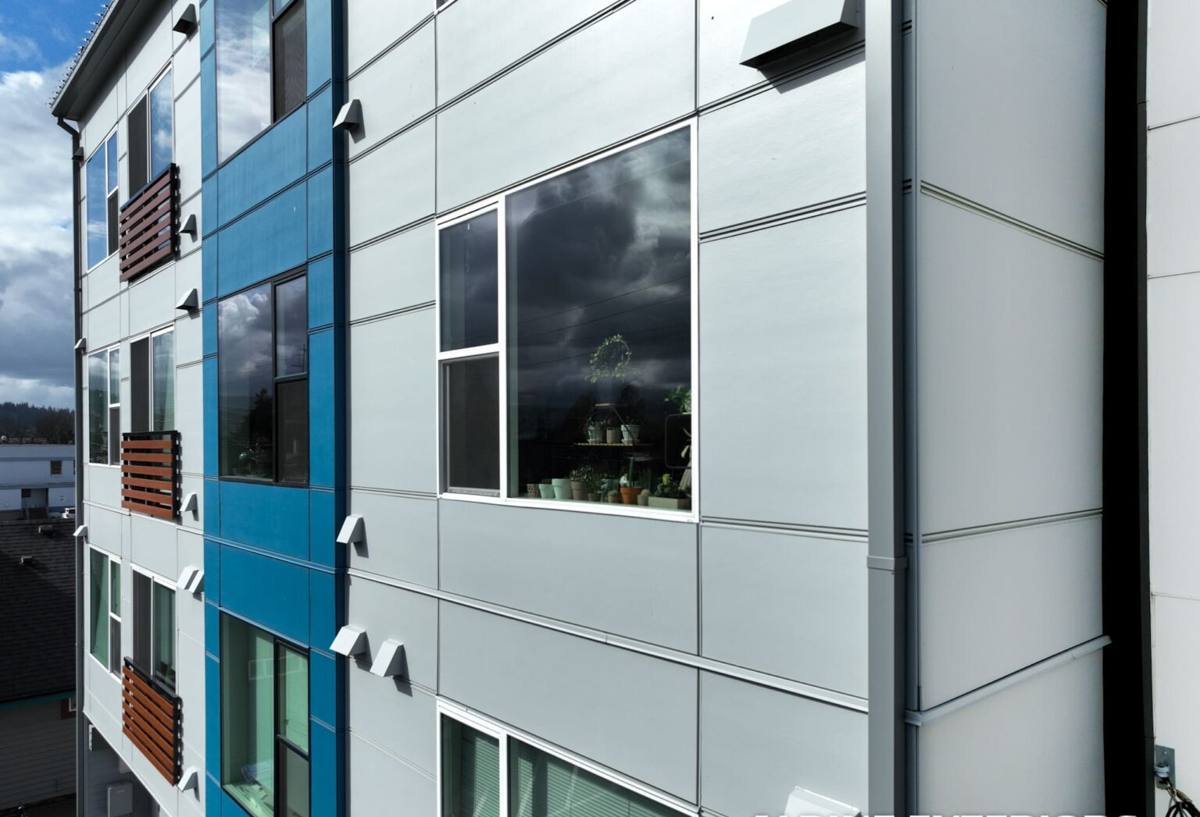
What Salt Air, Driving Rain, and Moss Season Actually Do to Siding
Salt Air
Airborne salt is corrosive to fasteners and trim hardware. On siding systems that rely on exposed nails or staples, salt exposure speeds up rust, which weakens the fastener's grip and lets panels work loose. It also degrades some paint and coating systems faster than inland weather would, leading to chalking and premature fading.
Driving Rain
Wind off the water doesn't let rain run straight down a wall — it drives it sideways and up under laps, around trim, and into any gap that a calm-weather installation wouldn't need to worry about. Siding and flashing details that would hold up fine in a low-wind climate can fail here because water gets pushed into places it was never supposed to reach.
Moss and Sustained Moisture
Whatcom County's long wet season means siding surfaces — especially north-facing and shaded walls — stay damp for extended stretches. That's ideal for moss and algae growth. Beyond the cosmetic issue, moss holds moisture against the surface, which is a problem for any material that isn't fully moisture-stable, and it can work into seams and laps where it keeps the substrate wet far longer than open air would allow.
Signs a Sehome Home Needs Siding Repair, Not Just Cleaning
- Soft or spongy spots when you press on the siding, especially near the bottom courses or around windows
- Visible gaps at seams, corners, or trim joints that weren't there when the siding was installed
- Persistent moss or algae growth that comes back quickly after cleaning
- Streaking or staining below nail heads or fasteners, which often points to corrosion
- Panels that have started to bow, cup, or pull away from the wall
- Peeling or bubbling paint/finish concentrated on one side of the house rather than evenly across all elevations
- Rising utility bills or noticeably colder rooms along an exterior wall, which can indicate moisture has reached the sheathing or insulation
Any one of these on its own might be minor. Several showing up on the same wall, particularly a wall facing prevailing wind and rain, usually means water has been getting behind the siding for a while.
What a Correct Repair Actually Involves
A repair that only addresses the visible damage tends to fail again within a season or two, because it doesn't answer the question of how water got in. A repair done right in this climate generally involves:
- Removing enough surrounding material to see the actual extent of the damage, not just the spot that's visible from the ground.
- Checking the water-resistive barrier and flashing behind the siding at that location — if the underlying moisture barrier failed, replacing the siding alone won't fix the problem.
- Assessing the sheathing for soft spots or rot, since prolonged moisture exposure can compromise what's underneath the siding, not just the siding itself.
- Matching materials correctly so the repair doesn't create a new weak seam — mismatched thickness, profile, or fastening method at a patch is a common place for the next failure to start.
- Re-flashing and properly lapping every seam and penetration in the repaired area, with attention to how wind-driven rain will actually hit that wall, not just how rain falls in calm conditions.
- Sealing and finishing so the repaired section holds up against the same salt air and moisture exposure that caused the original failure.
Skipping any of these steps is how a $400 repair turns into a $4,000 repair two years later, once water has had time to work into the wall assembly.
How Siding Materials Hold Up to Repair in This Climate
Not every siding material responds to Whatcom County's coastal, wet conditions the same way, and that affects both how often repairs are needed and how well a repair holds once it's done.
| Material | Common Failure Point Locally | Repair Difficulty |
|---|---|---|
| Vinyl | Cracking in cold snaps, warping near heat sources, seams loosening under wind-driven rain | Panels are replaceable but color-matching older, faded vinyl is difficult |
| Cedar | Moisture absorption, moss growth, rot at end grain and fastener points | Labor-intensive; often requires replacing whole boards, not just sections |
| LP SmartSide (engineered wood) | Edge swelling where moisture penetrates cut ends or seams | Repairable if caught early; swelling at seams is harder to reverse once it starts |
| Fiber cement (James Hardie) | Failures are almost always installation-related — caulk instead of flashing, unsealed cuts — rather than the material itself breaking down | Individual planks can be replaced cleanly; material itself is dimensionally stable in wet conditions |
This is a big part of why we install exclusively James Hardie fiber cement siding on new work: it's not that other materials can't be repaired, it's that fiber cement's stability in sustained moisture and salt air means fewer of the underlying-material failures we see with wood-based and vinyl products in this specific climate. When we're called for a repair on a Hardie-sided home, the cause is almost always a flashing or installation detail, not the panel itself breaking down — which makes the repair more predictable and longer-lasting.
Our Repair Process
When we come out for a siding repair in Sehome, the process generally looks like this:
- On-site assessment — we look at the damaged area and the surrounding wall, including checking for softness, gaps, and signs of moisture spread beyond what's visible
- Honest scope conversation — we tell you whether this is a contained repair or whether the damage suggests a larger moisture problem worth addressing now rather than patching around
- Material matching — for fiber cement repairs, we match plank profile, exposure, and color so the repair doesn't stand out; for other materials, we'll tell you upfront if a perfect match isn't realistic
- Proper flashing and sealing — every repair gets flashed and lapped correctly for wind-driven rain, not just caulked and painted over
- Cleanup and walkthrough — we show you what we found and what we did, including anything worth keeping an eye on elsewhere on the house
Why Hiring a Crew That Already Works Sehome Matters
Siding repair isn't a one-size-fits-all trade. A crew that mostly works drier inland climates may default to techniques that are fine there but undersized for what a wall facing Bellingham Bay actually deals with — lighter flashing details, caulk-dependent seams, or assumptions about how much water a wall will see in a given winter. Working repeatedly in Whatcom County means we've seen how these specific conditions — salt air, sideways rain, and long moss seasons — actually play out on real walls over multiple winters, not just on paper. That local pattern recognition is often the difference between a repair that holds and one that reopens the same spot again in a year or two.
What Repair Costs Typically Depend On
| Factor | Why It Matters |
|---|---|
| Extent of hidden damage | Repairs that only need surface panel replacement cost far less than ones where sheathing or the moisture barrier also needs work |
| Material | Availability and matching cost vary — fiber cement in a discontinued color, for example, may need a slightly different approach than a current ColorPlus finish |
| Wall accessibility | Second-story or hard-to-reach areas add labor time |
| Number of separate repair areas | Several small repairs across a house often cost less combined than treating each as a separate service call |
| Underlying cause | If the root cause is a flashing or drainage issue affecting multiple areas, fixing it once tends to be more cost-effective than repeated patch repairs |
Keeping Repaired Siding in Good Shape Afterward
- Rinse siding periodically, especially north-facing and shaded walls where moss tends to return fastest
- Trim back vegetation and tree cover that keeps a wall shaded and damp longer than it needs to be
- Check gutters and downspouts each fall — clogged gutters send extra water directly down the wall during exactly the wind-driven rain events that cause the most damage
- Walk the exterior once or twice a year and press on a few spots near ground level and around windows, where problems tend to start
- Address small issues — a loose piece of trim, a gap at a seam — before the next wet season rather than after
Siding repair in Sehome is really a conversation about how your specific walls handle this specific climate. If you're seeing any of the warning signs above, or just want an honest look at a section of siding that concerns you, we're happy to come take a look. Reach out for a free, no-pressure estimate using the form below.