 Whatcom County
South Hill's Siding Has a Harder Job Than Most
South Hill sits up on elevated, often tree-shaded ground overlooking the rest of Bellingham and Whatcom County, and that position cuts both ways. The elevation and mature tree canopy mean many homes get less direct sun on at least one exposure, which slows drying time after every rain event. Add in the marine air moving off Bellingham Bay and the Salish Sea, and you get a siding environment that's constantly damp, salt-tinged, and shaded — exactly the conditions that break down the wrong materials years before they should fail.
Whatcom County doesn't get hurricane-force storms, but it gets something arguably harder on siding: long stretches of driving rain pushed sideways by wind, followed by weeks of gray, low-evaporation weather. That combination is why "moss season" isn't a joke here — it's a real maintenance problem that runs from fall through spring on any siding that holds moisture or has seams where organic material can collect.
A siding replacement in South Hill isn't just a cosmetic upgrade. It's a chance to correct water management mistakes that were likely built into the original installation, and to put a product on the house that's actually engineered for this climate instead of one that merely survives it.
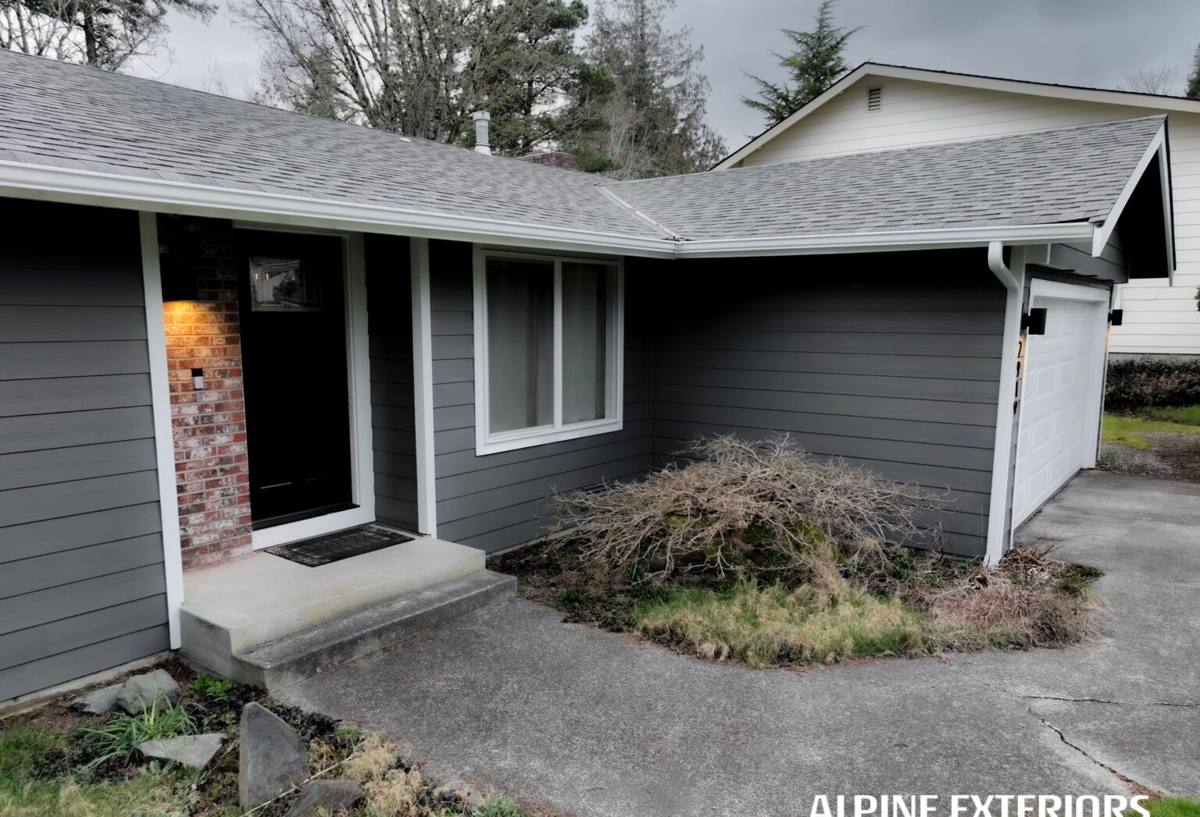
Signs a South Hill Home Needs Replacement, Not Just Repair
Homeowners often call us asking for a repair quote and end up needing a full replacement once we look closer. Siding damage in this climate tends to hide behind the surface — by the time it's visible, the sheathing or framing underneath may already be compromised. Watch for these signs:
- Soft or spongy spots when you press on the siding, especially near the bottom courses and around window trim
- Persistent moss or algae growth that returns within weeks of cleaning
- Paint that's peeling, bubbling, or chalking heavily on one exposure more than others
- Visible warping, cupping, or buckling of individual boards or panels
- Gaps opening up at seams, corners, or where siding meets trim, windows, or the foundation
- A musty smell in interior rooms along an exterior wall, which often means moisture has already reached the wall cavity
- Siding that's more than 20-25 years old and made of a material not rated for this level of sustained moisture exposure
Any one of these can be isolated and fixable. Several at once, especially combined with age, usually means the whole system — not just the outer layer — needs to come off and be rebuilt correctly.
What Correct Siding Replacement Actually Involves
It Starts Underneath the Siding, Not With It
The siding you see is the last layer of a water management system, not the whole system. A correct replacement in a wet climate like Whatcom County requires a continuous, properly lapped weather-resistant barrier (WRB) behind the siding, flashed correctly at every window, door, and penetration so water is directed out and down rather than trapped in.
Rainscreen Gap
Where conditions call for it — north-facing walls, heavily shaded lots, or homes with a documented moisture history, all common in South Hill — we build in a rainscreen air gap behind the siding. That gap lets bulk water drain and lets the wall assembly dry from both sides instead of staying damp against the back of the siding, which is exactly where rot and mold get started.
Fastening and Flashing Details
Fastener placement, spacing, and depth matter more than most homeowners realize. Overdriven nails crack fiber cement and create entry points for water; underdriven ones leave boards loose and prone to movement. Flashing at every horizontal trim board, window head, and roof-to-wall intersection has to be layered correctly so water always sheds outward — a detail that's invisible once the job is finished but determines whether the siding lasts 10 years or 40.
Why We Only Install James Hardie Fiber Cement
We get asked regularly about vinyl, LP SmartSide, and cedar, and we're upfront about why we don't install them. This isn't about any of those products being bad in every application — it's about what holds up, with minimal maintenance, in a climate that stays wet for months at a time.
| Material | How It Handles This Climate | Why We Don't Use It |
|---|---|---|
| Vinyl | Sheds water on the surface but relies on gaps and laps rather than a rigid, sealed system; can warp or crack in temperature swings | Doesn't stand up to sustained moisture cycling and impact the way a fiber cement system does; seams can trap moisture behind the panel |
| LP SmartSide (engineered wood) | Treated wood strand product; performs reasonably when detailing is perfect | Wood-based core is more sensitive to prolonged moisture exposure and installation error than fiber cement; higher long-term maintenance burden in a climate this wet |
| Cedar | Attractive, traditional look; breathes well when maintained | Requires ongoing refinishing, is vulnerable to moss and rot in shaded, damp conditions, and has a much shorter maintenance-free window than fiber cement |
| James Hardie fiber cement | Non-combustible, dimensionally stable, factory-baked ColorPlus finish resists moisture, salt air, and UV fade | This is what we install — engineered specifically for wet, marine climates like Whatcom County's |
James Hardie's HZ5 product line is engineered for regions with freeze-thaw cycles and sustained damp weather, which describes South Hill's winters well. The ColorPlus factory finish is baked on rather than site-applied, which matters directly here: a factory finish resists the peeling and chalking that hand-painted siding suffers under constant marine humidity. Add a strong transferable warranty and a material that simply doesn't feed moss and mildew the way wood-based products can, and it's a straightforward call for us as installers who have to stand behind the work.
Our Process for South Hill Projects
1. On-Site Assessment
We start by walking the exterior with you, checking current siding condition, existing moisture damage, trim and window flashing, and any shaded or exposed areas that need special attention given the lot's tree cover and elevation.
2. Tear-Off and Sheathing Inspection
Old siding and building wrap come off down to the sheathing so we can actually see what's there. Any soft, rotted, or water-damaged sheathing gets identified and repaired before anything new goes on — covering over a compromised wall assembly is how "new siding" fails within a few years.
3. Water Management Rebuild
New WRB, properly lapped and taped, correct window and door flashing, and a rainscreen gap where the wall assembly calls for it.
4. James Hardie Installation
Boards or panels installed to Hardie's fastening and clearance specifications, with attention to ground clearance, deck and porch intersections, and trim details — all areas where corner-cutting shows up as problems within a few wet seasons.
5. Final Walkthrough
We review the completed exterior with you, cover maintenance basics for ColorPlus finishes, and make sure you understand what's covered under the manufacturer warranty.
What Drives Cost on a South Hill Project
Every home is different, but the main cost factors on siding replacement projects in this area tend to be the same handful of things:
- Extent of hidden damage — rot or moisture damage found once old siding comes off adds sheathing and framing repair
- Home size and wall complexity — more corners, dormers, and trim details mean more labor and material
- Access and lot conditions — hillside lots, retaining walls, or limited driveway access can affect staging and equipment
- Siding profile and color — lap width, panel style, and ColorPlus color selection affect material cost
- Existing water management — homes needing a rainscreen retrofit or extensive re-flashing take more time than a straightforward tear-off and replace
We give a firm, itemized quote after the on-site assessment rather than a rough phone estimate, because the hidden-damage variable is too significant to guess at from the street.
Why Local Experience Matters for This Job
A crew that only occasionally works in Whatcom County treats every job like a generic install. A crew that works South Hill and the surrounding areas regularly already knows which exposures need extra flashing attention, how shaded, tree-covered lots affect drying time and moss growth, and how the local building department expects water management details to be documented. That familiarity shows up in fewer surprises during tear-off and a system that's actually built for the microclimate it's going on, not just for a generic Pacific Northwest checklist.
If your South Hill home's siding is showing its age, we're happy to take a look and walk you through what we find — no pressure, no obligation. Reach out below for a free estimate.