 Whatcom County
Siding Repair for Silver Beach, Whatcom County
Silver Beach is one of the closer-in communities we work in around Whatcom County, and the siding problems we see here follow a pretty consistent pattern. Homes sit close to water, catch a lot of wind-driven rain off the water, and spend a good chunk of the year under tree cover and cloud cover that keeps siding damp longer than it should be. Add in the salt-laden air that moves through this part of the county and you've got a combination that's hard on fasteners, hard on paint film, and hard on any siding material that isn't built to shed water fast.
Siding repair sounds simple — patch the bad spot, move on — but done wrong it just buys a homeowner another year or two before the same section fails again. Done right, it stops water intrusion at the source, matches the surrounding material so it doesn't look like a patch job, and tells you honestly whether that section (or the whole wall) needs more than a repair. That's what this page walks through.
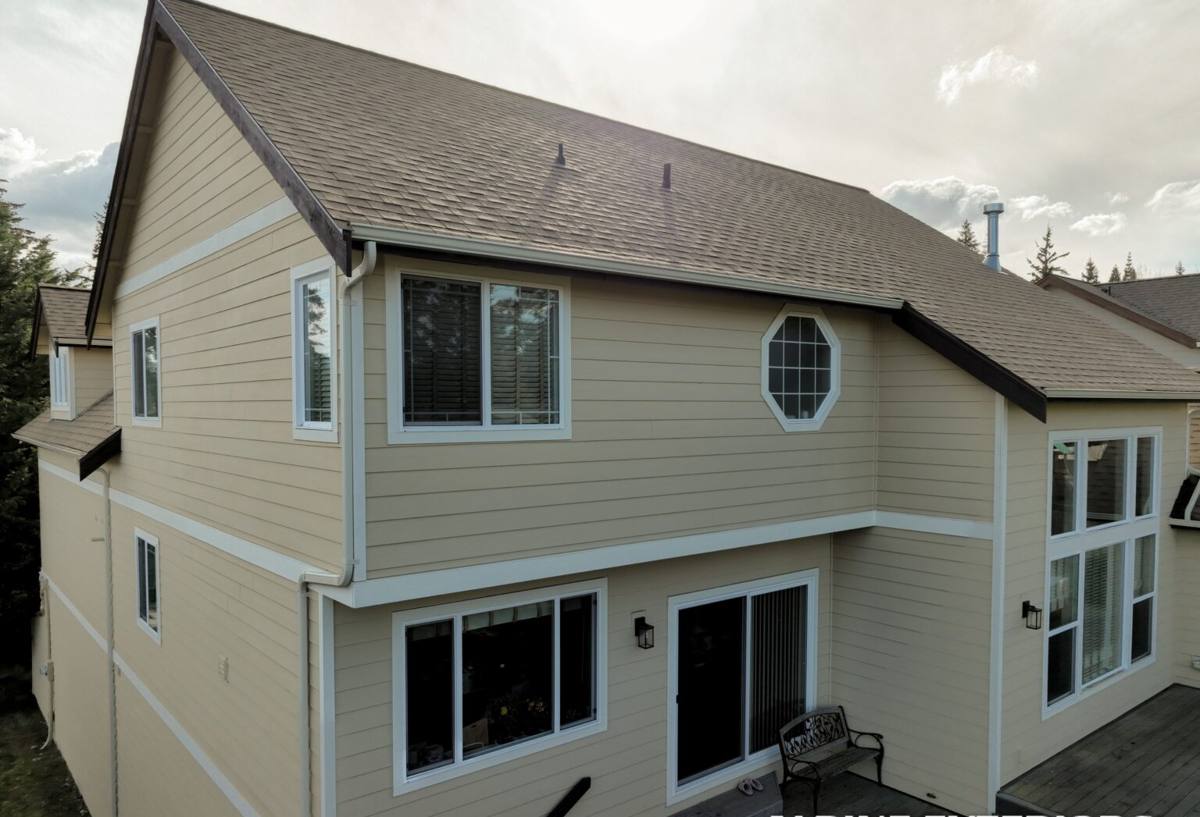
Why Silver Beach Siding Wears the Way It Does
Three things drive most of the repair calls we get in this part of Whatcom County:
Salt Air and Driving Rain
Homes closer to the water take rain sideways more often than homes tucked further inland. Wind-driven rain finds every gap in flashing, every hairline crack in caulk, and every spot where siding boards butt together without proper protection. Salt air accelerates corrosion on exposed fasteners and metal trim, which is often the real reason a siding panel has come loose — not the panel itself, but the nail or staple holding it.
A Long Moss and Mildew Season
Whatcom County's wet season runs long, and shaded, north-facing walls in a community like Silver Beach can stay damp for weeks at a stretch. That moisture holds moss and mildew against the siding surface, which traps even more water against the substrate underneath. On wood-based products, that's a direct path to rot. On any material, it's a path to premature paint and finish failure.
Age of the Housing Stock
Like much of Whatcom County, Silver Beach has a mix of older homes with original siding and newer construction. Older siding — especially older wood, older vinyl, and early-generation engineered wood products — is more likely to be at or past the point where a patch is a real fix versus a stopgap. Knowing which category a given repair falls into is half the job.
Signs Your Siding Needs a Repair Call
Most homeowners notice a problem long before they call, but they don't always recognize which signs mean "small fix" and which mean "call now before it spreads."
| What You See | Likely Cause | Urgency |
|---|---|---|
| Soft or spongy spot when pressed | Moisture intrusion, possible rot underneath | High — address before it spreads to framing |
| Bubbling or peeling paint in one area | Trapped moisture behind the finish | Medium — repair before winter rains |
| Visible gap or warping at a seam | Failed caulk, movement, or fastener failure | Medium — water entry point |
| Persistent moss or dark streaking | Poor drainage, shade, or a drip point above | Low to medium — clean and monitor |
| Cracked or missing panel | Impact damage or material fatigue | High if it exposes the wall behind it |
A soft spot is the one homeowners underestimate most. By the time siding feels spongy under hand pressure, water has usually been getting behind it for a while. Left alone through another wet season, that's how a $400 repair turns into a full wall section replacement.
What a Correct Repair Actually Involves
A rushed repair replaces the visible bad piece and calls it done. A correct repair treats the visible damage as a symptom and checks the cause. That means:
- Removing enough surrounding material to see the actual extent of water damage, not just the obvious spot
- Checking the water-resistive barrier and flashing behind the siding, not just the siding itself
- Inspecting the sheathing underneath for soft spots before closing anything back up
- Matching replacement material for profile, exposure, and finish so the repair doesn't stand out
- Re-sealing and re-flashing properly rather than relying on caulk alone to do the job
- Confirming drainage — gutters, kickout flashing, grading — isn't going to reintroduce the same problem
That last point matters more in Whatcom County than in drier climates. A perfectly repaired section of siding will fail again on the same timeline if the water source above or beside it — a misaligned gutter, a missing kickout flashing at a roof-wall intersection — never got fixed.
Repair or Replace? An Honest Read
Not every call ends with a repair recommendation. Sometimes a wall's condition means a patch isn't the responsible answer, and we'll say so.
| Factor | Repair Usually Makes Sense | Replacement Should Be Considered |
|---|---|---|
| Extent of damage | Isolated to one or two sections | Recurring across multiple walls or elevations |
| Material condition | Surrounding siding is sound and still available to match | Original material is discontinued or widely deteriorated |
| Cause identified | Root cause found and fixable (flashing, caulk, a gutter issue) | Systemic moisture problem with no clean source |
| Age of siding | Well within expected service life | Near or past the material's realistic lifespan |
| Sheathing condition | Solid, no rot found on inspection | Soft or compromised sheathing found behind siding |
We won't push a full replacement when a targeted repair genuinely solves the problem — that's not how we want to run our business in this county. But we also won't patch over a wall that's telling us it needs more, because that just costs the homeowner twice.
Matching Material and What We Recommend Going Forward
Most repair jobs mean matching what's already on the house — vinyl, wood, engineered wood, or fiber cement — as closely as possible in profile and finish. We're straightforward with homeowners about what that matching material is and how it will perform going forward, even when it's not a product we'd choose to install new.
When a repair grows into a larger project — a full wall, a full elevation, or the whole house — that's the point where we talk about what goes back up. We install James Hardie fiber cement siding exclusively for full installs, not vinyl, not LP SmartSide, not primed wood. Hardie's ColorPlus factory finish and non-combustible fiber cement construction hold up to the salt air and sustained moisture this part of Whatcom County sees better than the materials we're often repairing. We won't oversell that during a small patch job, but if a homeowner in Silver Beach is facing a bigger decision, we'll give a straight answer about why we'd put Hardie on our own home before we'd put back what came off.
Our Process on a Silver Beach Repair Call
The process stays the same whether the job is one panel or one wall:
- On-site inspection of the damaged area and a check of surrounding sections for related issues
- Identification of the moisture source — flashing, caulk failure, gutter, grading, or a combination
- A clear, honest recommendation: repair, or a conversation about replacement, with the reasoning explained
- Material sourcing and matching, or a straightforward quote for a Hardie install if replacement is the right call
- The repair itself — removal, inspection of what's underneath, correct flashing and sealing, reinstallation
- A final check that the fix addresses the cause, not just the symptom
Because we work regularly throughout Whatcom County, we're familiar with how homes in communities like Silver Beach are built and where the common trouble spots tend to show up — around window trim, at roof-wall intersections, and on shaded elevations that stay wet longest.
A Homeowner's Quick-Check List
Before calling anyone, a quick walk around the house tells you a lot:
- Press gently on any siding that looks discolored or stained — note any spots that feel soft
- Look at seams and corners for gaps, cracked caulk, or visible daylight
- Check for moss or algae concentrated in one area versus spread evenly — concentration often points to a drainage issue
- Look up at the gutter and roofline directly above any problem spot
- Note whether the issue is new or has been there for more than one wet season
That information helps any contractor — us included — give a faster, more accurate read on the phone before ever stepping on site.
Why a Local Crew Matters for This Kind of Work
Siding repair isn't glamorous work, and it's tempting for homeowners to assume any contractor can handle it. The difference shows up in the details: knowing which materials were commonly used on homes of a given era in this area, knowing how Whatcom County's wet season behaves on a shaded lakeside or waterside lot, and being willing to come back if a repair doesn't hold — which matters more when the contractor is actually local and not passing through on a storm-chasing crew. We work this county regularly, and a repair we do in Silver Beach this year is one we'll stand behind next year too.
If you're seeing soft spots, gaps, or damage on your home's siding, we're glad to take a look and give you a straight answer — repair or replace — with no pressure either way. Reach out for a free estimate using the form below.