 Whatcom County
Siding Repair Built for Sunnyland's Climate
Sunnyland sits close enough to Bellingham Bay that homes here deal with a specific combination of weather stress most inland Whatcom County neighborhoods don't see as intensely: salt-laden air moving off the water, driving rain that comes in sideways during fall and winter storms, and a moss season that can stretch from October well into May. Individually, each of these is manageable. Together, over years, they find every weak point in a home's siding system — nail heads, butt joints, corner trim, and anywhere caulk has started to fail.
We repair siding in Sunnyland regularly enough to know what tends to go wrong first, and just as importantly, what a repair actually needs to accomplish to hold up through another Pacific Northwest winter instead of failing again in two years.
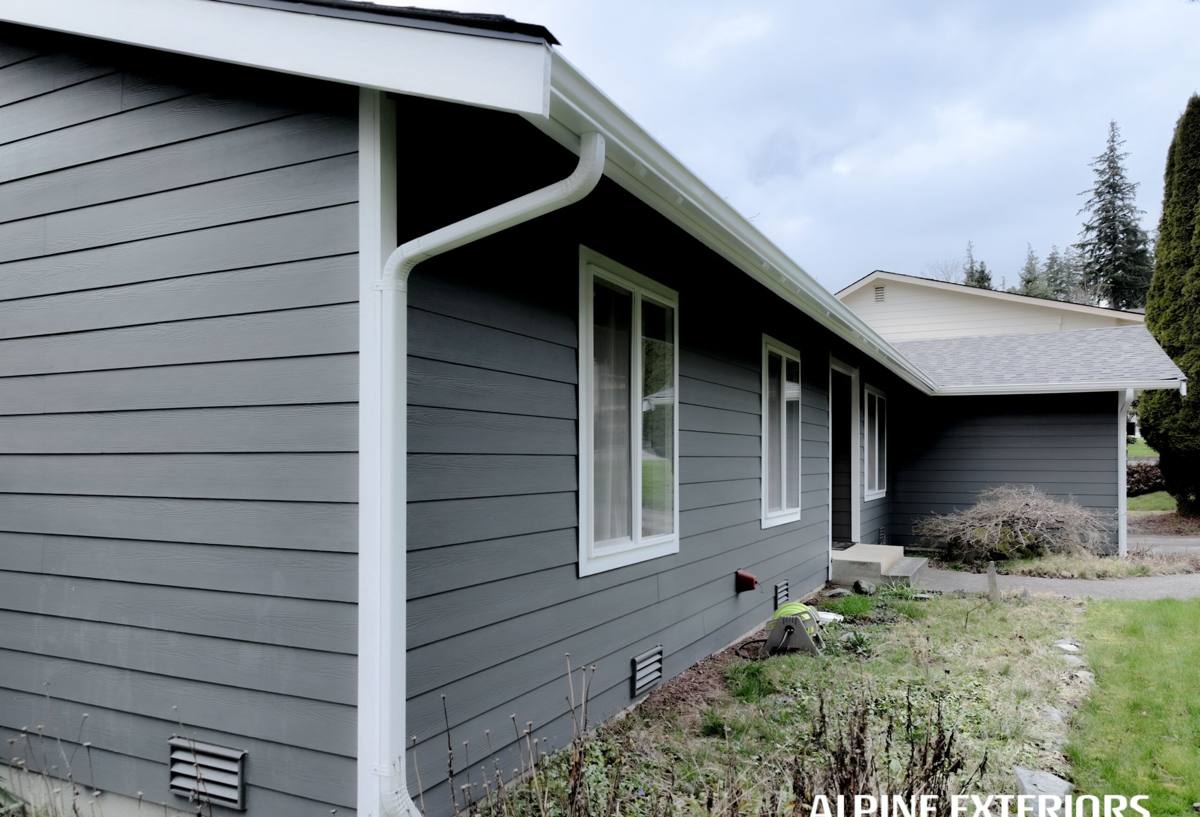
What Salt Air, Rain, and Moss Actually Do to Siding
Salt Air's Slow Corrosion
Homes within a few miles of the water are exposed to airborne salt that settles on exterior surfaces and accelerates corrosion of exposed fasteners, flashing, and metal trim. On wood-based and composite sidings, this often shows up as fastener staining, streaking below nail heads, or accelerated breakdown of finishes that weren't rated for coastal exposure.
Driving Rain and Wind-Driven Moisture
Whatcom County storms frequently come with enough wind to push rain horizontally against west- and south-facing walls. Siding that would shed rain fine in a calm downpour can take on water at laps, seams, and penetrations (hose bibs, light fixtures, vents) when wind forces it upward and sideways. Over time, this drives moisture behind the siding plane rather than off of it.
Moss and Prolonged Dampness
Whatcom County's long wet season means north-facing walls, areas shaded by mature trees, and spots with poor sun exposure can stay damp for weeks at a time. Moss and algae take hold in these conditions, and once established, they hold additional moisture against the siding surface, extending how long the material stays wet after each rain event. On materials sensitive to sustained moisture, this is where rot and delamination usually start.
Common Siding Repair Needs We See in Sunnyland
- Soft or delaminating panels near ground level, under downspouts, or behind shrubs and landscaping where airflow is limited
- Failed caulking at trim joints, window and door casings, and butt seams, allowing water intrusion
- Corroded or popped fasteners on walls with direct exposure to prevailing wind and salt air
- Moss and algae staining on shaded or north-facing elevations, sometimes masking underlying moisture damage
- Impact damage from storm debris, tree limbs, or lawn equipment that's gone unaddressed and allowed water behind the panel
- Warped or bowed sections where older wood-based or composite siding has absorbed water repeatedly over multiple wet seasons
What a Correct Repair Actually Involves
A lot of siding repair work in this region is done wrong — not because the crew is careless, but because a quick patch is faster to sell and faster to complete than a repair that actually addresses the cause. A repair that just replaces a visibly damaged piece of siding without checking what's behind it is a repair that's likely to fail again within a season or two.
Step 1: Diagnose Beyond the Visible Damage
Before replacing anything, we check the condition of the water-resistive barrier, flashing, and sheathing behind the damaged siding. Moisture that's been sitting behind a panel for a while often extends further than the visible stain or soft spot suggests. Cutting out only the obviously damaged section and closing it back up over compromised sheathing just delays the problem.
Step 2: Address the Moisture Path, Not Just the Symptom
If the damage traces back to a specific cause — a missing kick-out flashing, a caulk joint that was never properly sealed, a downspout dumping water directly onto a wall — that cause gets corrected as part of the repair. Replacing siding without fixing what let water in means the new material is on the same clock as the old.
Step 3: Match Material and Finish
Where the surrounding siding is in good condition, we match profile, exposure, and color as closely as possible so the repair blends in rather than standing out as an obvious patch. On James Hardie ColorPlus siding, this is more straightforward because factory-finished color batches are more consistent than field-applied paint, and Hardie's product lines have been in stable production long enough that matching existing installations is usually achievable.
Step 4: Seal and Detail Correctly
Given how much of Sunnyland's siding stress comes from wind-driven rain, we pay particular attention to how repaired sections integrate with flashing, trim, and adjacent panels — proper shingling of water-resistive barrier layers, correctly lapped flashing, and sealant used only where it's actually needed rather than as a substitute for proper flashing detail.
Repair vs. Replacement: How to Tell Which One You Need
Not every damaged section calls for a full re-side, and not every repair is worth doing on siding that's already at the end of its service life. Here's how we generally think about it:
| Situation | Likely Approach | Why |
|---|---|---|
| Isolated impact damage, siding otherwise sound | Targeted repair | Surrounding material has years of life left; no reason to replace it |
| Localized moss/moisture damage, one or two elevations | Repair + moisture-source fix | Addressing the cause prevents recurrence without a full project |
| Widespread soft spots across multiple walls | Full or partial re-side | Likely indicates a systemic issue (original install, material age) rather than a one-off failure |
| Siding is original wood, LP, or older composite nearing 20+ years | Replacement, not repair | Patching short-remaining-life material is a poor return on the work involved |
| Cosmetic fading or minor caulk failure only | Maintenance, not repair | Resealing and cleaning may fully resolve it without panel replacement |
Why We Install Only James Hardie Fiber Cement
When repair work does turn into a replacement conversation — whether it's one wall or the whole house — we only install James Hardie fiber cement siding. We don't install vinyl, LP SmartSide, Cemplank, Allura, or primed wood products, and that's a deliberate standard, not an oversight.
Fiber cement is non-combustible and dimensionally stable in a way that matters directly in a climate like this one: it doesn't absorb and release moisture the way wood-based products do, which makes it far more resistant to the rot and delamination we see driving repair calls on other materials in Sunnyland. Hardie's ColorPlus factory finish is baked on under controlled conditions, which holds up better against salt air and UV exposure than field-applied paint, and it makes future color-matching for any repair work more reliable. Hardie's HZ5 product line is engineered for the kind of freeze-thaw and moisture cycling the Pacific Northwest sees, and the company backs it with a strong, transferable warranty — something that carries real value if you sell the home before its siding does.
None of this means fiber cement is maintenance-free or immune to problems; it still needs correct installation, proper flashing, and periodic attention like any siding system. But it removes several of the failure modes — rot from sustained dampness, fastener bleed-through, warping — that account for a large share of the repair work we do on other materials in this exact climate.
Our Repair Process in Sunnyland
- On-site inspection: we assess the visible damage and check adjacent areas, flashing, and penetrations for related issues before quoting anything
- Honest scope discussion: we tell you plainly whether this is a repair, a partial re-side, or something better addressed with full replacement, and why
- Moisture source correction: any drainage, flashing, or sealant issue causing the damage gets fixed as part of the job, not left for next time
- Repair execution: damaged material is removed, underlying sheathing and barrier checked and repaired if needed, and new material installed to manufacturer spec
- Finish and match: trim, caulk, and color are matched as closely as the existing siding allows
Why Local Experience with Sunnyland's Conditions Matters
A repair crew that mostly works drier, inland areas can still do competent work, but they may not immediately recognize the signs of salt-air corrosion on fasteners, or know that a particular elevation in this neighborhood tends to hold moisture longer because of tree cover and orientation to the water. Crews who work Whatcom County's coastal neighborhoods regularly develop a faster eye for where damage is likely to extend beyond what's visible, and they've usually already seen how different siding materials in this specific area hold up — or don't — over time. That translates into fewer surprises once a repair is opened up, and fewer callbacks after it's closed.
A Few Things to Check Before You Call Anyone
- Look for soft spots by pressing gently on siding near ground level and under windows — sponginess usually means moisture has already gotten in
- Check north-facing and shaded walls for heavier moss or algae buildup compared to sun-exposed sides
- Look at caulk joints around windows, doors, and trim for cracking, gaps, or shrinkage
- Note any areas where gutters or downspouts appear to be discharging water directly onto siding
- Watch for streaking or discoloration below nail heads or fasteners, which can indicate corrosion
Get an Honest Assessment
If you're seeing soft siding, moss buildup, or water stains on your Sunnyland home, it's worth having someone look at it before the next wet season sets in — small issues here tend to grow during the winter, not stay the same size. We offer free, no-pressure estimates and will tell you plainly whether you're looking at a simple repair, a larger project, or something in between. Fill out the form below to get started.